A cash-or-nothing option pays fixed cash on a trigger. See why payout differs from profit, how equality changes a complementary pair, and how pricing uses a discounted probability.
Cash-or-nothing option
A cash-or-nothing option pays a predetermined cash amount if a stated condition holds, and zero otherwise. A call usually tests whether an underlying price finishes above a strike price. Once it qualifies, a larger price move does not increase the payment: the exposure is to crossing the threshold, rather than to the size of the gain beyond it.
It is one form of digital option. An asset-or-nothing option instead pays the terminal asset value on its trigger. Specifying “cash” therefore identifies the payment amount, not merely the fact that settlement happens in cash.
A USD 10 payment, not a USD 10 profit
Consider one synthetic European contract on a share quoted in USD. It observes the share price only at maturity T, has strike K=100 USD per share, and pays fixed cash B=10 USD at T if ST>K. No share is bought or delivered. The strict inequality is part of this example’s contract.
At the strike, this call pays zero. Immediately above it, the whole USD 10 becomes payable. The payoff has a discontinuity; it does not slope upwards like a vanilla call, whose payment is (ST−K)+ per underlying unit.
The fixed amount is a payoff, not the option’s purchase price or a promised return. A buyer pays a premium before receiving any contingent cash. If the initial premium is P0, financed at a constant continuously compounded rate f, the terminal net cash result before other costs is DTcall−P0efT. Even a triggered payment must be compared with that carried cost.
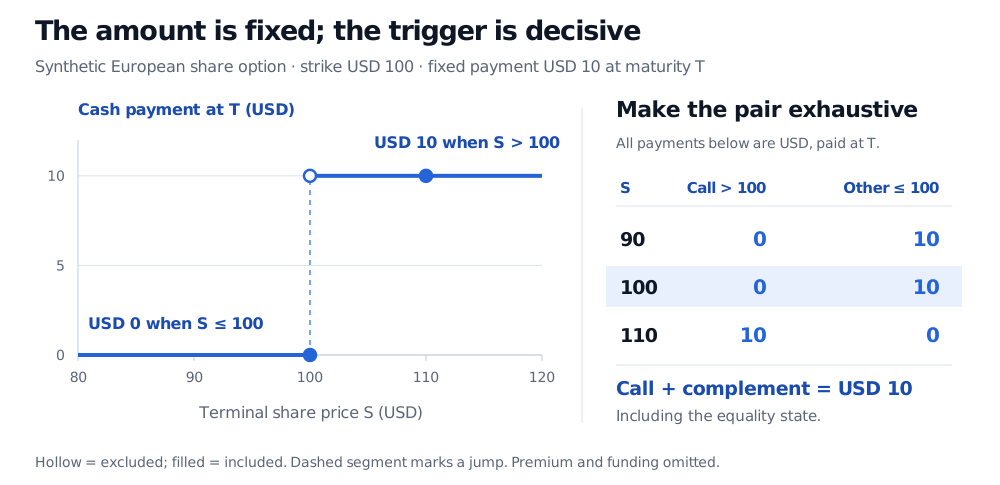
A synthetic cash call pays USD 10 only above a USD 100 share-price strike and zero at the strike. A complementary contract pays USD 10 at or below the strike. At terminal prices 90, 100 and 110, the paired payments are respectively 0 plus 10, 0 plus 10 and 10 plus 0.
Original synthetic terminal-payoff diagram. Hollow points exclude a value; filled points include it. A strict call and an inclusive complementary contract pay USD 10 in total in every state, including equality. Premium and funding are omitted from the plotted payments.
The small inequality that makes a complete pair
A matching contract paying on ST≤K supplies the exact complement:
DTother=B1{ST≤K},DTcall+DTother=B.
Together they deliver a certain amount at T, provided the observation, settlement and performance terms match. If a cash put instead uses the strict condition ST<K, buying that put with the strict call leaves the equality state unpaid. Calling two contracts a “call and put” does not establish that their events cover every outcome.
Equality has probability zero in a continuous lognormal model. It can have positive probability in a tree or another model with discrete states. Neither observation replaces the contractual tie rule; it determines whether changing that rule affects the model price.
Price is a discounted probability under a valuation model
In an idealised frictionless model with deterministic constant risk-free rate r and payment at T, risk-neutral valuation gives
D0call=Be−rTQ(ST>K).
The probability is under the pricing measure Q, rather than a trader’s forecast of success. Dividing the price by B alone still leaves the discount factor. For the exhaustive pair above, linear pricing gives D0call+D0other=Be−rT.
Under the European Black–Scholes model, with positive spot S0, strike, volatility σ and maturity, and constant continuous dividend yield q,
Here Φ is the standard normal cumulative distribution function. The normal tail and discounting are separate ingredients. The Black–Scholes PDE, Formula and Implied Volatility develops that distinction and derives the Φ(d2) probability (public preview; full lesson requires membership).
Sources
John C. Hull, Options, Futures, and Other Derivatives, 9th Global Edition, Pearson, 2018, §26.10, pp. 628–629: cash-or-nothing payments and the Black–Scholes valuation.