Distinguish a jump from a removable hole, an infinite limit or a kink, using a digital expiry payoff and the difference between terminal payment and pre-expiry price.
Discontinuity
A discontinuity is a failure of a function to be continuous at a point. For an interior point a of its domain, continuity requires the finite limit to exist and agree with the actual value:
x→alimf(x)=f(a).
The failure can be a jump, an isolated wrong value, unbounded growth or persistent oscillation. These lead to different practical responses. A missing value may be repairable; an actual jump in a contractual payment cannot be repaired by choosing a different value at its threshold.
One cent can switch the whole payment
Consider a synthetic digital option that pays USD 10 if its final settlement reference is at least USD 100, and zero otherwise. Let S denote that reference in USD, with domain S≥0. Its terminal payoff, in USD, is
D(S)={0,10,0≤S<100,S≥100.
Settlement reference (USD)
Payment (USD)
99.99
0
100.00
10
100.01
10
This is a contract example, not a market quotation. Premiums and trading costs are excluded. The mathematical model allows real-valued settlement references; the three rows illustrate the rule rather than impose a minimum price tick.
Approaching the strike from below keeps the payment at zero. Approaching from above keeps it at ten:
S→100−limD(S)=0,S→100+limD(S)=10,D(100)=10.
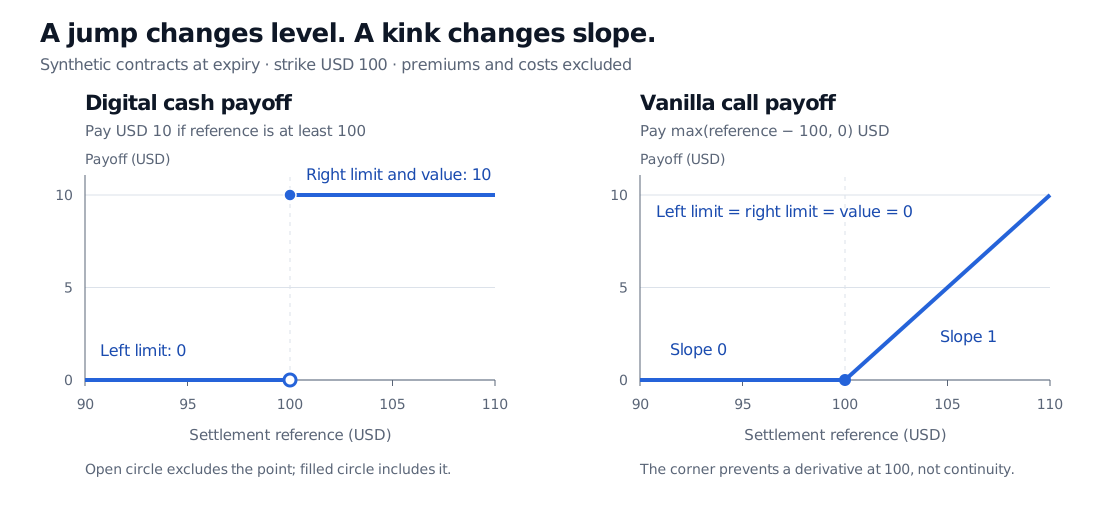
Both one-sided limits exist and are finite, but they disagree. The two-sided limit does not exist: this is a jump discontinuity of size USD 10. Assigning any other value at exactly 100 would leave those two limits unchanged.
The equality convention still matters for settlement. A different contract paying only when S>100 would give D(100)=0. Its jump would remain. Always read whether the threshold includes equality rather than infer it from the word “digital.”
Synthetic expiry payoffs at strike USD 100. A digital paying USD 10 at and above the strike has left limit USD 0, right limit USD 10 and value USD 10. A vanilla call has both limits and value USD 0, although its slope changes from zero to one.
Original synthetic payoff comparison. Open and filled circles specify the digital's equality convention; neither panel is a current option price or a realised price path.
A kink is a different failure
The call option payoff C(S)=max(S−100,0) has a corner at 100. Yet both limiting payoffs and the payoff at 100 equal zero. It is continuous there. Its left slope is zero and its right slope is one, so the terminal payoff has no ordinary derivative at the strike.
Discontinuity rules out differentiability, but lack of differentiability does not establish discontinuity. For payoff diagrams, ask separately whether levels meet and whether slopes meet.
This also changes how a numerical sensitivity should be read. A central difference of the digital's terminal payoff across the strike is
2hD(100+h)−D(100−h)=2h10,0<h<100.
A USD 0.01 bump gives 500 USD of payoff change per USD of reference change. Shrinking the bump makes the quotient larger, not closer to a finite derivative. Reporting such a number as a stable hedge ratio would hide the jump.
Classify the failure before trying to fix it
For a real-valued function defined around an interior point, useful cases are:
Type
What the limit reveals
Can changing one value restore continuity?
Removable
A finite two-sided limit exists, but the point value differs.
Yes: set the point value equal to that limit.
Jump
Finite left and right limits exist but differ.
No.
Infinite
The function tends to positive or negative infinity from at least one side.
No finite point value can fix that behaviour.
Oscillatory
Values keep revisiting separated levels arbitrarily close to the point.
No. A bounded function can still fail to have a limit.
For example, define r(x)=x+2 for x=0 and r(0)=7. The limit at zero is 2, so replacing 7 by 2 removes the discontinuity. By contrast, defining b(0)=0 alongside b(x)=1/x2 for x=0 does not stop the nearby values growing without bound. Similarly, o(x)=sin(1/x) for x=0, with o(0)=0, continues oscillating between −1 and 1 near zero. These examples illustrate distinct failures rather than an exhaustive classification of every possible function. OpenStax's continuity discussion develops the first three cases; its limit discussion explains the oscillatory example.
Specify the domain. Strictly, continuity at a point concerns a point belonging to the function's domain, with limits taken through that domain. The unextended formula 1/x2 is continuous on R∖{0}. Introductory calculus also calls the excluded point an “infinite discontinuity,” describing why no continuous extension to zero exists. A missing value with a finite limit is often called a “removable discontinuity” in the same extension sense. At a domain endpoint, use the available one-sided limit; the absence of inputs on the other side is not itself a discontinuity.
For algebraic methods that distinguish a removable hole from a genuine failure of the limit, see Calculating Limits: Limit Laws and Algebraic Techniques. The public page is a preview; the complete lesson requires full membership.
The terminal payoff is not today's price
The digital example describes payment at expiry as a function of the settlement reference. A price before expiry averages future payments under a pricing model. It need not inherit the terminal jump.
For example, in the Black-Scholes model, with constant annual volatility σ>0, constant continuous interest rate r and dividend yield q, the price of this European cash digital with positive time to expiry τ is
Here S>0 is current spot, and Φ is the standard normal cumulative distribution function. At fixed τ>0, this expression is continuous in spot. The model assigns zero probability to finishing at exactly the strike, so the strict and inclusive terminal conventions give the same pre-expiry value in this model. Neither statement is a universal property of every pricing model.
Keep the object and variable explicit: a jump in a terminal payoff, a corner in a terminal payoff, and a change in a live option's delta are related questions with different mathematical tests.
Sources
James Stewart, Single Variable Calculus: Early Transcendentals, 6th edition (Thomson Brooks/Cole, 2008), §2.5, especially Definitions 1–2 and Example 2: continuity, one-sided continuity and removable, infinite and jump discontinuities.
John C. Hull, Options, Futures, and Other Derivatives, 9th Global Edition (Pearson Education Limited, 2018), §26.10, “Binary Options”: cash-or-nothing payoffs and the Black-Scholes valuation formula. The USD 10 contract, equality convention and numerical comparison here are original specifications.
Gilbert Strang and Edwin “Jed” Herman, Calculus Volume 1, OpenStax, §2.4, “Continuity” and §2.2, “The Limit of a Function”: continuity conditions, discontinuity types and oscillation without a limit.