Identify admissible inputs, distinguish a domain from a range, and check formula boundaries, compositions and financial model restrictions.
Domain of a function
The domain of a function is the set of inputs for which that function is defined. For a financial model, specifying the domain also means stating which inputs the model admits: a formula may accept a number that makes no sense for the contract being modelled.
If a function is written f:D→C, then D is its domain and C its codomain, the declared set of possible destinations. The range is the set of outputs actually attained, f(D)={f(x):x∈D}, which may be smaller than C. Inputs and outputs need not even have the same units: a yield can be the input and a price in dollars the output.
A discounting formula with a real boundary
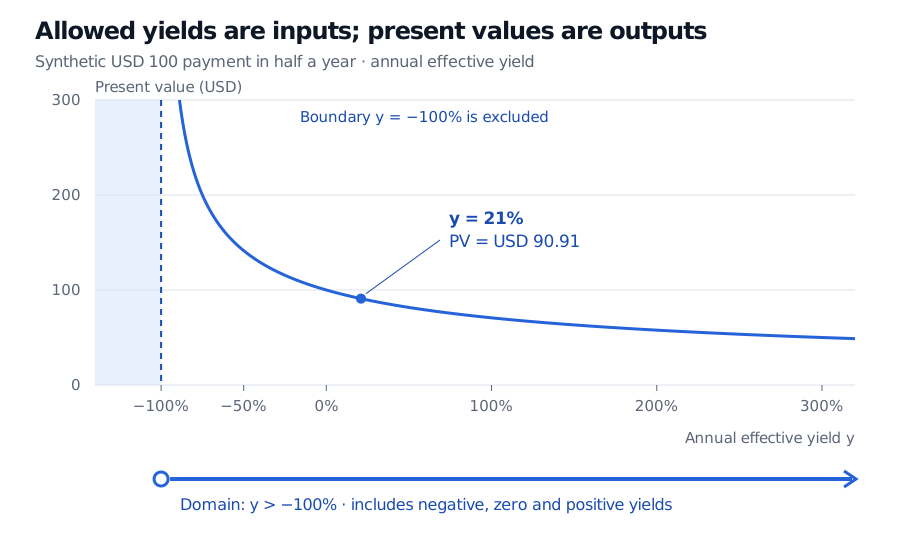
Suppose a hypothetical contract pays USD 100 exactly half a year from now. Ignore default, fees and intermediate cash flows. Let y be its annual effective yield, entered as a decimal, and explicitly adopt fractional-year compound discounting:
P(y)=(1+y)1/2100=1+y100.
To calculate a real present value, the square root needs 1+y≥0. Because that root is also the denominator, zero is excluded. Both restrictions together give
D={y∈R:y>−1}=(−1,∞).
At an annual effective yield of 21%,
P(0.21)=1.21100=1.1100=90.909090… USD.
Annual effective yield
Present value (USD)
Domain decision
−36%
125.00
Admitted; negative yield is allowed
0%
100.00
Admitted; no discounting
21%
90.91
Admitted
300%
50.00
Admitted; a hypothetical stress input
−100%
Undefined
Excluded: denominator is zero
Below −100%
No real value under this formula
Excluded: negative square-root argument
Synthetic half-year USD 100 payment: annual effective yields must exceed minus 100 percent. At 21 percent the present value is USD 90.91; the excluded minus 100 percent boundary is shown with a dashed line and an open circle on the input-domain strip.
Original hypothetical example. The plotted curve is a finite window; the domain extends to every finite yield above −100%.
Here the range is (0,∞) in USD: every positive price can be reached by choosing y=(100/P)2−1. Zero is never an output at a finite admitted yield. As y approaches −1 from above, the price grows without bound; that one-sided limit does not give a value at −1.
The boundary belongs to this convention. With continuous compounding, P(r)=100e−r/2 admits every finite real continuously compounded rate r. Do not transfer the −100% boundary to that different rate variable. Nor does a mathematically admitted yield establish that a quoted market price or investment is sensible.
Find the domain before simplifying
Unless a domain is stated, an elementary real-valued formula usually takes its natural domain: every real input for which the expression is defined. The main restrictions are:
These conditions apply simultaneously. For example,
h(x)=x−5x−2⟹Dh=[2,5)∪(5,∞).
The input 2 is included: a zero numerator is harmless here, and h(2)=0. The input 5 is excluded. Square brackets include a finite endpoint; parentheses exclude it. Infinity is not a real endpoint and always takes a parenthesis.
Algebraic cancellation preserves values only where the original expression existed:
x−3x2−9=x+3for x=3.
The original rational function still excludes 3. Defining its value there to be 6 creates an extension, rather than recovering a value the fraction already had.
For instance, ln(1−x2) requires 1−x2>0, so its domain is (−1,1). The inner polynomial accepts all real inputs, but the outer logarithm rejects zero and negative intermediate values.
A model can impose a smaller domain
Suppose V(q)=50q describes the USD value of a long-only holding priced at USD 50 per share, with whole shares only. The formula accepts every real q. This holding model admits only q∈{0,1,2,…}. Twenty shares give USD 1,000; a negative share count would describe a short position outside the stated model, and a fractional count would violate its whole-share assumption.
Likewise, 100/(1+y)2 is algebraically defined for y<−1, because the exponent is an integer. A standard positive-growth-factor discounting model can still explicitly require 1+y>0. The formula's natural domain and the model's chosen domain answer different questions.
In a pricing or risk calculation, state the input's meaning and units, find the formula's restrictions, then intersect them with the contract and model restrictions. A failed domain check means the stated function has no value there; a nearby limit, a simplified expression or a software-produced number cannot silently change that contract.
James Stewart, Single Variable Calculus: Early Transcendentals, 6th edition (2008), §§1.1 and 1.3: domains, ranges, natural domains and combinations of functions.
John C. Hull, Options, Futures, and Other Derivatives, 9th Global Edition, §4.2: annual effective and continuously compounded interest-rate conventions.