Read left- and right-hand limits correctly, separate threshold values from nearby payoffs, and handle domain endpoints without inventing missing inputs.
One-sided limit
A one-sided limit is the value a function approaches when its input gets close to a point from one specified side. A left-hand limit uses only smaller inputs; a right-hand limit uses only larger inputs. This distinction matters at a contract threshold: a payoff can approach different amounts from below and above even though the payoff at the threshold is fully specified.
The superscripts are direction labels, not arithmetic instructions to subtract or add a number. They do not specify the sign of the output, or whether the output approaches its limit from above or below. Neither approach includes x=a.
“Approaches” means more than finding a few convenient inputs. For example, a finite right-hand limit L requires that, for every output tolerance ε>0, some input tolerance δ>0 makes
0<x−a<δ,x∈D⟹∣f(x)−L∣<ε.
There must be admissible inputs arbitrarily close to a on that side. For the left-hand definition, replace the input condition by 0<a−x<δ. The general limit uses the same idea without restricting the approach to one side.
The threshold rule and the nearby payoff are separate
Consider a hypothetical cash-or-nothing digital option. Let S≥0 be the terminal asset price in USD. The contract pays USD 1 if S is at least USD 100 and nothing otherwise. Expressing the payoff D(S) in USD,
D(S)={0,1,S<100,S≥100.
Approaching 100 from below keeps the payoff at 0. Approaching from above keeps it at 1. Thus
S→100−limD(S)=0,S→100+limD(S)=1,D(100)=1.
These are three answers to three questions. The left-hand limit describes below-threshold inputs, the right-hand limit describes above-threshold inputs, and the point value follows the inclusive settlement rule. Changing the rule to pay only when S>100 would change D(100) to 0 while leaving both one-sided limits unchanged.
This calculation concerns the terminal payoff as terminal price varies. It does not calculate the option's current price or its price sensitivity before expiry.
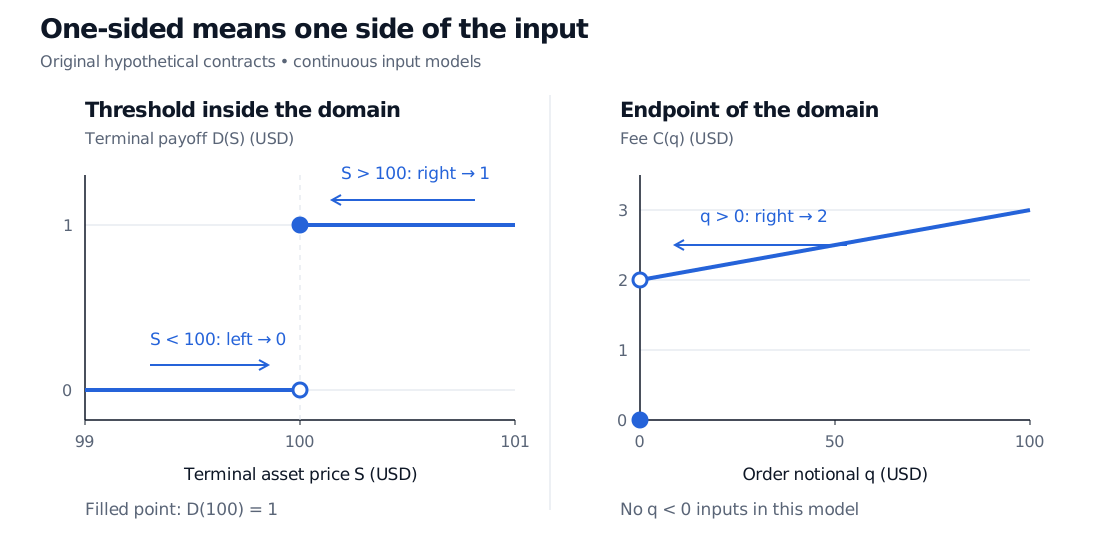
A hypothetical digital payoff has left limit USD 0 and right limit USD 1 at terminal asset price USD 100; its value there is USD 1. A fee defined for nonnegative order notional has value USD 0 at zero and right limit USD 2, with no negative-notional inputs.
Original hypothetical continuous-input models. The arrows show the side of the input approach; open and filled circles separate nearby behaviour from the assigned point value.
When the two sides agree
When the domain supplies inputs arbitrarily close on both sides of the point being approached, a finite two-sided limit exists if and only if both one-sided limits exist and have the same finite value:
x→alimf(x)=L⟺x→a−limf(x)=x→a+limf(x)=L.
The digital payoff fails this test because 0=1. Knowing its point value does not repair the disagreement. Conversely, equal one-sided limits establish the two-sided limit without requiring f(a) to equal it, or even to be defined. Continuity at an interior point additionally requires f(a)=L; discontinuity describes the failure of that matching condition.
An endpoint has only the available approach
Suppose a synthetic fee model accepts a continuous nonnegative order notional q, in USD. No order costs nothing; any positive order incurs USD 2 plus 1% of notional. The fee C(q), in USD, is
C(q)={0,2+0.01q,q=0,q>0,q≥0.
Positive order notional (USD)
Fee (USD)
10
2.10
1
2.01
0.1
2.001
Since C(q)−2=0.01q for every positive input,
q→0+limC(q)=2,C(0)=0.
An arbitrarily small positive order still approaches the fixed charge. There is no left-hand approach at zero within this domain: negative order notional is not defined by the model. State the right-hand limit explicitly rather than extending the formula to invented negative inputs. For continuity relative to this domain, the relevant test at zero would be whether that right-hand limit equals C(0); here it does not.
The continuous notional assumption makes arbitrarily small orders mathematically available. A real minimum order size or lot grid instead gives a smallest permitted trade. The model's limit describes its continuous idealisation; the actual fee rule determines the charge for an admissible order.
For a broader lesson connecting these limits to local sensitivities, see Limits and Differentiation (public preview; full lesson requires membership).
Sources
Stewart, J. Single Variable Calculus: Early Transcendentals, 6th ed., §§2.2 and 2.4: one-sided notation, agreement of the two sides, and precise one-sided definitions.
Hull, J. C. (2018). Options, Futures, and Other Derivatives, 9th Global ed., §26.10: cash-or-nothing binary payoffs. The inclusive threshold and USD 1 amount above are explicitly chosen hypothetical contract terms.
OpenStax, Calculus Volume 1, §2.2: The Limit of a Function, “One-Sided Limits” and Theorem 2.2: approach direction and the relationship between one-sided and two-sided limits.