More precisely, for every output tolerance , there must be an input tolerance such that every valid input satisfying also satisfies . The tolerances use the respective output and input units. This is a local condition: it does not assert that every small-looking change has a small financial effect at every scale.
The call joins up, even at its corner
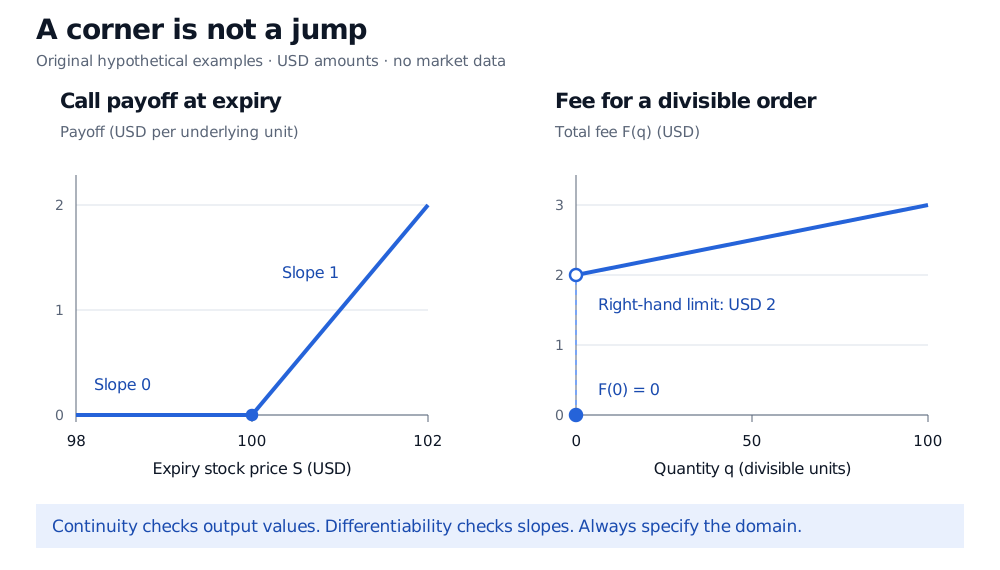
Below 100, the payoff is zero. Above 100, it increases dollar for dollar with the terminal price. At the join,
All three agree, so the payoff is continuous there. For instance, terminal prices 99.99, 100 and 100.01 give payoffs 0, 0 and 0.01 dollars. These are hypothetical terminal scenarios, not option prices observed before expiry. Premiums and trading costs are excluded: this is payoff, not profit.
The limiting argument does not depend on a few selected prices. For every admissible ,
As approaches 100, the upper bound shrinks to zero. That proves the payoff approaches its value at the strike.
The first trade can switch on a charge
A quantity of 1 costs USD 2.01, while 0.01 costs USD 2.0001. Reducing a positive order makes the variable charge disappear, but leaves the entry charge:
The model is discontinuous at zero: an arbitrarily small positive trade still triggers almost USD 2. A smooth approximation that connects the origin to the positive-order curve can hide this participation cost and change an optimiser's choice between trading and staying out.
The domain matters. There are no negative quantities in this model, so continuity at zero uses only the right-hand limit. For a function on a closed interval , continuity at is checked from the right and at from the left; interior points use both sides. On a disconnected domain, only approaches through valid inputs count.
If quantity were restricted to whole units, zero would be isolated in the domain: there would be no sequence of positive admissible quantities shrinking to zero. The entry charge would remain economically relevant, but the continuous-domain limit above would no longer describe that integer decision problem.
What the assumption buys you
Continuity makes substitution into a limit valid at the point. It also supports existence results. A continuous function on a closed interval takes every value between its endpoint values; with opposite endpoint signs, this justifies a bracket for bisection. A continuous objective on a nonempty compact feasible set attains a maximum and a minimum. Neither result establishes uniqueness, and continuity alone supplies no derivative or hedge.
Sources
- James Stewart, Single Variable Calculus: Early Transcendentals, 6th edition, §§2.5 and 2.8: continuity, endpoints, and the relationship with differentiability.
- John C. Hull, Options, Futures, and Other Derivatives, 9th Global Edition, §§10.2 and 19.4: European option payoffs and price delta. The numerical examples and figure here are original.
- MIT 18.01, §2.1: Informal Definition of Limit and Continuity, and the proof that differentiability implies continuity.
- Options Industry Council: Long Call: call rights, expiry outcomes and the distinction between payoff and profit after premium.