A logarithm finds the exponent behind a growth multiple. Solve a compounding-time problem, choose a base and distinguish log-returns from simple returns.
Logarithm
A logarithm answers “what exponent produces this number?” If a balance grows by multiplying each period, a logarithm can recover how many periods produced an observed growth multiple.
logbx=y⟺by=x,b>0,b=1,x>0.
The base b specifies the multiplier; the argument x is the positive number whose exponent we seek. For example, log101000=3 because 103=1000. This makes the logarithm the inverse function of the exponential function with the same base.
The restrictions matter. Base 1 cannot distinguish exponents, since every power is 1. Zero and negative arguments have no real logarithm. Every admissible base gives logb1=0. Logs increase with the argument when b>1 and decrease when 0<b<1; the latter bases are valid, even though less common.
Counting periods of compounding
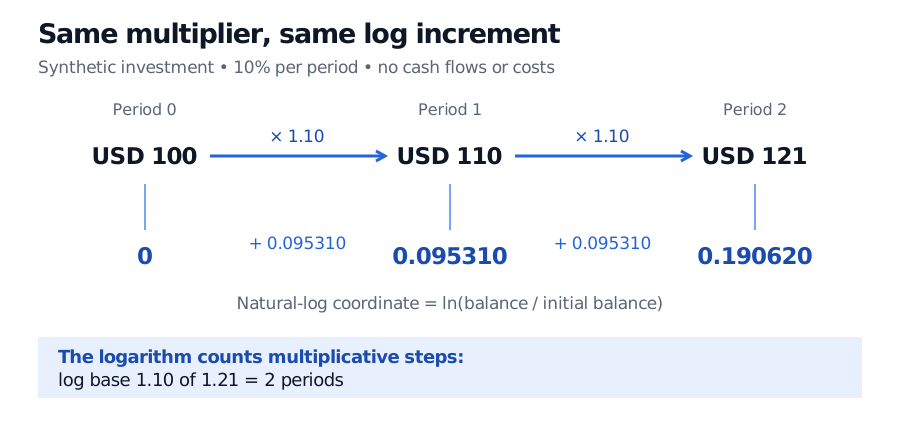
Suppose a hypothetical investment starts at USD 100 and earns exactly 10% each period, reinvested, with no contributions, withdrawals or costs. When does its period-end balance reach USD 121?
The direct check is USD 100 → USD 110 → USD 121. The answer counts periods in the stated growth model; it makes no prediction about an actual investment. A fractional-period answer in another example would need an assumption about how growth accrues within each period.
Synthetic wealth is USD 100, USD 110 and USD 121 at periods 0, 1 and 2. Each step multiplies wealth by 1.10. Natural logs of the wealth relative are 0, 0.095310 and 0.190620, equal increments of 0.095310.
Original synthetic example. Equal multiplicative growth becomes equal additive increments on the natural-log scale; displayed log values are rounded.
Products become sums
For positive u,v, an admissible base b and a real exponent a,
These identities follow from exponent laws. If u=bp and v=bq, then uv=bp+q, so the logarithm returns p+q. There is no corresponding sum rule: in general, logb(u+v)=logbu+logbv.
The natural logarithm, written ln, uses base e; the common logarithm uses base 10. An unqualified “log” can mean either, depending on context. State the base when ambiguity matters. To calculate the growth-time answer on a standard calculator, use change of logarithm base: t=ln(1.21)/ln(1.10).
For positive prices with no intervening distributions, the natural-log price return is r=ln(S1/S0). In the example, each period has log-return ln(1.10)≈0.095310 and simple return 0.10. Over two periods, the log-return is 2ln(1.10)=ln(1.21)≈0.190620, while the simple return is 1.21−1=0.21, or 21%. They describe the same price change under different conventions.
Consecutive log-returns add because consecutive price relatives multiply. This does not justify adding different assets' log-returns to obtain a portfolio return. Use a dimensionless ratio inside the logarithm, and account explicitly for dividends or reinvested distributions when measuring total returns.
Exponentials and Logarithms extends these ideas to discounting and continuously compounded rates (public preview; full lesson requires membership).
Sources
Stewart, J. (2008). Single Variable Calculus: Early Transcendentals, 6th edition, §1.6, “Inverse Functions and Logarithms,” pp. 64–66.