The natural logarithm uses base e to recover a continuous growth exponent. Understand positive inputs, negative logs and the difference between interval returns and annual rates.
Natural logarithm
The natural logarithm, written lnx, is the logarithm to base e≈2.71828. It returns the exponent needed to produce a positive number using the exponential function:
lnx=y⟺ey=x,x>0.
In finance, this turns a positive growth multiple into a continuously compounded return. Recovering an annual rate needs one more step: divide that return by the elapsed time in years.
A growth multiple is not an annual rate
Suppose a hypothetical investment grows from USD 100 to USD 125 over exactly three years, with no external contributions or withdrawals and all distributions reinvested. Its growth multiple is 125/100=1.25. The log-return over the whole three-year interval is
That is 7.438118% per year under continuous compounding. The equivalent effective annual rate is
R=er−1=1.251/3−1≈0.07721735,
or 7.721735%. Both conventions reproduce the same endpoint: 100e3r=100(1+R)3=125, using unrounded rates. The simple return over the entire interval is 25%; neither annual rate is 25% divided by three.
The ratio inside ln is dimensionless: dollars cancel against dollars. L is also dimensionless; dividing by three years gives r units of inverse years, so rT is dimensionless in erT. Taking the log of a price quoted as a bare currency amount hides a choice of unit; a price ratio avoids it.
This constant rate summarises the endpoints. It does not imply that the investment followed a smooth path or earned the same return every year. With external cash flows, the ending-to-starting value ratio alone cannot measure investment performance.
A negative logarithm is ordinary
The real natural logarithm accepts strictly positive inputs and can return any real number:
Positive input x
Natural logarithm
0<x<1
lnx<0
x=1
lnx=0
x>1
lnx>0
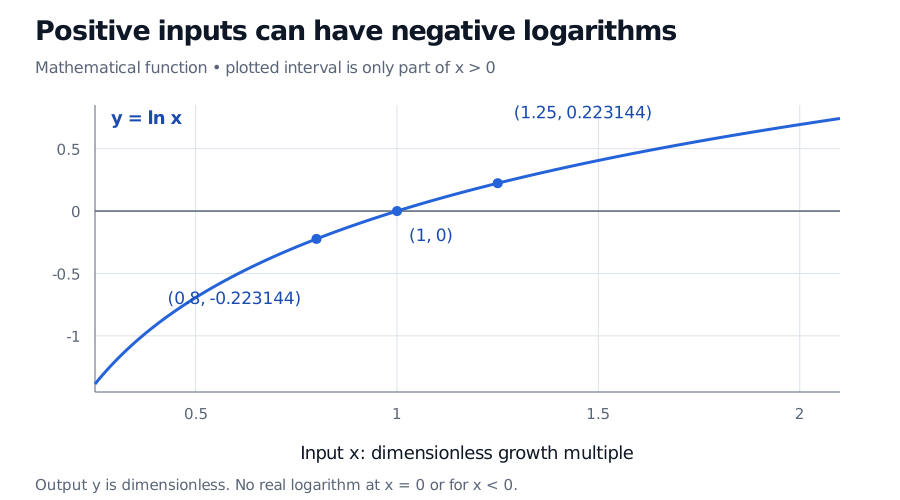
For example, a fall from USD 125 to USD 100 gives a positive ratio 0.8, with ln(0.8)≈−0.22314355. A negative result is valid; a negative argument is outside the real domain. Likewise, ln0 is undefined: the curve tends to negative infinity as its positive input approaches zero, but infinity is not a finite log-return for a zero ending value. Price log-returns require positive prices; negative quoted prices cannot be inserted into this formula.
Graph of y = ln x for positive dimensionless x. The curve passes through (0.8, -0.223144), (1, 0) and (1.25, 0.223144); inputs below one give negative outputs.
The logarithm is increasing across its positive domain. Reciprocal inputs 0.8 and 1.25 have opposite logarithms; the plotted interval shows only part of the domain.
Why base e keeps appearing
Natural logs undo natural exponentials in both directions:
ln(ey)=y(y∈R),elnx=x(x>0).
Their calculus is especially simple:
dxdlnx=x1,x>0.
For a positive differentiable value path V(t), the chain rule gives dlnV(t)/dt=V′(t)/V(t): the slope of log value is the instantaneous proportional growth rate. This explains the close connection between natural logs and continuous compounding. An observed investment path need not be differentiable for its endpoint log-return to exist.
The general logarithm page covers other bases and product rules; change of logarithm base explains conversions. An unqualified log depends on the notation or software, so check its documented base. The owned lesson Exponentials and Logarithms develops growth, discounting and consecutive log-return aggregation (public preview; full lesson requires membership).
Sources
Stewart, J. (2008). Single Variable Calculus: Early Transcendentals, 6th edition, §1.6, “Inverse Functions and Logarithms,” pp. 64–66.