An exponential function puts its variable in the exponent. Understand positive bases, equal-step multipliers and constant proportional change through a stipulated cash-balance model.
Exponential function
An exponential function has a fixed positive base and a variable in the exponent:
f(x)=ax,a>0,a=1.
The input x can be any real number, and the output is always positive. The base restriction matters: a negative base does not give a real-valued function for every real input, while zero fails for negative inputs. The excluded case a=1 produces the constant function 1.
The location of the variable distinguishes the family. In 2x, the base stays fixed while the exponent changes. In x2, the exponent stays fixed while the base changes: that is a power function. Their algebra and differentiation rules differ.
Equal steps, equal multipliers
The defining operational property is
f(x+h)=ax+h=axah=f(x)ah.
A fixed step h in the input multiplies the output by the same factor ah, wherever the step starts. It does not add a fixed amount. When a>1, increasing the input produces exponential growth; when 0<a<1, it produces exponential decay. Both curves pass through (0,1) and remain above zero.
Multiplying by a positive starting value C gives y(x)=Cax, a scaled exponential. Its equal-step ratio is still ah, but y(0)=C. Be careful with the identity f(x+h)=f(x)f(h): it applies to the normalised function ax. For the scaled version, y(x+h)=y(x)y(h)/C.
A cash balance with an exponential clock
Suppose a hypothetical account starts with USD 1,000, earns a stipulated constant 5% continuously compounded annual rate, and has no deposits, withdrawals, fees or taxes. With t measured in years, its model balance is
B(t)=1,000e0.05t.
Here e≈2.71828 is the natural base. The normalised accumulation factor f(t)=e0.05t starts at 1 and satisfies f(t+s)=f(t)f(s). The exponent 0.05t is dimensionless: an annual rate multiplies a time in years.
Time
Model balance
Gain over preceding two years
0 years
USD 1,000.00
—
2 years
USD 1,105.17
USD 105.17
4 years
USD 1,221.40
USD 116.23
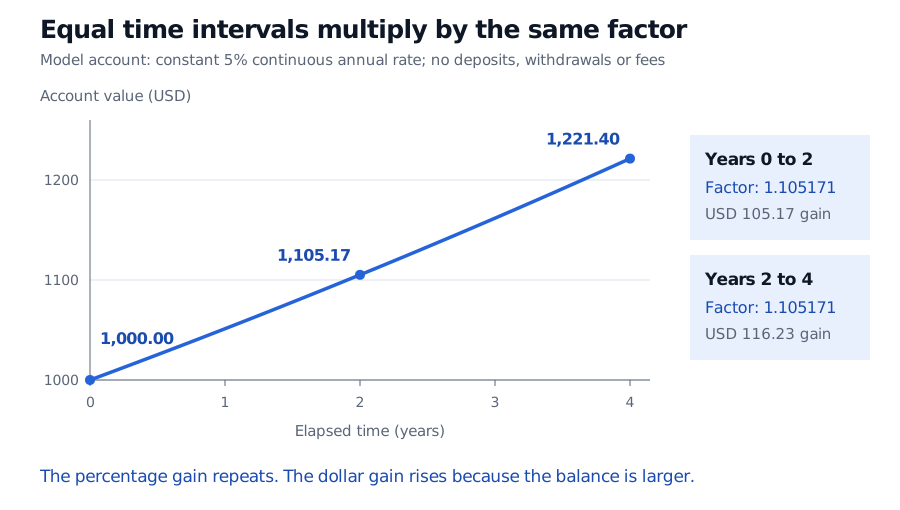
Each two-year interval multiplies the balance by e0.1≈1.105171. The second dollar gain is larger because the same multiplier acts on a larger starting balance.
A stipulated USD 1,000 account at a constant 5% continuous annual rate reaches USD 1,105.17 after two years and USD 1,221.40 after four. Each two-year multiplier is 1.105171; the gains are USD 105.17 and USD 116.23.
Original hypothetical model: equal two-year intervals share one multiplier, while their dollar gains differ. Rate and time units are fixed throughout.
This is a specified accumulation rule, not a forecast of an investment's realised returns. A 5% continuous rate also differs from a 5% effective annual rate: the former produces an annual gain of e0.05−1≈5.127%. Changing rates or external cash flows require a different balance model.
Why the natural base appears in calculus
Every positive base can be written using a logarithm: ax=exlna. Differentiating shows that an exponential's rate of change is proportional to its current level:
f′(x)=(lna)f(x),f(x)f′(x)=lna.
For the account, B′(t)=0.05B(t). At two years the instantaneous slope is about USD 55.26 per year. This is a local rate of change; the exact gain over the next year uses the multiplier e0.05.
The special case ex has derivative ex. More precisely, it is the unique solution of y′=ywith y(0)=1; without that initial condition, every Cex solves the same differential equation. Constant proportional change, rather than constant dollar change, is the useful pattern to recognise.
For a fuller treatment of exponent laws, logarithmic inverses and rate calculations, see Exponentials and Logarithms (public preview; full lesson requires membership).
Sources
Stewart, J. (2008). Single Variable Calculus: Early Transcendentals, 6th ed., §§1.5–1.6 and §3.1: exponential functions, logarithms and derivatives.
Hull, J. C. Options, Futures, and Other Derivatives, 9th Global Edition, §4.2, equation (4.2): continuously compounded accumulation.