See why constant proportional growth produces larger dollar gains, calculate doubling time, and distinguish a 6% continuous rate from a 6% effective annual rate.
Exponential growth
Exponential growth is an increase at a constant proportional rate: the larger a positive quantity becomes, the more it adds over the next interval of a fixed length. Its defining feature is a constant multiplier over equal intervals, rather than a constant dollar increase.
In finance, this is the mechanism behind compound interest when the rate stays fixed and interest remains invested. The growing balance itself earns the next increment. A rising market price need not follow that mechanism: a smooth exponential curve is a stipulated model, not evidence that an investment will deliver a fixed return.
The mechanism in one equation
For an initial value V0>0, a constant continuous growth rate k>0, and elapsed time t,
V(t)=V0ekt.
This is an exponential function of time. If t is in years, k is a rate per year; the product kt must be dimensionless. The notation does not mean “add k dollars each year.”
For any interval of length h,
V(t)V(t+h)=ekh.
The multiplier depends on the interval's length, not its starting date. Equivalently, the instantaneous growth law is
dtdV=kV(t),V(t)1dtdV=k.
The first expression measures an amount per unit of time; the second divides by the current amount to measure proportional growth. At k=0.06 per year, a USD 100 balance has an instantaneous growth rate of USD 6 per year. A USD 200 balance has an instantaneous growth rate of USD 12 per year. Both have the same proportional rate.
A reserve that earns on its growing balance
Suppose a hypothetical reserve starts with USD 100 and follows a fixed 6% continuously compounded annual rate. All interest remains in the reserve; there are no deposits, withdrawals, taxes or fees. The stipulated balance is
V(t)=100e0.06tUSD,t in years.
Compare this with a separate arrangement that simply adds USD 6 per year, giving L(t)=100+6t. The two have the same starting balance and initial instantaneous dollar growth rate, but only the first lets growth feed back into future growth.
Elapsed years
Exponential reserve (USD)
Fixed USD 6 per year (USD)
0
100.00
100.00
1
106.18
106.00
5
134.99
130.00
10
182.21
160.00
Values are rounded to cents after calculation. After five years, 100e0.30=134.985880…, while adding a fixed amount gives 100+6(5)=130. The gap widens because the exponential reserve keeps earning on a larger base.
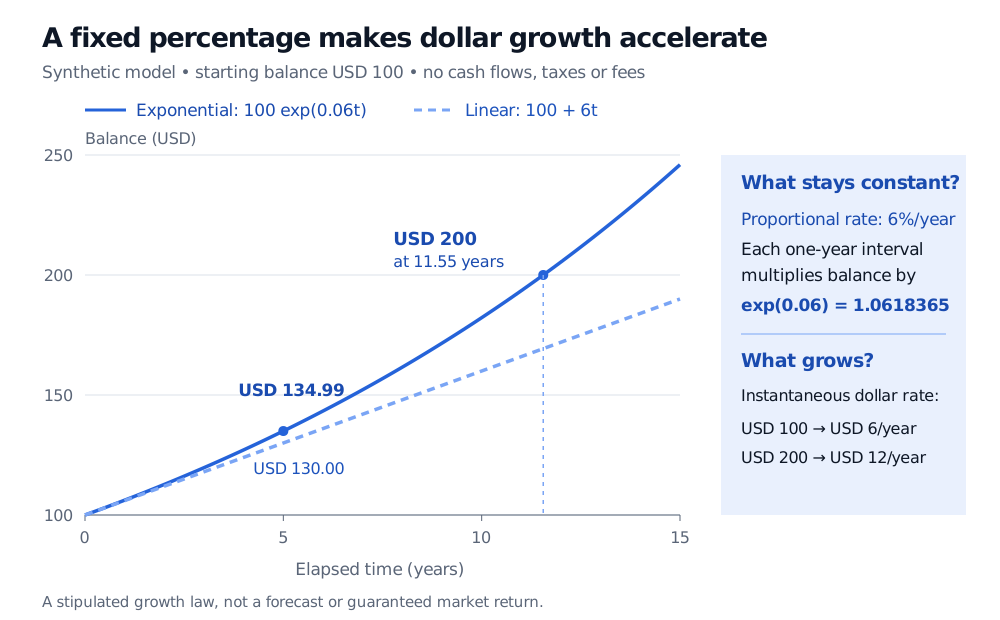
A hypothetical USD 100 reserve following 100 exp(0.06t) reaches USD 134.99 after five years and USD 200 after 11.55 years. A comparison adding USD 6 each year reaches USD 130 after five years. The continuous proportional rate stays 6% per year while the instantaneous dollar growth rate doubles from USD 6 to USD 12 per year when the balance doubles.
Original deterministic comparison in USD, with time in years. The solid curve follows a stipulated continuous 6% annual rate; the dashed line adds USD 6 per year. No cash flows, taxes or fees; neither series is market data or a forecast.
The curved shape is a consequence of proportional growth. Rapid growth alone is insufficient to identify an exponential process: a straight line can rise quickly, and many increasing curves have changing proportional rates.
One growth law, two rate quotes
A 6% continuous rate is different from a 6% effective annual rate. Under continuous compounding, one year's growth factor is e0.06, so the effective annual rate is
i=e0.06−1≈0.0618365=6.18365%.
Thus the first year's increase is about USD 6.18, even though the instantaneous growth rate at the starting instant is USD 6 per year. An instantaneous rate and a finite year's increase answer different questions.
Conversely, a 6% effective annual rate gives a factor of 1.06 per complete year. Its equivalent continuous annual rate is ln(1.06)≈5.82689%, and five years would produce 100(1.06)5≈133.82 dollars. Both conventions describe exponential growth; holding the numerical quote at 6% while changing its convention changes the economic growth.
Doubling does not get faster
Although the dollar increments grow, the time needed for each doubling stays constant. Divide the target 2V0 by the initial value and use the natural logarithm:
ekT2=2⟹T2=kln2.
For the reserve, T2=ln(2)/0.06≈11.55 years. It takes that long to grow from USD 100 to USD 200, and the same additional time to grow from USD 200 to USD 400. A larger starting balance changes the dollar scale, not the doubling time.
More generally, the time to reach a target M>V0 is
t=kln(M/V0).
The logarithm undoes the multiplication. This calculation requires a positive starting value and a positive target; zero does not turn into a positive balance under the growth law alone.
When the curve stops describing the situation
The reserve example assumes that the proportional rate stays fixed and every increment remains available to earn more. Changing rates, cash withdrawals, contributions, fees and taxes can change the path. A fitted exponential curve through two observed wealth values does not establish a constant-rate mechanism between them or guarantee its continuation.
Setting k=0 gives a constant balance. A negative k gives exponential decay of a positive balance. The exponential function handles all three cases; exponential growth is the positive-rate case.
James Stewart, Single Variable Calculus: Early Transcendentals, 6th ed. (2008), §3.8, “Exponential Growth and Decay”: proportional-rate models and doubling time.
John C. Hull, Options, Futures, and Other Derivatives, 9th ed., Global Edition, §4.2, especially equations (4.2)–(4.4): continuous accumulation and conversion between rate conventions.