Read the base and exponent, match compounding periods to rates, and use zero, negative and fractional powers with their real-domain restrictions.
Exponent
An exponent is the number written above and to the right of a base in a power such as ax. The base is a; the exponent is x. For a positive integer exponent, it counts repeated multiplication: 23=2×2×2=8, not 2×3.
In finance, the exponent often counts how many times a growth factor applies. Confusing the rate with the factor, or years with compounding periods, changes the cash amount.
Read the period before the power
Suppose USD 1,000 earns a fixed 4% annual effective rate for three complete years, with all interest reinvested and no fees. The annual growth factor is 1+0.04=1.04, so compound interest gives
The base 1.04 describes one year's multiplication; the exponent 3 counts three such periods. The growth factor 1.124864 is dimensionless. Multiplying it by the principal leaves the answer in USD: USD 1,124.86 rounded to cents.
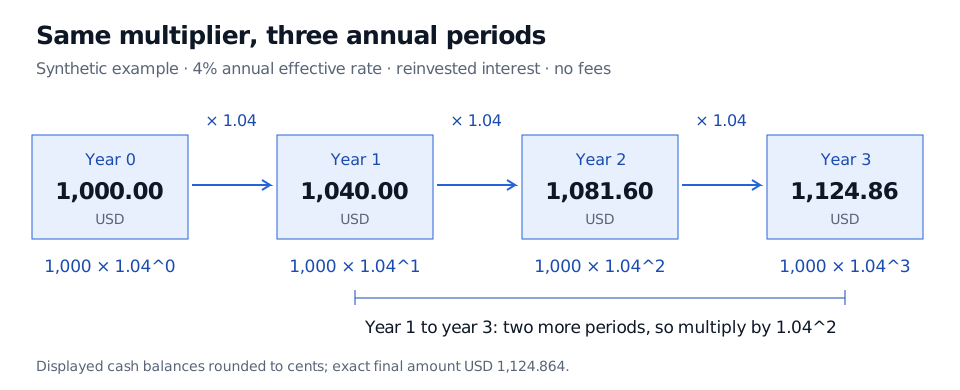
USD 1,000 grows to USD 1,040 after one year, USD 1,081.60 after two and USD 1,124.864 after three. Each step multiplies by 1.04; the exponent counts years because the factor is annual.
Original synthetic timeline: 4% annual effective interest, reinvested, with no fees. Cash labels are rounded to cents; the calculation retains full precision.
For a nominal annual rate j compounded m times per year, the matched expression is P(1+j/m)mT, where T is measured in years and mT counts periods. For example, 4% nominal compounded semiannually over three years uses base 1.02 and exponent 6; its factor is 1.126162419264, different from 1.043. A fractional number of contractual periods needs a stated accrual or interpolation convention; algebra alone does not supply the contract's rule.
Zero, negative and fractional exponents
An exponent extends beyond counting factors:
Exponent
Meaning and condition
Example
Zero
a0=1 for a=0
1.040=1: no elapsed periods
Negative integer
a−n=1/an for a=0, positive integer n
2−3=1/8, a reciprocal, not a negative number
Fractional
For a>0, ap/q=(qa)p, with integers p and q>0
0.041/2=0.2
A negative exponent reverses accumulation. At a fixed 5% annual effective rate, the two-year discount factor is
(1.05)−2=1.0521=441400≈0.90702948.
It is positive: its minus sign belongs to the exponent. Multiplying a payment due in two years by this factor moves it to today's comparison date under the stated rate convention.
A fractional exponent can change units as well as values. If a one-period decimal return has variance0.04, its standard deviation is 0.041/2=0.2, or 20% for that same period. Taking the square root converts squared-return units to return units; it does not annualise the result.
Keep the domain attached
For positive basesa,b and real exponents x,y, the familiar rules are safe:
axay=ax+y,ayax=ax−y,(ax)y=axy,(ab)x=axbx.
This explains the timeline: three annual multipliers can be grouped as one year's factor followed by two more, 1.043=1.0411.042. For arbitrary real x, a positive base can also be defined through the logarithm: ax=exlna.
Negative bases require more care. Integer powers are real; parentheses matter: (−2)2=4, whereas −22=−4. A rational exponent p/q in lowest terms gives a real power of a negative base when q is odd, using the real odd root; for example, (−8)1/3=−2. An even denominator gives no real value. Negative bases do not support arbitrary real exponents in this framework.
Nor can the power-of-a-power rule be carried over without checking: ((−1)2)1/2=1, while (−1)2(1/2)=−1. The principal square root returns the nonnegative root.
Zero raised to a positive exponent is zero; a negative exponent at zero is undefined because it would divide by zero. Treat 00 as undefined here; some discrete contexts adopt a separate convention. Finally, an exponent is notation, while an exponential function has its variable in the exponent: ax. A power function such as x2 has its variable in the base.
For the next step, Exponentials and Logarithms connects these rules to continuous compounding and the inverse operation used to infer a growth rate (public preview; full lesson requires membership).