Convert logarithms between bases, derive the conversion factor, and distinguish a growth-time calculation from financial return and chart conventions.
Change of logarithm base
Change of logarithm base rewrites a logarithm using logarithms to another base:
logbx=lnblnx,x>0,b>0,b=1.
Here ln is the natural logarithm, with base e. A calculator with only natural or base-10 logs can therefore evaluate any admissible real base. More generally,
logbx=logablogax,a>0,a=1.
Both logs in the quotient must use the same base. For example, log101000=ln(1000)/ln(10)=3.
Why the denominator is there
Set y=logbx. By definition, by=x. Taking natural logs gives ylnb=lnx, so division by lnb yields the formula. The denominator converts the natural-log scale into units of one multiplication by b.
Base 1 is excluded because 1y is always 1: it cannot invert an exponential over positive inputs, and ln1=0 would make the quotient undefined. Bases between zero and one are valid, but their logs decrease as the argument increases. For example, log1/2(1/4)=2. Zero and negative arguments have no real logarithm; complex logarithms require a different treatment.
A growth clock, with its assumption exposed
Suppose a hypothetical investment starts at USD 100 and follows the exponential function
V(t)=100×2t,
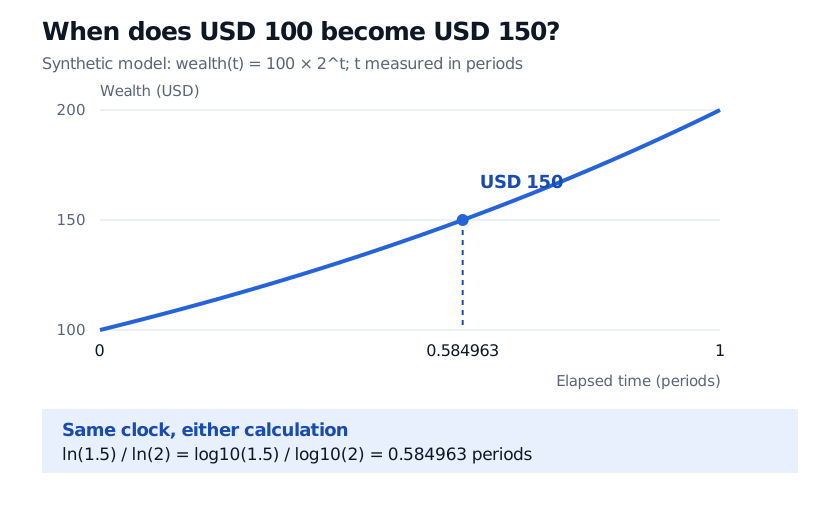
where t counts periods. It doubles each period, with exponential interpolation between period boundaries; this is a teaching model, not a return forecast. To reach USD 150, solve 2t=1.5:
Knowing only that wealth doubles at period ends would not determine this fractional-period arrival time. The path assumption supplies that information. If growth is credited only at the ends of whole periods, the first credited balance at least USD 150 occurs at period 1 instead.
Synthetic exponential wealth rises from USD 100 at period 0 to USD 200 at period 1 and reaches USD 150 at 0.584963 periods. Natural-log and base-10-log quotients give the same time.
Original synthetic growth clock. The fractional arrival time assumes exponential growth throughout the period.
A base change is not a return-convention change
For the same positive price relative 150/100=1.5, with no cash distributions, these quantities differ:
Quantity
Value
Meaning
Simple price return
0.5
A 50% increase in price
Natural-log price return
ln1.5≈0.405465
The conventional continuously compounded return over the interval
Base-10 log price relative
log101.5≈0.176091
The same relative on another logarithmic scale
The base-10 quantity must be multiplied by ln10 to recover the natural-log return. Calling it a continuously compounded return without conversion changes the numerical convention. A price ratio is dimensionless; dividends or other distributions need an explicit total-return treatment.
Similarly, changing a chart's logarithmic axis from base 10 to base 2 rescales its log coordinates. Equal multiplicative ratios still occupy equal distances, but the numerical coordinates change. State the base whenever an unqualified “log” could be ambiguous.
For the surrounding finance applications, Exponentials and Logarithms develops discounting, continuous rates and the addition of log-returns through time (public preview; full lesson requires membership).
Sources
Stewart, J. (2008). Single Variable Calculus: Early Transcendentals, 6th edition, §1.6, “Inverse Functions and Logarithms,” Change of Base Formula 10.