An inverse function recovers a unique input from an output. Recover an annual effective rate from a balance, select the valid branch, and check both compositions.
Inverse function
An inverse function takes an output and returns the unique input that produced it. If f maps an annual interest rate to a future account balance, f−1 maps an admissible balance back to that rate. In finance, this change of direction turns a valuation formula into a question about the assumption implied by a value.
The word unique carries the condition. An inverse exists on a function’s range when the original function is one-to-one: two different allowed inputs never produce the same output. An equation can have several solutions without defining an inverse function.
The domain is part of the answer
Let f have domainD and range R, the set of outputs it actually reaches. Its inverse has domain R and range D:
f−1(y)=x⟺f(x)=y,x∈D,y∈R.
If a larger codomain has been declared, values outside R still have no preimage. A two-sided inverse on that entire codomain requires every element of it to be reached as well.
Graphically, a horizontal line must meet the original graph at most once. A strictly increasing or strictly decreasing function passes this test on its domain. If a curve doubles back, restricting its domain may produce an invertible function—but that restriction must be stated, rather than silently choosing whichever solution looks convenient. OpenStax’s inverse-functions section develops these conditions and the horizontal-line test.
Recovering the rate behind USD 121
Take a hypothetical account with USD 100 initially, no deposits, withdrawals, fees or taxes, and a constant annual effective interest rate r. Interest is credited once at each year-end and retained. Over two whole years, compound interest gives
V=f(r)=100(1+r)2,r>−1.
Here V is the numerical balance in USD and r is a decimal annual rate: 0.10 means 10% per year. The model requires a positive annual growth factor 1+r, so its domain excludes a loss of 100% or worse. The range is V>0; balances can approach zero without reaching it within the stated domain. This is an annual effective convention, not a nominal rate to divide by a compounding frequency. The annual-compounding case of the standard future-value formula gives precisely this accumulation rule.
To invert it, undo the operations in reverse order: divide the balance by the initial USD 100, take the positive square root, then subtract one:
100V=(1+r)2⟹f−1(V)=100V−1,V>0.
The ratio inside the root is dimensionless because numerator and denominator use the same currency unit. For USD 121,
f−1(121)=1.21−1=0.10=10%.
A forward cash ledger confirms it: USD 100 becomes USD 110 after one year and USD 121 after two. The annual rate is 10%; the total two-year gain is 21%.
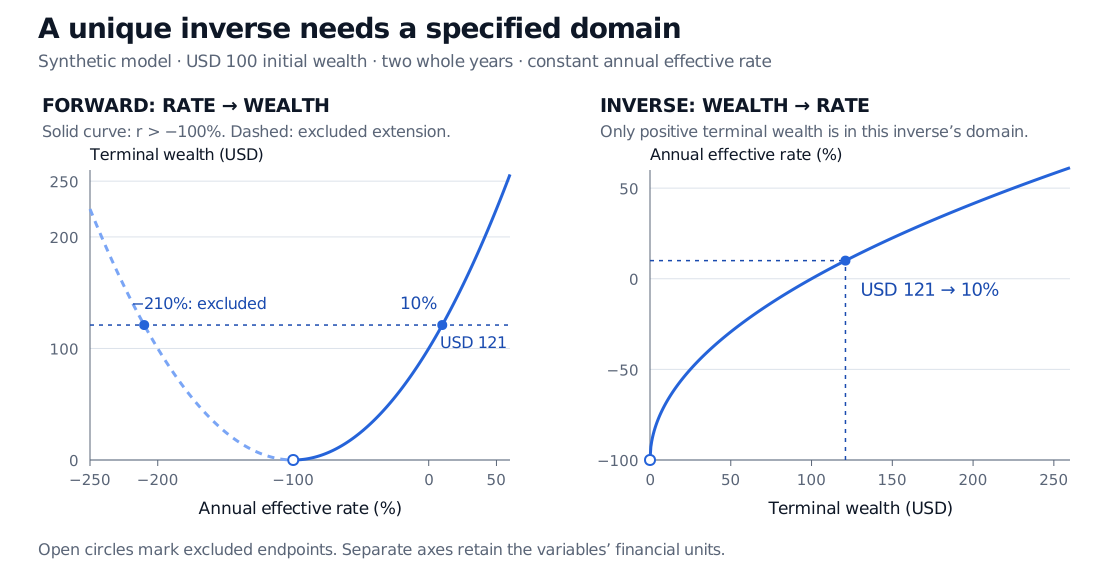
Why discard the other square root? Solving the quadratic without its domain gives r=−1−1.21=−2.10, or −210%. Algebraically, 100(−1.10)2=121. But −2.10<−1, outside the account model. It would reverse the sign of the balance each year. The positive square root is justified by 1+r>0, not by an assumption that interest rates must be positive. Rates between −100% and zero are allowed here.
Synthetic two-year accumulation of USD 100. The quadratic’s algebraic extension reaches USD 121 at −210% and 10%, but only 10% satisfies r greater than −100%. The inverse maps USD 121 back to a 10% annual effective rate. Both panels exclude the zero-balance boundary.
Original hypothetical model. The dashed branch is excluded from the financial domain. Each panel retains its own rate and currency axes; open circles mark excluded endpoints.
The boundary deserves attention: although the formulas can be evaluated at r=−1 and V=0, those values are outside the function and inverse defined above. Allowing a zero growth factor would define a different, closed domain and would require updating both ranges accordingly.
Two round trips, and a misleading exponent
An inverse must undo the function in both directions. These are compositions, not products:
The domain makes the absolute value equal 1+r. Without it, the first identity fails on the excluded branch even though substituting either quadratic root gives the desired balance. Checking only the second round trip would miss that failure.
The notation f−1 means “inverse function”; it does not mean the reciprocal 1/f. In this example f−1(121)=0.10 is a rate, while 1/f(0.10)=1/121 has reciprocal-currency units. Only the inverse recovers the original input.
For dimensionless coordinates plotted with matching scales, inverse graphs exchange (x,y) with (y,x) and reflect across y=x. Rates and USD balances have different units, so the figure uses separate, explicitly labelled axes rather than treating that reflection as a financial identity.
What the recovered input does—and does not—tell you
The 10% answer is unique within the constant-rate model. A realised account path earning 0% in the first year and 21% in the second also takes USD 100 to USD 121. The inverse above recovers the constant annual effective equivalent; a terminal balance alone does not identify both yearly rates. Uniqueness depends on what is being held fixed and what counts as the unknown input.
Some useful inverses have named formulas: the logarithm reverses an exponential. Others require numerical solution. The existence of a unique input is a mathematical property; having a short closed-form expression for it is a separate question.
For a free continuation, the full Functions sample lesson, particularly Composition, shows how to read an inner and outer function and check their domains. The Exponential Functions, Logarithms, and the Number e lesson, under Inverse functions and logarithms, develops cancellation identities and the exponential/logarithm pair; the public page is a preview and the full lesson requires membership.
Sources
James Stewart, Single Variable Calculus: Early Transcendentals, 6th edition, §1.6, “Inverse Functions and Logarithms”: one-to-one functions, cancellation identities, domain/range exchange and inverse-versus-reciprocal notation.