A control premium is the uplift from a non-controlling equity value to a comparable controlling value. A minority discount, or discount for lack of control, is the reduction from the pro rata value on a controlling basis to the value of a stake that lacks control. The distinction matters when using acquisition prices to value a stake that gives its owner a share of the cash flows but little power over how the business is run. IVSC, International Valuation Standards, IVS 103 and IVS 200
Control can have value if it lets the holder change the board, redirect investment or sell an underperforming division. The size of the stake tells only part of the story. Voting arrangements and board appointment rights determine what the holder can actually change, and the value depends on what those changes would achieve. Damodaran, The Value of Control
The same gap uses two denominators
A fictional company is worth 20 USD per common share on a non-controlling basis and 25 USD on a controlling basis. The estimates use the same date, share class and marketability assumptions. The difference reflects improvements the controlling owner can make while the company remains standalone.
With positive per-share values on the non-controlling basis and on the controlling basis, the premium and discount are
Going from 20 to 25 adds 25% of 20. Going back subtracts 20% of 25. Either rate crosses the gap once from its own starting value. The conversion applies when both percentages refer to the same pair of valuation bases.
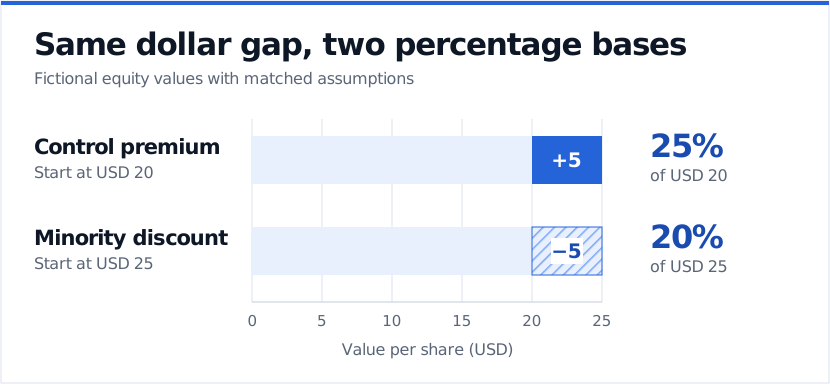
The solid segment adds the last 5 USD to the lower base. The hatched segment removes the same 5 USD from the higher base.
An offer premium depends on the deal and the benchmark
A takeover premium compares the offered value per share with a reference market price, such as the last close before credible deal reports or a volume-weighted average price (VWAP) ending on that date. The price after deal news can already reflect the chance of a takeover. In the Mars deal, Kellanova’s 2024 filing showed that the same 83.50 USD cash offer was about 33% above the 62.98 USD close on 2 August, before the deal reports, and about 44% above the 58.09 USD 30-day VWAP ending that day. Kellanova, Form 8-K, Implied Premia and Multiple Analyses
A bidder may pay for both standalone improvements and synergies that depend on combining the businesses. For example, a buyer pursuing add-on acquisitions may be able to sell the target’s products through its existing distribution network. How much of that expected gain reaches the target shareholders can depend on bargaining or competing bids. Reversing a takeover premium measures the gap back to the reference share price, with all those deal effects still in the comparison. In precedent transaction analysis, keep the offer benchmark and deal economics visible before comparing premiums across deals. If the starting figure is enterprise value, bridge it to common equity value per share before comparing it with a share price. Damodaran, The Value of Control
Control and marketability can vary independently
A small stake in a listed company can be easy to sell and carry little influence. A controlling stake in a private company can carry substantial influence and take months to sell. A discount for lack of marketability reflects the difficulty of selling the stake, including any relevant transfer restrictions. A minority discount reflects the decisions the holder lacks the power to make. Which adjustment matters depends on the rights of the stake and what the starting valuation already reflects. IVSC, International Valuation Standards, IVS 103 Appendix A10.17
Sources
- Aswath Damodaran, NYU Stern, The Value of Control, June 2005, pp. 40–42 and 56–58.
- International Valuation Standards Council, International Valuation Standards, edition effective 31 January 2025, IVS 103 Appendix A10.17 and IVS 200 section 90.
- Kellanova, October 2024 Form 8-K merger proxy supplement, Item 8.01.