Buy-and-build is a strategy in which an investor, often a private equity sponsor, buys an operating company as a platform and grows it through subsequent add-on acquisitions, also called bolt-ons. The platform provides the management, systems or distribution network that can absorb those businesses. For an analyst, the question is how much of the group's value comes from earnings it bought, how much comes from improving operations and how much depends on what a future buyer pays for those earnings. Hammer et al., Pricing and Value Creation in Private Equity-Backed Buy-and-Build Strategies
Buying at 6× and valuing at 8×
A fictional sponsor buys a platform for an enterprise value (EV) of USD 400 million, then acquires an add-on for USD 60 million of EV. The two businesses have comparable annual EBITDA and no overlapping sales or costs to eliminate in this example. Hold both earnings streams fixed, assume zero synergies and set aside financing, fees and the time between deals.
| Business | Purchase EV (USD millions) | EBITDA (USD millions) | Purchase EV/EBITDA |
|---|---|---|---|
| Platform | 400 | 50 | 8× |
| Add-on | 60 | 10 | 6× |
| Combined | 460 | 60 | 7.67× |
The blended EV/EBITDA multiple is total purchase EV divided by total EBITDA. The platform supplies most of the EBITDA, so the blended multiple is closer to 8× than to 6×.
If a buyer values the combined business at 8×, implied group EV is million USD, which is USD 20 million above the aggregate purchase EV. The platform's implied value stays at USD 400 million. The add-on contributes USD 80 million to the group valuation after costing USD 60 million in EV. This pricing effect is often called multiple arbitrage. It depends on a buyer valuing the acquired earnings at the group multiple. Heisig et al., Buying Performance?
At 7×, the same earnings imply USD 420 million of group EV, USD 40 million below the aggregate purchase EV. The break-even multiple in this EV comparison is . Even if the buyer pays 8×, a drop in group EBITDA to USD 57.5 million would erase the illustrative gap.
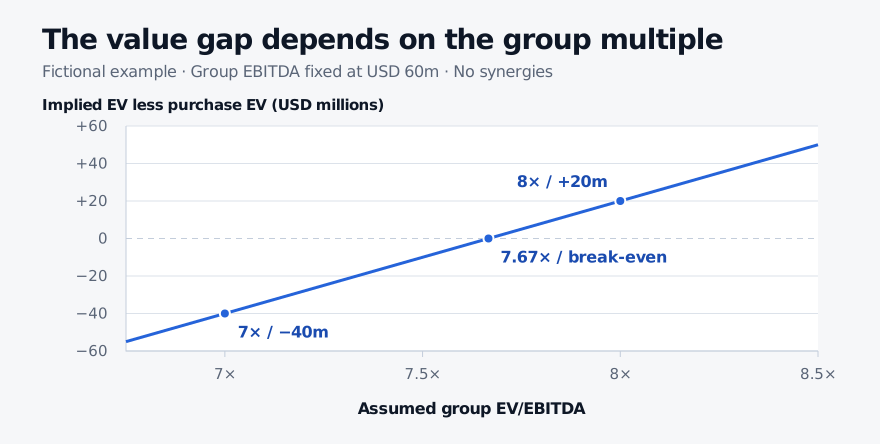
With earnings fixed, the price a buyer assigns to each dollar of group EBITDA determines whether implied enterprise value covers the aggregate purchase prices.
What the purchase multiple can hide
- Earnings quality. Put the platform and each add-on on the same measurement basis, such as comparable trailing 12-month periods with consistent adjustments. Reconcile pro forma earnings that include pre-close months with reported post-close results. An add-on can look cheaper if its EBITDA excludes recurring operating costs or includes savings that are still forecast. TransDigm’s 2025 Form 10-K shows how a serial acquirer can exclude cash integration expenses from its adjusted measure and explicitly flags comparability with other issuers. TransDigm, Fiscal 2025 Form 10-K, Item 7 and Note 2
- Integration. An add-on's existing earnings are purchased growth. Shared procurement savings can lift earnings further, while customer losses or extra central staffing can offset them. Budget the cash cost of switching systems and distinguish savings already in the earnings base from savings still to come. Hammer et al., survey evidence and conclusions
- Realisation. The USD 20 million is an illustrative difference between two enterprise values. An interim mark is an estimate. To work out realised sponsor proceeds, start with the actual sale EV, reconcile it to equity proceeds after net debt, other senior claims and sale costs, then allocate those proceeds to the sponsor. A leveraged buyout model can compare those proceeds and any interim distributions against the sponsor's dated equity contributions, including any new equity needed for the add-on.
Sources
- Benjamin Hammer, Nikolaus Marcotty-Dehm, Denis Schweizer and Bernhard Schwetzler, Pricing and Value Creation in Private Equity-Backed Buy-and-Build Strategies, 2022.
- Philipp Heisig, Jonas Kick and Bernhard Schwetzler, Buying Performance? The Impact of Multiple Arbitrage in Buy-and-Build Strategies, working paper.
- TransDigm Group, Fiscal 2025 Form 10-K, Item 7 and Note 2.