GAAP earnings are profit measured under generally accepted accounting principles. Adjusted earnings are an issuer-defined non-GAAP performance measure that adds or removes specified items from the comparable GAAP figure. The adjustment policy matters for valuation and for an earnings surprise signal. An actual and a forecast measured on different bases can give a spurious beat or miss. The phrase pro forma earnings is sometimes used for adjusted earnings. In U.S. filings, Regulation S-X Article 11 gives pro forma a specific transaction-reporting meaning, and SEC staff flags using that label for a measure calculated inconsistently with Article 11 as misleading. SEC staff, Q100.05
From an 8 million charge to a 6 million adjustment
A fictional U.S. company reports GAAP net income of 50 million USD, including an 8 million pre-tax restructuring charge. Assume the facts support excluding that specific charge from a supplemental performance measure. At an assumed 25% effective tax rate on the adjustment, reversing the charge removes 2 million of the associated tax benefit. The reconciliation is million USD.
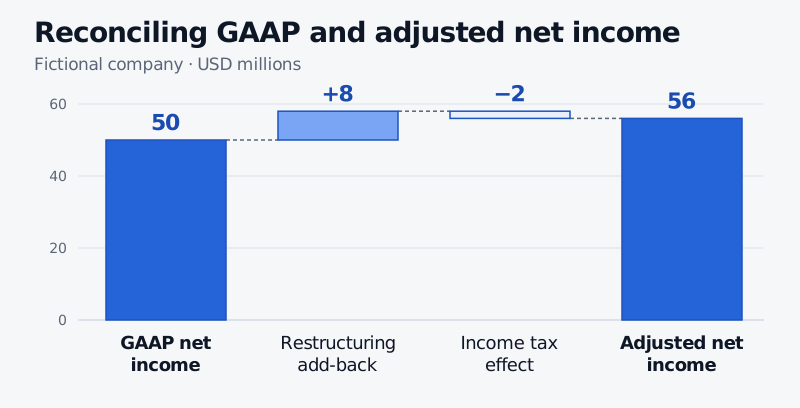
The issuer reverses 8 of expense before tax. The benefit to the adjusted bottom line is 6 after tax.
SEC staff guidance calls for a separate, explained tax adjustment, with current and deferred income tax expense consistent with the adjusted profitability measure. The adjustment here is to after-tax net income. An adjusted EBITDA bridge also changes the treatment of interest, taxes, depreciation and amortisation. SEC staff, Q102.11 and Q103.01
What to check in the release
For covered U.S. public disclosures of material information that includes a non-GAAP measure, Regulation G calls for the closest GAAP measure, a quantitative bridge for historical figures and an overall presentation that avoids misleading investors. Item 10(e) adds requirements for SEC filings. Under Item 10(e)(1)(i), the GAAP comparator gets at least equal prominence and management explains why it considers the adjusted figure useful. Form 8-K Item 2.02 applies those requirements to earnings releases furnished under that item. Regulation G, § 244.100, Regulation S-K, Item 10(e), Form 8-K, Item 2.02, Instruction 2
Read across releases for recurring restructuring costs, changes in adjustment policy and similar gains left in earnings. SEC staff says excluding ordinary cash operating costs needed to run the business can mislead, even when those expenses recur irregularly. In filings, Item 10(e) also restricts calling an excluded item unusual, infrequent or non-recurring if a similar item occurred in the past two years or the item is reasonably likely to recur in the next two. A clearly labelled bridge still needs a defensible adjustment. Regulation S-K, Item 10(e)(1)(ii)(B), SEC staff, Q100.01–100.03, Q100.06 and Q102.03
Article 11 asks what the transaction would have changed
Regulation S-X Article 11 requires pro forma financial information for specified events, including certain significant acquisitions and disposals. The ordinary presentation starts with historical financial statements and shows the effect of applying the required transaction accounting as if the deal had occurred on the dates assumed for the pro forma presentation. That can include a change in amortisation following a purchase price allocation. When applicable, a separate column depicts the registrant as a standalone entity. If management elects to show qualifying estimates of synergies and their related offsets, it reconciles them in the explanatory notes. Item 10(e) bars non-GAAP measures from the face of required Article 11 pro forma financial information. Regulation S-X, § 210.11-01 and § 210.11-02, Regulation S-K, Item 10(e)(1)(ii)(D)
Ligand Pharmaceuticals illustrates both uses of adjustments. Its second-quarter 2026 earnings release reconciles Ligand’s own GAAP net income to adjusted net income, including adjustments for share-based compensation and a separate line for the tax effects of reconciling items. Its separate XOMA merger exhibit presents combined historical operations as if the merger had already taken place, with columns for the two companies and the transaction accounting adjustments. Ligand Q2 earnings release, Adjusted Financial Measures and reconciliation, Ligand–XOMA merger exhibit, combined statements and Note 1
For an earnings-surprise dataset, record the basis with each actual and forecast. If the forecast is for adjusted diluted earnings per share, check that the actual matches the period, adjustments and share basis before calculating the surprise. The SelfMadeQuant lesson works through how forecasts and reported earnings become event-study labels. Event Definition (full lesson for members)
Sources
- Regulation G, 17 CFR § 244.100
- Regulation S-K, Item 10(e)
- SEC Form 8-K, Item 2.02
- SEC staff interpretations on non-GAAP financial measures, last updated 13 December 2022
- Regulation S-X, Article 11 presentation requirements and preparation requirements
- Ligand Pharmaceuticals, second-quarter 2026 earnings release and Ligand–XOMA merger exhibit