Serial restructuring charges are expenses for reorganising a business that reappear across reporting periods. They can arise from phases of one plan or from new plans that incur similar costs. If each round is excluded from adjusted earnings, a forecast based on that measure can overstate ongoing profit when the business keeps incurring those costs.
Three years of charges and cash payments
A fictional company recognises severance of 10, 12 and 8 million USD in three consecutive years on the same reporting basis. Those charges reduce GAAP operating profit. The company starts with zero restructuring liability, pays 6, 11 and 10 million USD across those years and has no changes in estimates or non-cash settlements. The year-end liability is the amount already charged that the company still owes.
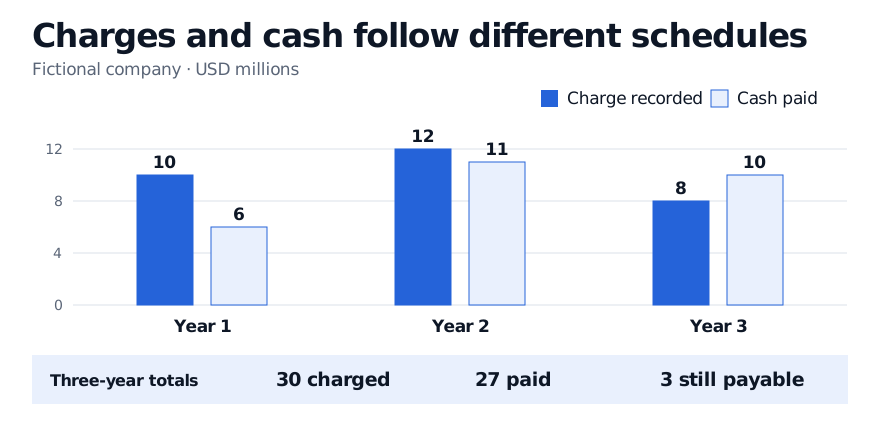
Year 3 cash payments exceed the new charge because part of the cash settles earlier severance.
If all three charges are added back to GAAP operating profit, the resulting adjusted operating profit is 30 million USD higher across the three years. Adding them back to EBITDA instead would raise EBITDA by the same amount in this severance-only example. EBITDA already reverses depreciation and amortisation, so check for overlap if a restructuring line includes accelerated depreciation. A bridge to adjusted net income also needs the associated tax effect. Track cash paid and the outstanding liability separately from either earnings bridge. SEC staff, Q102.11 and Q103.01–103.02
Follow the plan through the filings
- Match the plans. Compare the announcement, operations affected and expected end date. A continuing plan can produce fresh charges or payments against old liabilities. Separate plans can involve similar cuts to the same business. Under U.S. GAAP ASC 420, an in-scope exit cost liability is recognised when the company incurs the obligation. Commitment to a plan alone falls short of that threshold. FASB ASU 2024-02, Issue 9
- Trace the cash. Use the footnote to reconcile the opening and closing liability. Identify actual payments, changes in estimates and any non-cash settlements. Keep non-cash charges, such as asset impairments, separate when estimating cash needs. C.H. Robinson 2025 Form 10-K, Note 14
- Read the reconciliation. Match the period, segment and costs covered by each exclusion. Check whether similar costs and related gains receive consistent treatment. If similar new plans keep generating costs, use that history when estimating ongoing expenses. If one plan has a credible end date, forecast the remaining payments separately from the post-plan cost base. SEC staff, Q100.01–100.03
C.H. Robinson's 2025 Form 10-K shows cash payments in 2025 for both its completed 2024 plan and its newer 2025 plan, with separate liability reconciliations. Its September 2026 Form 10-Q still tracks charges and payments under the 2025 plan. The Q3 earnings presentation has separate bridges to adjusted operating income and adjusted net income. Its adjustments also cover items beyond the restructuring plan, so match the definitions before comparing the tables. 2025 Form 10-K, Note 14, Q3 2026 Form 10-Q, Note 13, Q3 2026 earnings presentation, slides 29–30
What the SEC rules distinguish
For covered public disclosures of material information, Regulation G calls for the closest GAAP comparator, a quantitative bridge for historical figures and a presentation that avoids misleading investors. In SEC filings, Item 10(e) restricts excluding an item described as non-recurring, infrequent or unusual from a performance measure if a similar charge or gain occurred in the prior two years or the item is reasonably likely to recur within the next two years. Regulation G, § 244.100(a)–(b), Regulation S-K, Item 10(e)(1)(ii)(B)
SEC staff distinguishes the label from whether an exclusion is permissible. The exclusion still has to satisfy the other applicable requirements. Staff gives normal cash operating costs that recur, even at irregular intervals, as an example of an exclusion that can mislead. The recurring severance in the fictional example is a reason to examine the cost and the basis of the add-back. SEC staff, Q100.01 and Q102.03