A non-cash charge reduces earnings without itself moving cash. A non-cash add-back reverses a charge already deducted from the starting earnings figure. On the indirect cash flow statement, that reversal helps reconcile earnings to cash from operations (CFO). In a valuation, the same charge can point to equipment the company must replace or compensation it pays in equity. FASB, ASC 230-10-45-28 as reproduced in ASU 2016-14
From 50 of earnings to 63 of operating cash
A fictional company using U.S. GAAP reports net income of 50 currency units after 15 of depreciation and amortisation (D&A) and 6 of equity-settled stock-based compensation. Operating receivables rose by 8 solely because of sales and collections. With no other reconciling items, the indirect calculation is
The two expenses reduced net income and involved no cash payment in the period, so the bridge reverses them. The receivables increase comes from accrual timing. Recorded sales exceeded customer collections by 8, so the bridge subtracts 8. A cash bonus accrued this period and paid next period also creates a timing difference. Its eventual payment reduces operating cash flow. FASB, ASC 230-10-45-28
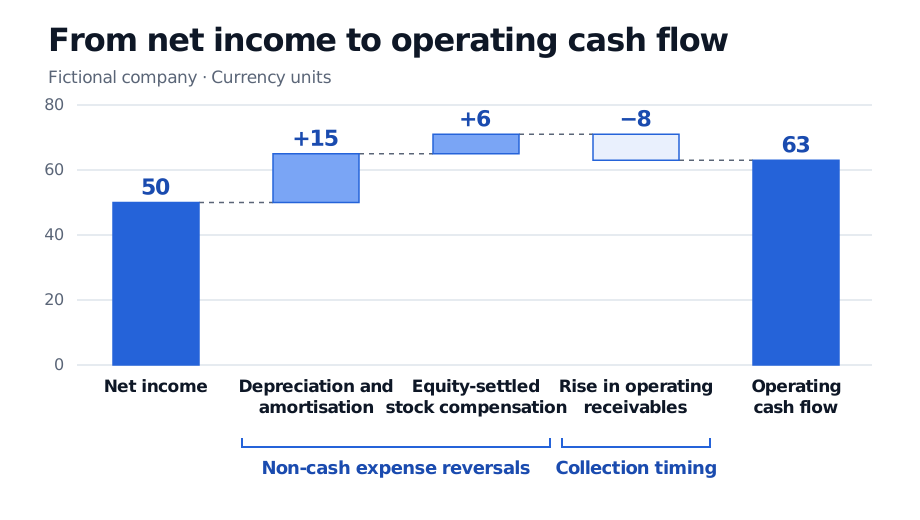
The two add-backs lift the running total to 71 before collection timing brings it down to 63.
Some bridge adjustments remove items whose cash belongs in another section. If an equipment sale produces a gain included in net income, subtract the gain from the operating bridge and show the full cash proceeds in investing. A loss on the sale would go back into the operating bridge as a positive adjustment for the same classification reason. FASB, ASC 230-10-45-28, ASC 230-10-45-12(c)
Check the starting line before rebuilding a reconciliation from a filing. The example uses net income under U.S. GAAP. When an IFRS reporter applies IFRS 18, the amended IAS 7 bridge starts at operating profit or loss. IFRS 18 applies to annual periods beginning on or after 1 January 2027, with early application permitted. IFRS Foundation, IAS 7 amendment history, IFRS 18 effective date
What to carry into the forecast
If you start from reported CFO, the D&A reversal and receivables adjustment are already in the total. Applying either again counts it twice. Forecast cash capital expenditure separately when estimating free cash flow. D&A allocates historical asset costs. Future replacement spending depends on what the business needs to keep operating and what those assets will cost. Damodaran, Valuation, capital expenditure and depreciation
Equity-settled stock compensation uses part of the shareholders’ claim to pay employees. In a discounted cash flow model, one approach is to keep the cost of future grants in forecast operating expenses and account separately for outstanding awards when valuing existing shares. If you capture future grants through an explicit dilution model, avoid also deducting the same grants in the cash flow forecast. Damodaran, Employee Options, Restricted Stock and Value, slides 11–17 and 28
For adjusted EBITDA, read the issuer's reconciliation and ask whether each exclusion helps measure the recurring business. Plain EBITDA already removes D&A. Stock compensation can recur even when paid in shares, and a cash restructuring cost can recur at irregular intervals. Compare the exclusions with prior periods and check whether similar gains and charges receive the same treatment. U.S. SEC staff guidance identifies exclusion of normal, recurring cash operating costs as an example of a potentially misleading non-GAAP performance measure. SEC staff, Non-GAAP Financial Measures, Questions 100.01–100.03 and 103.01
Read the bridge before scoring the gap
In Microsoft's filing for the quarter ended 30 September 2026, the stock compensation add-back appears above the changes in operating assets and liabilities. Accounts receivable contributes positively to the cash bridge that quarter, the opposite sign from the fictional example. When a filing screen flags a gap between profit and cash, check which lines moved and whether the same pattern appears in comparable periods. Microsoft Form 10-Q, Cash Flows Statements
The SelfMadeQuant filing monitor uses year-to-date net income less CFO, scaled by assets, as one accrual feature in a filing review screen. Section 4.5 gives the calculation. Financial Filing Change and Deterioration Monitor (full report for members)
Sources
- FASB ASU 2016-14, ASC 230-10-45-28 and 45-29 and FASB ASU 2016-15, ASC 230-10-45-12(c)
- IFRS Foundation, IAS 7 Statement of Cash Flows and IFRS 18 Presentation and Disclosure in Financial Statements
- SEC staff, Non-GAAP Financial Measures
- Aswath Damodaran, Valuation and Employee Options, Restricted Stock and Value
- Microsoft, Form 10-Q for the quarter ended 30 September 2026