Accrual accounting recognises revenue when earned and expenses when incurred under the applicable recognition rules, even if payment happens in another period. Cash accounting generally records income when received and expenses when paid. A profitable month can therefore produce zero operating cash flow, and a later cash receipt can come from work already counted in earnings. IFRS Conceptual Framework, §§1.17–1.20 · IRS Publication 583, “Choosing an Accounting Method”
The work, the bill and the payment
A fictional business completes a service in March and has an unconditional right to USD 100. The customer pays in May. The business uses USD 70 of subcontractor services on that same job in March, then pays the subcontractor in April. Assume both bills are settled in full. There are no other transactions, taxes or inventory. For customer contracts under IFRS 15, revenue recognition follows the transfer of the promised goods or services. The service in this example is fully delivered within March. IFRS 15, public overview
- March. The accrual income statement records USD 100 of revenue and USD 70 of expense, leaving USD 30 of profit. The balance sheet records a USD 100 receivable and a USD 70 payable. Neither bill has been settled, so both the simple cash-basis result and operating cash flow are zero.
- April. Paying USD 70 clears the payable and reduces cash. April accrual profit is zero because March already included the expense. On a simple cash basis, April records a USD 70 expense.
- May. Collecting USD 100 clears the receivable and increases cash. May accrual profit is zero because March already included the revenue. On a simple cash basis, May records USD 100 of revenue.
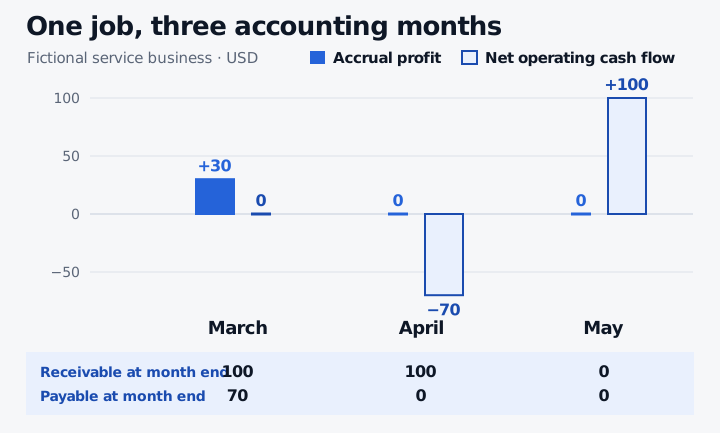
The unpaid balances connect March's accrual profit to the cash that moves in April and May. Bars show monthly amounts and the balances are measured at month end.
Over all three months the job contributes USD 30 of accrual profit and USD 30 of net operating cash flow. The business still needs USD 70 on hand in April, before the customer pays.
How accrual statements show cash
The accounting basis determines when the business recognises income and expenses. The statement of cash flows reports how cash and cash equivalents changed during the period, including operating, investing and financing cash flows. An accrual set of financial statements can show both March profit and the separate April and May cash movements. IAS 7, public overview
In this example, profit and operating cash flow differ only because of the two unpaid balances. Let be accrual profit and let and be the changes in receivables and payables from the start to the end of the month. The reconciliation is
In March, the reconciliation gives 30 − 100 + 70 = 0. In April, the payable falls by 70, taking cash flow to −70. In May, the receivable falls by 100, bringing cash flow to +100. An actual indirect cash flow statement can require other adjustments, such as adding back depreciation. SEC, Beginners’ Guide to Financial Statements, “Operating Activities”
For company analysis, compare earnings and operating cash flow over the same period. If profit rises while operating cash flow stays flat, rising receivables can show that some of the sales are still uncollected. Check the size of those balances and when they turn into cash before interpreting the gap as a lasting change in cash conversion.