Revenue recognition is the accounting process that determines how much revenue a business records and in which reporting period. For customer contracts in scope of IFRS 15 or US GAAP ASC 606, the business recognises the amount attributable to a promised good or service when or as the customer obtains control of it. Invoicing and collection follow their own schedules. A change in when customers pay can change near-term cash flow without changing the sales an analyst forecasts for the quarter. IFRS 15, paragraphs 31–38 and 105–108 · FASB review of Topic 606, Appendix A
One payment, three months of service
A help desk charges USD 90 up front to be available for three months. Assume the contract qualifies under IFRS 15, the promise is continuous access to support, and the customer benefits evenly over the three months, even if they never open a ticket. Elapsed time therefore measures progress in this contract. A contract with uneven service benefits could call for a different measure. IFRS 15, paragraphs 26(e), 35(a) and 39–41 · FASB staff Q&A, question 49
The customer pays just before coverage begins. The help desk records USD 90 of cash and a USD 90 contract liability for the service it still owes. Revenue is zero at that instant. At the end of month one, the income statement shows USD 30 of revenue from this contract and the balance sheet shows a USD 60 liability for the two months of service still owed. IFRS 15, paragraph 106
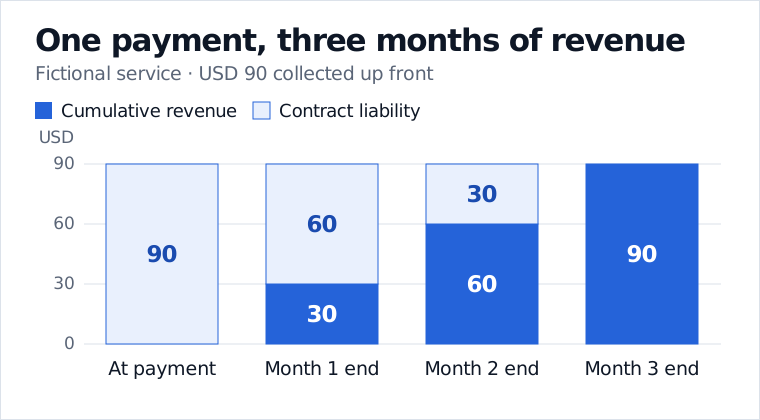
As each month of service is delivered, USD 30 moves from the contract liability to revenue. The customer makes a single payment at the start.
Reading reported sales
Start with the revenue policy in the filing. A seller that transfers control at handover records revenue at that point. A seller that transfers control over time uses a measure that reflects progress. Percentage-of-completion revenue explains how that measurement works on a project that qualifies for over-time recognition. Gross versus net revenue addresses a separate question. When another party is involved, does the seller report the sale amount as principal or its fee for arranging the sale as agent? IFRS 15, paragraphs 38–41 and B34–B36
In a forecast, model when the service is delivered separately from when invoices come due and cash is collected. Use the contract-balance notes to see how much reported revenue came from opening contract liabilities and why those liabilities changed. New advance billings or payments can replenish the balance as the business recognises revenue from older contracts. IFRS 15, paragraphs 116–119