Percentage-of-completion revenue recognition records revenue as a customer contract obligation is satisfied, in proportion to a measure of progress. Under IFRS 15 and ASC 606, the current terminology is revenue recognition over time using an appropriate measure of progress. The older label comes from construction accounting under guidance such as the superseded IAS 11. For an analyst forecasting sales, the choice of progress measure matters because a change in estimated cost to finish can move reported revenue with no change in the contract price or collections. IFRS Foundation, IAS 11 · IFRS 15, paragraphs 35–45 · FASB, ASC 606-10-25-27 to 25-37
When the obligation qualifies
An obligation is satisfied over time if the customer receives and uses the benefits as the supplier performs, controls the asset as the supplier creates or enhances it, or meets a third test with two parts. For that third test, the asset must have no alternative use to the supplier, and the supplier must have an enforceable right to be paid for performance to date. If none of these tests is met, the supplier recognises revenue at the point in time when control passes. IFRS 15, paragraphs 35–38 · FASB, ASC 606-10-25-27 to 25-30
A fictional engineering firm agrees to design and build one integrated test rig for a customer's factory. The rig is built to the customer's specifications and cannot be redirected to another buyer without significant rework. If the contract ends at any point for a reason other than the firm's failure to perform, the firm has a right under the contract and applicable law to recover the cost of the work done plus a reasonable profit margin on that work. Those facts satisfy the third test. Assume a qualifying customer contract and one performance obligation. IFRS 15, paragraphs 36–37 and B6–B13 · FASB, ASC 606-10-55-8 to 55-15
From costs to this period’s revenue
The firm can reasonably measure progress. It uses cost-to-cost, an input method, because eligible engineering and fabrication costs track the work transferred. Expected total eligible cost includes costs incurred so far and the eligible cost still expected to finish the job. An output method, such as a survey of work performed, can also be appropriate if it faithfully depicts transfer. The firm uses one method for the obligation and applies it consistently to similar obligations in similar circumstances. IFRS 15, paragraphs 39–45 and B14–B19 · FASB, ASC 606-10-25-31 to 25-37 and 55-16 to 55-21
All amounts below are in USD thousands. The fixed transaction price is 800, with no significant financing component. Eligible costs incurred to date are 200 out of 500 expected in total. This example needs no adjustments for waste or other inputs that distort progress.
The firm had already recognised 120 by the prior close, so only the increase goes into this period's sales. Suppose 250 has been invoiced and is unconditionally payable, and 180 of that has been collected. That leaves a receivable of 70. Under the regular billing terms, payment for the remaining 70 of recognised revenue depends on reaching a further milestone, so that amount is a contract asset. If a contract contains a significant financing component that must be accounted for, the firm adjusts the transaction price for financing and presents the interest separately from customer revenue. IFRS 15, paragraphs 60–65 and 105–108 · FASB, ASC 606-10-32-15 to 32-20 and 45-1 to 45-4
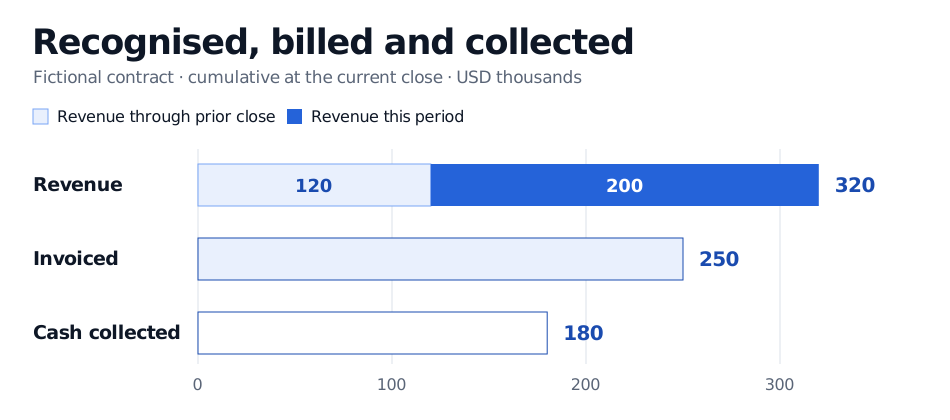
The gap from revenue to invoices is a contract asset in this example. The gap from invoices to collections is a receivable.
When the estimate changes
Suppose the firm learns before closing the same period that the remaining eligible work will cost more. With expected total eligible cost revised to 640 and eligible costs incurred still at 200, progress falls to 31.25%. Cumulative revenue falls to 250, so current-period revenue is 130 after subtracting the 120 already recognised. This cumulative catch-up reduces current-period revenue by 70 relative to the original estimate. The prior period stands because this is new information about the cost to finish. IFRS 15, paragraphs 40, 43 and 118(b) · FASB, ASC 606-10-25-32 and 25-35
More spending can also overstate progress. Unexpected waste that does not depict performance is excluded from the progress measure. An early transfer of an expensive component can need a different adjustment. For example, under specified conditions a seller recognises revenue equal to the cost of a non-distinct third-party component when the customer obtains control well before installation, and removes that component from the cost-to-cost calculation. When comparing reported revenue across companies, read the footnotes for the progress measure and significant changes in estimates. IFRS 15, paragraphs B19 and 123–124 · FASB, ASC 606-10-55-21 and 55-184 to 55-192
Sources
- IFRS Foundation, IFRS 15 Revenue from Contracts with Customers
- FASB Accounting Standards Codification, Topic 606 is the US GAAP standard. ASU 2014-09, Section A contains the original amendment text for the cited sections.