From the contract to reported sales
- Identify the contract with the customer. Check that both parties have approved the arrangement and are committed to it, each party's rights and payment terms can be identified, and the arrangement has commercial substance. Collection of substantially all the consideration the seller expects to be entitled to for the goods or services it will transfer must be probable. FASB, ASC 606-10-25-1 as amended by ASU 2016-12
- Identify the performance obligations. A performance obligation is a promise the seller accounts for separately, such as a promise to transfer a distinct good or service. A promised item is distinct when the customer can benefit from it on its own or with readily available resources and the promise is separately identifiable in the context of the contract. If a seller significantly integrates several items into one promised output, it may have to account for them together. A qualifying series of distinct items with the same transfer pattern also counts as one obligation. FASB, ASC 606-10-25-14 through 25-22 and ASU 2016-10
- Determine the transaction price. Estimate what the seller expects to be entitled to for transferring the promised goods or services. For a variable amount such as a bonus, include only the portion for which it is probable that cumulative recognised revenue will avoid a significant reversal when the uncertainty is resolved. FASB, ASC 606-10-32-2 through 32-13
- Allocate the transaction price. Normally each obligation receives a share proportional to its standalone selling price at contract inception. This is the price the seller would charge for the item separately. Specific criteria can direct a discount or variable amount to one obligation or a subset. FASB, ASC 606-10-32-28 through 32-41
- Recognise revenue when or as each obligation is satisfied. If the obligation meets an over-time criterion, recognise its allocated amount using a measure of progress that reflects the transfer. One such criterion is that the customer receives and consumes the benefits as the seller performs. Otherwise, recognise the allocated amount at the point when the customer obtains control. FASB, ASC 606-10-25-23 through 25-37
One scanner, sixty days of support
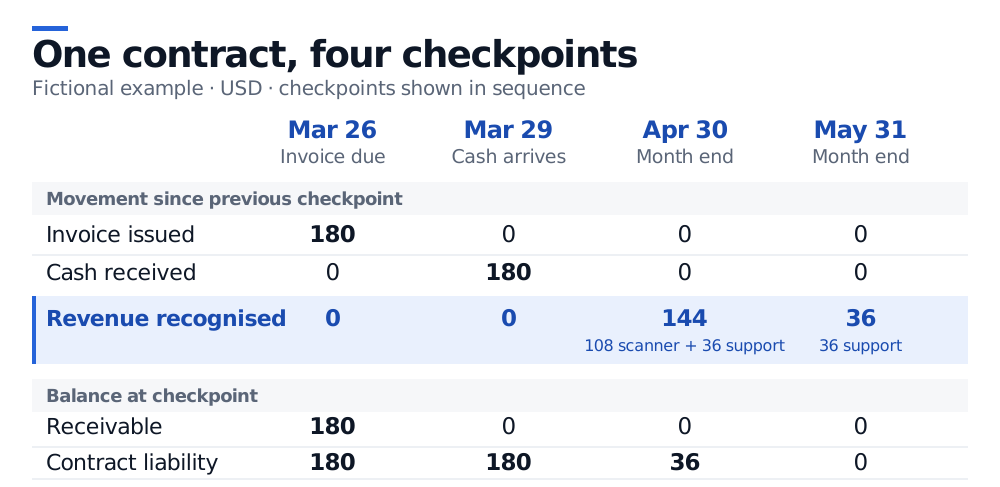
In a fictional qualifying contract, a supplier sells a standard scanner and 60 days of help-desk coverage for a fixed USD 180. The customer can use the scanner independently and can use the support with compatible equipment it already owns. The supplier promises each separately and performs no significant integration or customisation. Stipulate two distinct performance obligations with observable standalone selling prices of USD 120 for the scanner and USD 80 for support. Assume no other consideration, financing adjustment or allocation exception.
The total standalone price is USD 200. The scanner accounts for 60% and support for 40%, so the USD 20 bundle discount is shared in those proportions. The resulting allocations, in USD, are
The customer takes control of the scanner on April 1. The supplier recognises the entire USD 108 scanner allocation that day. Coverage runs from April 1 through May 30. Assume the customer benefits evenly from daily access to the help desk as the supplier makes it available, so elapsed days depict progress. April has 30 covered days and May has 30, earning USD 36 each month. Total revenue is USD 144 in April and USD 36 in May.
What to look for in a filing
Sources
- FASB Accounting Standards Codification, Topic 606 is the US GAAP standard. The original FASB update and the 2016-10 and 2016-12 amendments show how the cited paragraphs were introduced and clarified.
- SEC Staff Accounting Bulletin No. 116 explains that the SEC staff's legacy Topic 13 guidance ceased to apply to a registrant upon adoption of ASC 606.