Distinguish amounts invoiced, unearned revenue on the balance sheet and contracted revenue still to be recognised.
Deferred Revenue, Billings and RPO
Deferred revenue, also called unearned revenue, is a contract liability for goods or services the company still owes when the customer has already paid or payment is already due. Billings are amounts invoiced during a period. An issuer may also report calculated billings using its own definition. Remaining performance obligations (RPO) measure the transaction price allocated to goods or services still to be transferred under existing contracts, including the unfinished portion of work already underway. Reported RPO can include amounts the company will invoice later and can exclude amounts under disclosure exemptions. These measures separate the billing schedule from how much contracted work remains to earn as revenue. FASB, Topic 606 presentation and disclosure, IFRS 15, paragraphs 105–109 and 120–122.
Under the ASC 606 five-step model, the company estimates the consideration it expects to be entitled to for transferring the promised goods or services. It generally allocates that transaction price using relative standalone selling prices, then recognises revenue when or as it satisfies each obligation by transferring control. If an advance payment becomes due before delivery, the seller can record a receivable alongside the contract liability. Collecting it clears the receivable. Delivering the goods or services releases the liability into revenue. FASB, ASC 606-10-25, 32 and 45.
One contract, three numbers
A fictional company signs a noncancellable 24-month service contract for USD 10 per month. The customer receives the same service each month, so the company recognises USD 10 per month. It invoices and collects USD 120 at signing for the first year and will invoice the other USD 120 at the start of year two. The full USD 240 is the transaction price for one performance obligation. Assume no significant financing component, other contracts, changes in terms or disclosure exemptions.
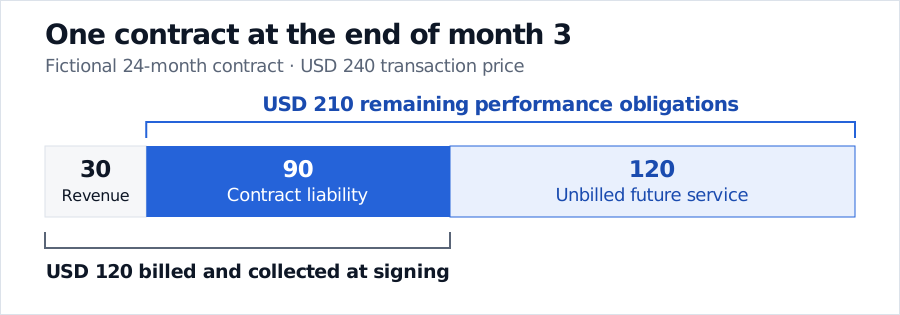
At the end of month three, the company has billed and collected USD 120 and recognised USD 30. Of the first invoice, USD 90 still relates to future service and sits in deferred revenue. The company also owes a second year of service for which the invoice is still to come. In USD,
Deferred revenueRPO=120−30=90,=90+120=210.
Fictional USD 240 contract at the end of month three. Recognised revenue is USD 30. Remaining performance obligations of USD 210 consist of USD 90 deferred revenue and USD 120 of unbilled future service. USD 120 was billed and collected at signing.
The company has already billed the first two portions of the bar. The last two portions are the service it still owes.
If the seller instead invoiced and collected at the end of each month as it completed that month's service, billings through month three would be USD 30 and deferred revenue would be zero. Revenue would still be USD 30 and RPO would still be USD 210. The change in invoice timing leaves the price and service schedule intact in this example.
Some issuers have used revenue plus the change in deferred revenue as a proxy for amounts invoiced. That calculation gives USD 120 in the upfront case because the opening liability is zero and the only changes are the invoice and the delivery of service. Acquired deferred revenue can move the liability without a new invoice. Revenue recognised ahead of invoicing can move a contract asset instead. Fortinet's FY2024 calculation excludes acquired deferred revenue, while Box's April 2026 filing also takes movements in contract assets into account. Fortinet FY2024 Form 10-K, Billings, Box Form 10-Q for April 2026, Billings.
Read the recognition window and the exclusions
When the RPO disclosure applies, the notes report the amount as of the reporting date and explain when the issuer expects to recognise it. For example, at 30 June 2026 Microsoft reported USD 75.712 billion of unearned revenue and USD 684 billion of total RPO. It expected to recognise about 30% of that RPO over the next 12 months. The near-term portion helps anchor a revenue forecast. A rise in the total by itself could reflect contracts that run for longer. A forecast still needs assumptions for new contracts and renewals outside the disclosed balance. Microsoft FY2026 Form 10-K, Note 12.
Check the scope before comparing those reported figures across issuers. ASC 606 and IFRS 15 let companies omit obligations from contracts originally expected to last a year or less. A customer prepayment on one of those contracts can therefore contribute to deferred revenue while the obligation is omitted from reported RPO. Both frameworks also have disclosure relief when the issuer recognises revenue using the right-to-invoice practical expedient, where the right to payment tracks the value of work completed to date. ASC 606 limits that disclosure exemption to variable consideration and provides separate exemptions for specified royalties and certain variable amounts allocated entirely to wholly unsatisfied obligations or service units in a series. Constrained estimates of variable consideration sit outside the transaction price itself. FASB, ASC 606-10-50-13 through 50-15, as amended, IFRS 15, paragraphs 120–122 and B16.