When a third party helps fulfil an in-scope customer contract, the company reports gross revenue as a principal if it controls the specified good or service before the customer receives it. It recognises the full consideration it expects to be entitled to for providing that item. An agent arranges for another party to provide an item it does not control and recognises only its fee or commission as revenue. That distinction can put very different sales figures on the income statement for the same customer spend. IFRS 15, B34–B36 and FASB, ASU 2016-08
Identify the promise before judging control
Start with the customer contract. Identify the distinct good, service or bundle the customer has been promised. Then assess control before transfer for each item. A business can be the principal for its own installation service and the agent for a third party's equipment in the same contract, if these are distinct promises. This is the same distinctness question that arises when identifying performance obligations under the ASC 606 five-step model. IFRS 15, B34–B35A
Ask who can direct the use of the item and capture substantially all of its remaining benefits before transfer. A company can direct a subcontractor to provide a service on its behalf and still be the principal. Primary responsibility for fulfilling the promise, inventory risk and discretion over the price can all inform the judgment. Their weight depends on the contract. An agent can have pricing discretion or collect the customer's payment. IFRS 15, B35–B37A and FASB, ASU 2016-08, Example 45
In the IFRS Interpretations Committee's software reseller case, the specified good was the licence. The reseller had already given its advice before the contract began, and the customer had no reason to expect further advice under that contract. The Committee left the control judgment to the reseller based on the terms of the relevant contracts. IFRS Interpretations Committee, Software Reseller agenda decision
Two cabinet sales with the same payment
In both fictional cases, the customer pays the company USD 100 for a cabinet and the supplier receives USD 80. Assume the parties have fulfilled their obligations and settled all payments, with no other costs.
- Principal. The retailer buys the cabinet for USD 80, can redirect it to another buyer before delivery, and owes the customer a conforming cabinet. It controls the cabinet before delivery and records USD 100 of sales and USD 80 of cost of sales.
- Agent. The storefront arranges the sale, and the supplier controls the cabinet through to delivery and is responsible for supplying it. The storefront collects USD 100, passes USD 80 to the supplier and earns its agreed USD 20 fee. The USD 80 clears an amount owed to the supplier.
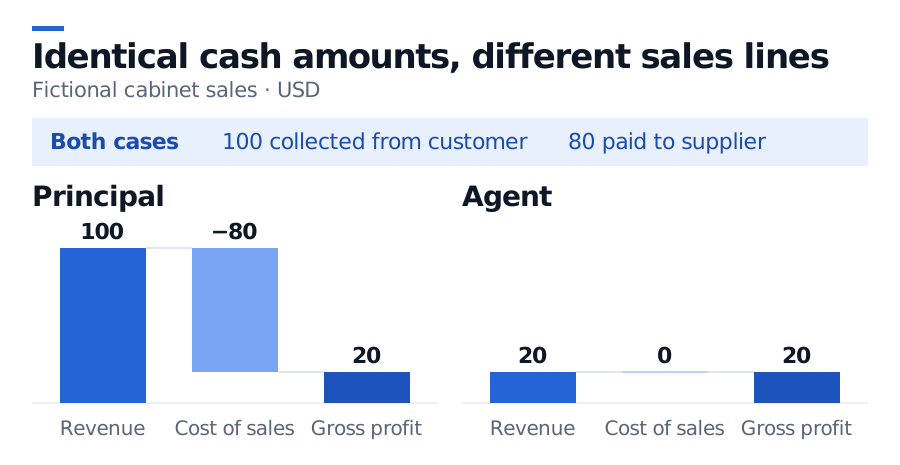
In the agent case, the supplier's share flows through the company and stays outside the income statement.
Both cases have USD 20 of gross profit. The principal's gross margin is 20% because reported sales are USD 100. The agent's is 100% here because its only revenue is the USD 20 fee and the example gives it no costs of its own. When comparing peers, check the revenue policy by business line. At the same enterprise value, the lower reported sales also produce a higher EV-to-sales multiple.