Stock-based compensation expense is the cost a company recognises for employee services paid for with shares, share options or other awards linked to its stock. An equity-settled award can reduce reported earnings without an operating cash payment. It can also affect diluted earnings per share through the share count. AASB 2, paragraphs 7–11.
The grant date sets the value, service sets the timing
Under Australia's AASB 2, an equity-settled employee award is normally measured using the award's fair value at grant date. If employees must serve for a specified period to earn the award, the company recognises the cost as they render that service. When the services are expensed as received, the accounting entry debits compensation expense and credits equity. Services that qualify for recognition as an asset follow the relevant asset accounting. AASB 2, paragraphs 7–15.
For an employee call option, grant-date fair value can be positive even when the share price equals the strike and immediate exercise would yield zero. Expected volatility, dividends and when employees are likely to exercise can affect that value. The SelfMadeQuant primer works through call payoffs above and below the strike (full lesson free with an account). AASB 2, Appendix B, paragraphs B4–B9, Options, Finance Primer.
One vesting date, three years of expense
A fictional company grants 1,000 equity-settled units on the first day of year one. Each unit has a grant-date fair value of 6 currency units (CU). All units vest together at the end of year three if the employees complete three years of service. The company expects all units to vest throughout the period, all do vest, and the company expenses the services as received. Assume straight-line recognition, no award modifications and no taxes.
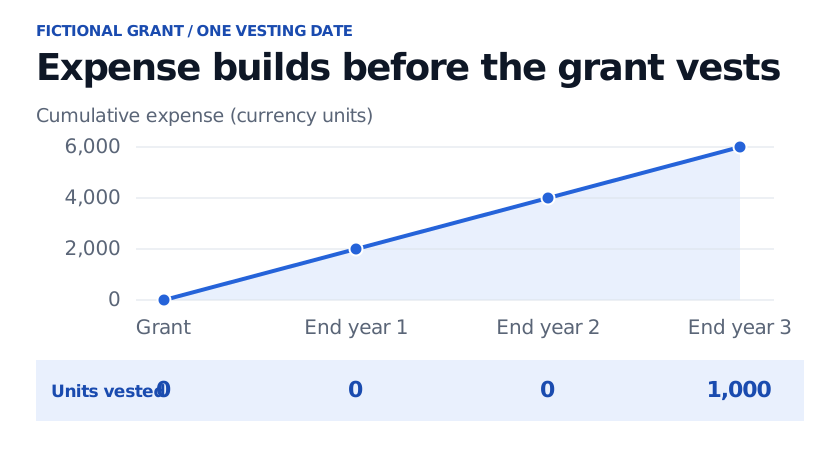
The company records expense throughout the service period. The units vest together once employees complete the third year.
A later share-price move leaves the 6 CU grant-date value per unit unchanged in this example. If employees leave before completing the service requirement, the company updates the number of units expected to vest and adjusts cumulative expense. A cash-settled award works differently. For example, a promise to pay cash based on share-price appreciation creates a liability whose fair value is remeasured at each reporting date and at settlement, with changes in profit or loss. AASB 2, paragraphs 19–23 and 30–33D.
Reading profit, cash flow and share count together
Profit and cash flow. In each year of the example, the 2,000 CU charge reduces profit. On an indirect cash flow statement, the company adds the 2,000 CU back in the reconciliation to operating cash flow because the charge involved no payment. The company still gave employees a claim on equity in exchange for their work. AASB 107, paragraphs 18–20.
Share count. Actual shares outstanding can increase at settlement, depending on how the company sources the shares it delivers. The denominator of diluted earnings per share can already reflect potential shares before delivery. For employee options with fixed or determinable terms, AASB 133 tests the options from the grant date and includes only the incremental shares that would be dilutive. In that test, assumed proceeds include the exercise price and the fair value of any remaining services. The number of units granted and the number of incremental shares in diluted EPS can therefore differ. AASB 133, paragraphs 36–48.
When a cash-flow forecast adds back recurring equity compensation, the per-share valuation still needs to reflect the claim that future awards give employees. Start with the share-based payment note for the expense, vesting terms and settlement method, and the EPS note for the reconciliation of basic and diluted share counts. AASB 2, paragraphs 44–51, AASB 133, paragraph 70.
Sources
The Australian compilations below apply to annual periods beginning in 2026.