Mining the footnotes and MD&A means extracting amounts, terms and explanations from financial statement notes and Management’s Discussion and Analysis, then tracing them back to the filing that disclosed them. A balance sheet can tell a credit analyst how much debt an issuer carries. The debt note can tell them how much principal comes due soon, and MD&A can explain where management expects to find the cash. Those distinctions turn financial statement data into inputs for a credit-risk model.
Follow the debt through the 10-K
Start with Item 8, which contains the financial statements and accompanying notes. Use the balance sheet to anchor the recorded amount, the debt note for principal, maturity dates and covenant disclosures, and a subsequent-events note for transactions after the reporting date. In US GAAP, ASC 470-10-50-1 calls for annual maturity and sinking-fund amounts for long-term borrowings for each of the next five years. Regulation S-X Rule 4-08(c) also calls for disclosure of specified uncured defaults or covenant breaches existing at the latest balance sheet date, and of the amount and waiver period when acceleration has been waived for a stated period. SEC Form 10-K, Item 8 · FASB ASU 2020-06, paragraph 12 · Regulation S-X Rule 4-08(c)
Then read Item 7, management’s account of liquidity, results and critical accounting estimates. Under Regulation S-K Item 303, look for material cash requirements in the next 12 months and beyond, financing sources and known trends or uncertainties reasonably likely to materially affect liquidity. The SEC removed the prescribed MD&A contractual obligations table in amendments effective in 2021. A filing can describe those cash requirements in prose or cross-reference a note, so a table-only search can miss them. Keep management’s expected funding sources separate from cash already raised. Regulation S-K Item 303(b) · SEC Release 33-10890, sections II.C.7 and II.F
One filing, three dates
A fictional issuer reports USD 200 million of debt principal at 31 December 2025. Its debt note puts 25 million in 2026, 75 million in 2027 and 100 million in later years. The simplified schedule covers the same instruments and currency as the total, with no interest or carrying-value adjustments. The buckets partition the 200 million already outstanding, and the next-12-month share is:
On 20 January 2026, the issuer sells USD 30 million of new notes. It first discloses the sale in the 10-K on 20 February at 21:20 UTC, both in a subsequent-events note and in MD&A. Record one financing event with two source locations. The sale is a new condition arising after year-end, so the December principal and its maturity schedule stay at 200 million. A later-date debt schedule needs the new instrument’s repayment terms and any intervening repayments. At a 31 January research cutoff, the January sale has occurred, but the filing-based feature has yet to become observable. Using the February text at that cutoff would introduce look-ahead bias. FASB ASC Topic 855, subsequent events · FASB’s predecessor standard, paragraphs 10–13
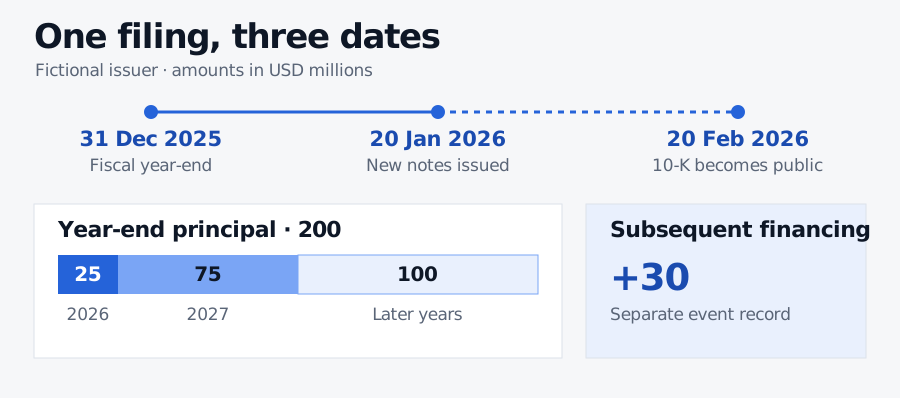
The maturity schedule measures December debt. The January financing enters the filing-based dataset when the February disclosure is available.
A real reconciliation. Apple’s fiscal 2025 Note 9 reports USD 91,281 million of term-debt principal. Subtract USD 309 million in net premium, discount and issuance-cost adjustments and USD 294 million in hedge fair-value adjustments to reach the carrying amount of USD 90,678 million, which matches the sum of the current and non-current term debt lines in Item 8. The USD 91.3 billion in Item 7 is the same principal rounded. Interest and commercial paper appear separately. EDGAR records the report period as 27 September 2025 and acceptance on 31 October 2025. Apple 2025 Form 10-K, Item 7 and Item 8, Note 9 · EDGAR filing detail
Keep enough information to reproduce each row
| Record | What to retain |
|---|---|
| Filing version | Issuer CIK, accession number, form, reporting period and original document URL. Keep amendments under their own accessions and apply them only once available. |
| Source location | Item, note or exhibit, table row and column or paragraph excerpt. Keep the raw text or value alongside the normalised result. |
| Economic meaning | Instrument or issuer scope, currency and scale, principal versus carrying value versus interest, and measurement date, maturity bucket or event date as applicable. |
| Availability | EDGAR acceptance timestamp with its time basis, and first observed public release or feed receipt when available. In a replay, apply the decision cutoff and any processing delay before using the feature. |
The SEC’s EDGAR data APIs are useful for locating submissions and entity-wide facts with standard tags. Inspect the actual filing for narrative, issuer-specific facts and instrument detail. Where a number is tagged, keep its concept, context, dimensions and unit and verify the table header and scale against the rendered filing. The SEC distinguishes the filing date from acceptance and says its public site supplies no first-availability timestamp. If acceptance is the only clock you have, record that proxy and use a conservative timing rule where the distinction could change the decision. SEC EDGAR API documentation · Regulation S-T Rule 405 · SEC EDGAR timestamp FAQ
SelfMadeQuant’s NLP Signal Validation lesson applies the availability rule to filing text and amendments. The preview is public and the full lesson requires membership. The Financial filing change and deterioration monitor is a member project that shows how a filing review queue handles section changes, amended filings and evidence excerpts.
Sources
- SEC Form 10-K, Part II, Items 7 and 8
- Regulation S-K Item 303 and SEC Release 33-10890
- Regulation S-X Rule 4-08
- FASB ASC 470-10-50-1, amendment in ASU 2020-06, FASB ASC Topic 855 and FASB Statement 165, historical source
- Apple fiscal 2025 Form 10-K and EDGAR filing detail
- Regulation S-T Rule 405, SEC EDGAR API documentation and SEC EDGAR timestamp FAQ