Fixed income is the family of debt investments whose contracts specify how interest and principal are to be paid. It includes bonds, bills, notes and loans. For an investor, the starting question is what the borrower owes, on which dates and under which conditions. Those terms determine what must be valued and which risks need managing.
The name does not mean that every payment amount is fixed. Floating-rate and inflation-linked debt belong to fixed income too. Nor does it mean that the market price stays constant, that income is guaranteed or that principal is risk-free.
A bond is an individual debt instrument. Fixed income is the broader investment family; the fixed-income market is the system through which debt is issued and traded. Buying ordinary debt makes the investor a creditor, whereas buying stock gives an ownership interest. The bondholder's payment claim comes from the debt contract, rather than a right to a share of the company's future profits.
Read “fixed” as a clue, then read the contract
The payment rule matters more than the category name.
| Form of debt | What the contract specifies | What can vary |
|---|---|---|
| Fixed-coupon bond | A coupon rate applied to the stated principal, payment dates and repayment terms | Market value; actual receipts if the issuer fails to pay or an embedded option is exercised |
| Zero-coupon bond | A maturity payment, with no periodic coupon | Market value; recovery if the issuer defaults |
| Floating-rate note | A reference-rate formula, spread and reset/payment rules | Coupon amounts as the reference rate resets, as well as market value |
| Inflation-linked bond | An indexation rule for principal, payments or both | Nominal receipts as the specified price index changes, as well as market value |
These descriptions are starting points. Amortising debt repays principal in installments; a callable bond may be redeemed early under its terms. Payment timing and contractual options can matter as much as the headline rate.
Real U.S. Treasury instruments illustrate the distinction. Treasury Floating Rate Notes pay interest using an index rate plus a spread. TIPS apply a fixed coupon rate to inflation-adjusted principal, so the nominal interest payment changes. Their specific rules should not be assumed to apply to every floating-rate or inflation-linked security.
One contract, two different percentages
Consider a synthetic two-year, fixed-coupon, non-callable bond with 1,000 currency units of face value. Its coupon rate is 4% annually, paid once per year. It repays all principal at maturity.
Assuming the issuer performs, the investor receives:
- Year 1: 40 of interest.
- Year 2: 40 of interest plus 1,000 of principal, for 1,040 in total.
Now value those remaining payments at a coupon date, with zero accrued interest. If the bond's yield to maturity is 5%, expressed as an annual effective rate, its price is
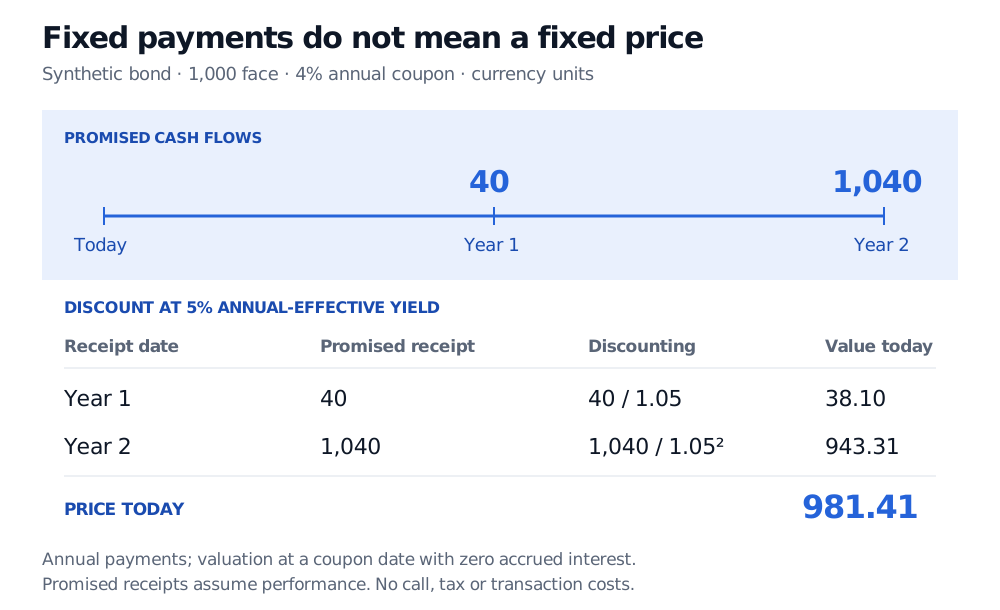
Original synthetic example, in currency units. Payments are annual; valuation is at a coupon date. Promised receipts assume performance; the example excludes calls, taxes and transaction costs. Values are rounded to two decimals.
The 4% coupon describes the contract relative to face value. The 5% yield relates the dated promised receipts to the price paid. They differ because the investor pays less than the 1,000 due at maturity. The final 1,040 receipt includes repayment of principal; treating all of it as income would count returned capital as earnings.
Yield to maturity summarises the price under a stated convention. It does not guarantee a realised compound return: payments may fail, the investor may sell early, and coupons may be reinvested at a different rate. SelfMadeQuant's Bonds and Yields lesson develops the calculation and distinguishes a single yield from maturity-specific discount rates. Its public page is a preview; the full lesson requires membership.
What a fixed-income analyst checks next
A payment schedule is the beginning of the analysis. For fixed promised receipts, a higher required yield means a lower present value. That is interest-rate risk, even when the issuer continues to pay exactly as promised. Duration is a common measure of that price sensitivity.
Other questions concern the receipts themselves. Credit risk concerns whether the borrower pays and what can be recovered after default. Inflation erodes the purchasing power of fixed nominal amounts. Liquidity affects the price obtainable when selling. Contractual options or principal repayments can change how long the investor remains exposed.
This is why an institution can use fixed income to plan around future liabilities while still needing careful risk management. Matching a liability requires attention to dates, currency, payment conditions and purchasing power—not just choosing something labelled “fixed income.”
Sources
- CFA Institute, Fixed-Income Instrument Features, 2026 public overview: loans, bonds, issuers and contractual features. The full curriculum reading has separate access requirements.
- Bruce Tuckman, Fixed Income Securities: Tools for Today's Markets, 2nd ed., Wiley, 2002, Chapter 1, pp. 3–7: dated bond cash flows and discount factors. The numerical example here is original.
- SEC Investor.gov, Bonds — FAQs: debt payments and credit, interest-rate, inflation, liquidity and call risks.
- U.S. Treasury, Floating Rate Notes and Treasury Inflation-Protected Securities: official examples of variable payment rules within fixed income.