A floating-rate note (FRN, or floater) is a bond whose coupon rate changes under a contractual rule tied to a reference rate. A common rule is reference rate plus a fixed margin. The investor's interest income adjusts as the reference changes, so a floater exchanges the certainty of a fixed coupon for income that follows its benchmark. It does not promise a constant market price.
Follow the fixing, not just the payment date
For a simple floater whose rate is fixed at the beginning of each accrual period and paid at its end,
where is the outstanding principal, is the reference rate fixed for that period, is the contractual margin, and is the accrual fraction from the specified day-count convention. The rates in this formula are annual simple rates written as decimals. The margin is added to the rate before calculating the cash payment; it is not added as a currency amount.
Consider a synthetic 1,000 USD face-value note with two quarters remaining. Each quarter has an accrual fraction of 0.25, with a 1% margin (100 basis points). The rate fixes at the start of each quarter; interest is paid at the end. Principal is repaid at month 6. Assume no default, caps, floors, fees or early redemption.
| Period | Reference fixed at its start | Annual coupon rate | Coupon received at its end |
|---|---|---|---|
| Month 0 to month 3 | 3% | 4% | USD |
| Month 3 to month 6 | 4% in this scenario | 5% | USD |
At month 0, the first 10 USD coupon is known. The second reference fixing is still unknown: 4% is a hypothetical later outcome, not information already available at month 0. Even if the benchmark rises before month 3, it does not rewrite the first coupon under this contract. At month 3, the holder receives 10 USD and the next quarter's coupon is set using the new fixing.
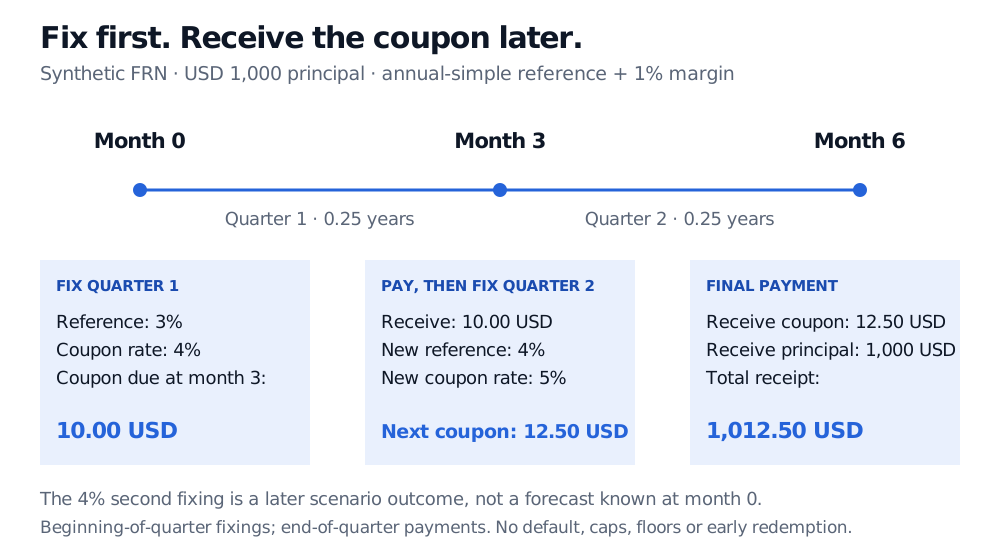
Original synthetic timeline, in USD per 1,000 USD principal. Each quarter has accrual fraction 0.25; beginning-of-quarter fixings determine end-of-quarter coupons. The second reference rate is a scenario outcome, not a forecast.
The final receipt is 1,012.50 USD, consisting of the last coupon plus principal. Total interest over the two quarters is 22.50 USD; returning principal is not additional interest income.
“Quarterly interest” does not tell you when the rate is known
The timeline is one convention, not a definition of every FRN. A note can accumulate daily overnight rates during the coupon period, so the full coupon is known only near its end, subject to its observation and payment rules. The BIS explanation of backward-looking and forward-looking rates distinguishes these mechanisms. A coupon compounded from realised overnight rates in arrears cannot simply be treated as a period-start fixing.
Reset frequency and payment frequency can also differ. For example, U.S. Treasury FRNs pay quarterly, while their index resets weekly with the 13-week Treasury bill auctions and interest accrues daily. Their spread is fixed for the security's life. Those are U.S. Treasury product terms; they are not the conventions used in the synthetic example above or universal requirements for floaters.
A changing coupon does not guarantee par
A floater's reset mechanism can reduce its interest-rate risk relative to a comparable fixed-coupon bond: when the reference rate rises, future coupons can rise too. But the contractual margin and the spread investors currently require are different quantities. If an issuer becomes less creditworthy, investors may require more compensation while the contract continues to pay the original margin. The price can then fall. A cap, a floor, a long wait until the next reset, or poor market liquidity can also matter.
Return to month 3 of the example, immediately after the 10 USD payment and the second fixing. Only 1,012.50 USD remains due in one quarter. If the market requires an annual simple return of 6% over that remaining quarter, the full price is
At a required rate of 5%, the same calculation gives 1,000 USD. The reset fixes the cash flow; it does not compel investors to accept the coupon rate as their required return. These are assumed discount rates for a synthetic single remaining payment, not observed market quotes. TreasuryDirect's pricing guide likewise states that an FRN's auction price can be above, below or equal to par.
The familiar reset-to-par result is an idealised valuation benchmark: a plain floater paying the same simple rate used by the model to discount it is worth principal immediately after a payment/reset, with compatible timing and no extra spread or options. Zero-Coupon Bonds, Market Rates, Swaps, and Conventions develops that single-curve benchmark and connects it to swaps. Its preview is public; the full lesson requires membership.
For an actual note, read the benchmark, margin, observation dates, accrual method, payment dates, cap/floor and redemption terms together. A floating coupon changes how interest is calculated; it does not remove the issuer's obligation to repay principal or the investor's exposure to credit risk.
Sources
- Frank J. Fabozzi, Bond Markets, Analysis, and Strategies, 9th edition (Pearson, 2016), Chapter 1, pp. 4–5, coupon reset formula and quoted margin; Chapter 2, p. 32, conditions for trading near par; Chapter 4, p. 70, floater spread sensitivity. The historical benchmark examples in that edition are not treated here as current market conventions.
- U.S. Treasury, Floating Rate Notes: index, fixed spread, weekly resets, daily accrual and quarterly payments.
- U.S. Treasury, Understanding Pricing and Interest Rates — Floating Rate Notes: FRN auction price versus par.
- Andreas Schrimpf and Vladyslav Sushko, BIS Quarterly Review, March 2019, Beyond LIBOR: a primer on the new benchmark rates, “Backward- vs forward-looking term rates”: the timing of compounded overnight rates versus forward-looking term fixings.