An inflation-linked bond is a bond whose contractual payments change with a specified price index. It helps an investor match liabilities that rise with inflation, rather than relying only on fixed nominal cash flows. The protection follows the contract's index and timing; it does not guarantee a stable market price or match every investor's living costs.
U.S. Treasury Inflation-Protected Securities (TIPS) provide a concrete example. Their principal is indexed to the non-seasonally adjusted U.S. City Average All Items CPI-U, and a fixed coupon rate is applied to that adjusted principal. Other inflation-linked bonds can use different indices, lags, payment structures and deflation provisions. Treasury's summary describes the U.S. contract.
A fixed rate can pay a changing amount
For a TIPS-style security, write for original face value, for the contractual index ratio at payment date , and for the fixed annual coupon rate. For a full semiannual coupon period,
The index ratio compares the reference CPI for the relevant date with the issue's base reference CPI. For actual TIPS, this is a daily calculation using lagged monthly CPI observations, distinct from the six-month coupon payment schedule. The reference CPI for the first day of a month uses the CPI for the third preceding month, with interpolation for other days. It does not use that day's observed consumer prices. Treasury publishes daily ratios; the Federal Reserve's mechanics discussion explains the lag.
Consider a synthetic bond with USD 1,000 original principal and a fixed 2% annual coupon rate. At a coupon date, stipulate an index ratio of 1.03. The adjusted principal is USD 1,030 and the semiannual coupon is USD 10.30. The 3% cumulative index increase has added USD 30 to the principal basis; it has not changed the coupon rate to 5% or created an immediate USD 30 cash distribution. Principal is paid at maturity.
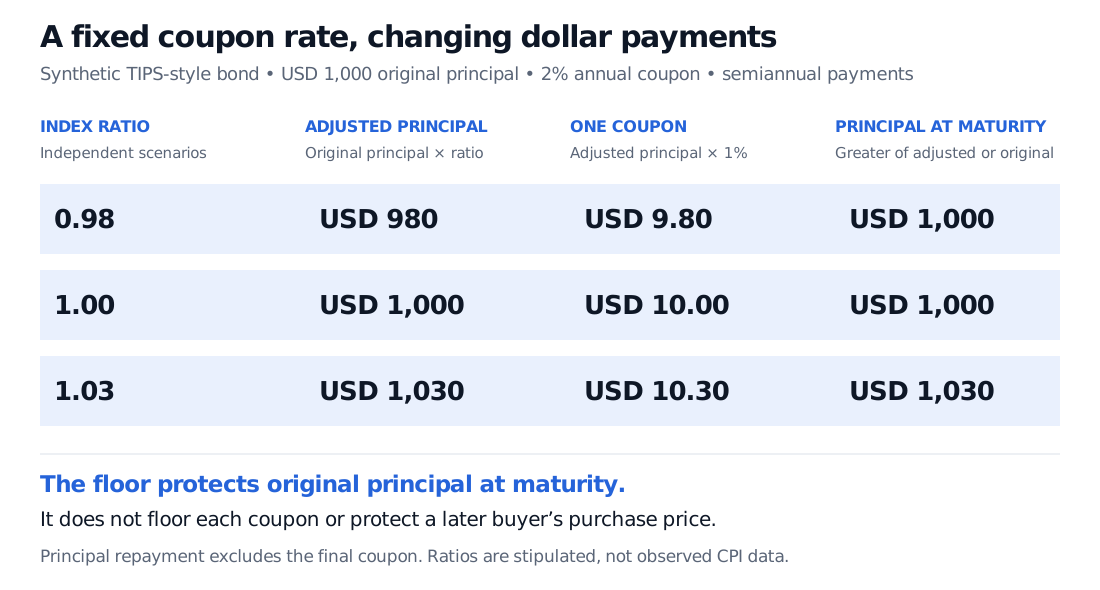
Original synthetic cash-flow comparison, not a CPI forecast or market quote. Each row is a separate index-ratio scenario. Principal redemption excludes the final coupon; assume payment in full, before fees and tax.
The maturity floor has a specific boundary
Actual U.S. TIPS repay the greater of inflation-adjusted principal and original principal at maturity:
At a maturity index ratio of 0.98, the example's adjusted principal is USD 980 but principal repayment is USD 1,000. The final coupon still uses adjusted principal: USD 9.80. The floor does not lift that coupon to USD 10.00. Treasury's TIPS terms distinguish the adjusted principal used for interest from the minimum principal repayment.
The floor refers to the security's original principal, not a later buyer's purchase price. Someone paying USD 1,080 for that USD 1,000 face amount does not obtain a USD 1,080 principal guarantee. The floor is USD 80 below that purchase outlay; this is a comparison of principal amounts, not a total-return calculation including coupons. Nor does the maturity floor set a minimum price when the bond is sold early.
Inflation protection still leaves valuation risk
The coupon rate describes the contract; real yield reflects the price paid for its remaining indexed payments. A higher required real yield can lower the market price even while indexation increases principal. Longer duration generally means greater sensitivity to yield changes. Bonds and Yields develops the cash-flow discounting behind this distinction (public preview; full lesson requires membership).
For portfolio construction, check what the protection actually matches:
- Index and dates: a CPI-linked payment may differ from a pension's wage-linked promise or a household's spending basket. Indexation lags also leave timing differences.
- Issuer and currency: indexation does not eliminate credit risk. A dollar TIPS payment also does not fix its value in another currency.
- Tax and cash timing: for U.S. federal tax purposes in a taxable account, inflation adjustments can generate taxable income before the principal is paid. Deflation adjustments and premium have specific rules; IRS Publication 1212 explains them. Treatment depends on the investor and account.
Comparing nominal and inflation-linked yields helps measure breakeven inflation. That comparison includes risk and liquidity premia as well as expected inflation; it is not a pure forecast. The Federal Reserve's TIPS yield-curve explanation sets out this interpretation.
Sources
- TreasuryDirect — Summary of Marketable Treasury Inflation-Protected Securities: index, fixed rate, semiannual interest and original-principal floor.
- TreasuryDirect — TIPS: principal, payments and maturity protection.
- TreasuryDirect — TIPS/CPI data: published daily index ratios.
- Gürkaynak, Sack and Wright — The TIPS Yield Curve and Inflation Compensation, Section 2: reference CPI lag, interpolation and coupon treatment.
- Federal Reserve Board — TIPS Yield Curve and Inflation Compensation: interpreting real yields and inflation compensation.
- IRS — Publication 1212, Inflation-Indexed Debt Instruments: U.S. federal tax mechanics.
- Frank J. Fabozzi and Francesco A. Fabozzi, Bond Markets, Analysis, and Strategies, 10th ed., MIT Press, 2021, Chapter 7, “Treasury Inflation Protection Securities,” ebook PDF file pages 235–237: indexed-principal and coupon mechanics.