A coupon is an interest payment specified by a bond contract. It is a cash amount, separate from repayment of principal. Identifying the coupon correctly lets an investor forecast income without mistaking a quoted interest rate for a return on the price paid.
Market descriptions often use “coupon” as shorthand for the coupon rate. Ask which quantity is meant: 30 USD per payment and 6% per year describe different things.
From a rate to a payment
Consider a fictional one-year bond with 1,000 USD face value, a fixed annual coupon rate of 6%, and two equal semiannual coupon payments. Principal remains unchanged until maturity. For this regular schedule,
The contract promises 30 USD at month 6 and another 30 USD at month 12. At month 12 it also promises to repay the 1,000 USD principal. The final receipt is therefore 1,030 USD, of which only 30 USD is a coupon.
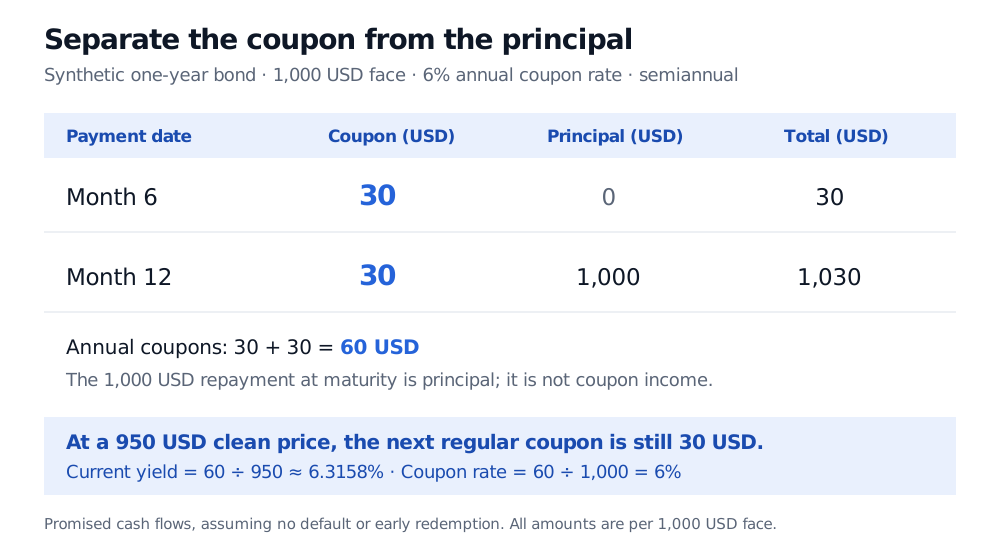
Original synthetic ledger, in USD per 1,000 USD face. These are promised payments assuming no default or early redemption. Principal is displayed separately from coupon income.
The amount scales with the face value held. Holding 5,000 USD face of this same bond gives 150 USD per regular payment and 300 USD of coupons over the year. It does not change the 6% rate.
The division by two belongs to this example's coupon frequency. For a short or long first period, or a contract using a different accrual rule, use its actual dates and day-count convention; do not assume every scheduled payment equals half the annual amount. As a concrete market example, TreasuryDirect describes fixed semiannual interest on ordinary U.S. Treasury notes and bonds.
A lower price does not rewrite the coupon
Suppose this same fixed-coupon bond has a clean price of 950 USD per 1,000 USD face. Its regular coupon is still 30 USD. Applying 6% to the 950 USD market price would use the wrong base.
The annual coupon amount of 60 USD divided by the clean price gives its current yield:
The coupon rate is still . Neither number is the yield to maturity, the discount rate that matches the price to the remaining dated coupons and principal under a stated compounding convention. Current yield leaves out the gain or loss between the purchase price and principal repayment, as well as payment timing. FINRA's yield guide distinguishes these measures.
For the next step from cash-flow schedule to valuation, Bonds and Yields introduces discount-factor pricing and YTM. Its preview is public; the full lesson requires membership.
Read the payment terms
A fixed coupon describes the contract, not a guarantee of receipt. Default can interrupt payment. A callable bond can stop paying future scheduled coupons if it is redeemed early according to its terms. Other contracts allow interest to be deferred or paid in kind rather than in cash.
Nor does every bond pay regular coupons. A zero-coupon bond has no periodic coupon payments. A floating-rate bond resets its rate according to a contractual formula, and an inflation-linked bond can have changing cash coupons because its principal is adjusted. A cash-flow forecast must therefore start with the instrument's actual payment rules.
Between payment dates, accrued interest may affect the amount a buyer pays at settlement. Paying that amount to a seller is distinct from receiving the issuer's next coupon; entitlement depends on the security's settlement and payment rules.
Sources
- Frank J. Fabozzi, Bond Markets, Analysis, and Strategies, 9th edition (Pearson, 2016), Chapter 1, pp. 4–5: principal, coupon rate, payment frequency and alternative interest structures.
- SEC Investor.gov, Corporate Bonds: coupon payments, fixed and floating interest, zero-coupon bonds and default risk.
- U.S. Treasury, Understanding Pricing and Interest Rates: interest on ordinary notes and bonds, TIPS principal adjustments and floating-rate notes.
- FINRA, Understanding Bond Yield and Return: coupon rate, current yield and YTM.