A callable bond gives its issuer the contractual right to redeem the bond before maturity at specified dates and redemption prices. The investor can therefore receive principal earlier than planned and lose the remaining coupon stream. A stated maturity and a fixed coupon rate do not guarantee that interest will continue until that maturity.
The issuer owns the option. The investor owns the debt and is short the embedded call: if the issuer validly exercises its right, the holder must accept redemption under the contract. This is different from the investor choosing to sell the bond in the secondary market.
Follow the payments before comparing yields
Consider an original synthetic contract with USD 1,000 face value, two years to maturity and a USD 60 annual coupon. It has just one early-call opportunity: the issuer may redeem for USD 1,000 immediately after paying the year-one coupon. Assume no default, fees or taxes.
| Investor receipts | Year 1 | Year 2 |
|---|---|---|
| Issuer calls at year 1 | 60 coupon + 1,000 redemption = 1,060 | 0 |
| Issuer does not call | 60 coupon | 60 coupon + 1,000 principal = 1,060 |
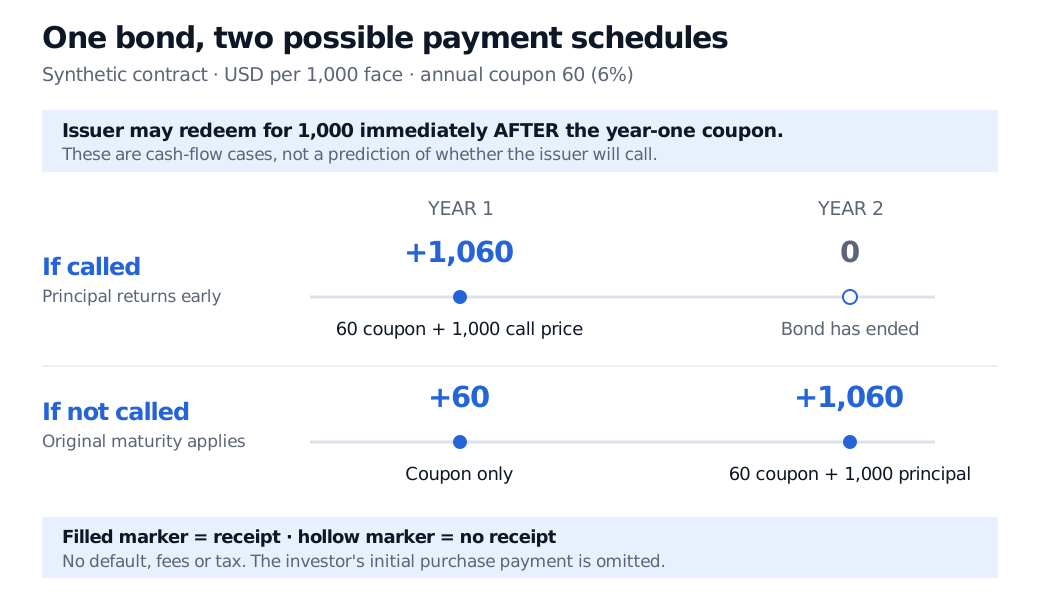
Original synthetic contract, USD per 1,000 face. The call occurs after the first coupon, so that coupon is paid in either case. These schedules assume no default and do not predict exercise.
A call removes the year-two coupon and brings principal forward by a year. The investor has not simply “lost USD 60”: the economic comparison must also account for the earlier receipt of USD 1,000, its subsequent use or reinvestment, and the original purchase price. Neither row is a profit calculation.
For a discounting benchmark, remove the call right and stipulate a deterministic, flat 4% annual effective discount rate for both payments. The otherwise identical straight bond has present value
That calculation prices the fixed straight-bond schedule. Pricing the callable contract additionally needs an exercise rule and a model of the discount rates and relevant credit conditions at possible call dates. An observed yield to maturity alone does not supply those ingredients. For the underlying payment-valuation method, Bonds and Yields has a public preview; the full lesson requires membership.
Why the option matters to the holder
In a consistent valuation model, an otherwise matching callable bond can be viewed as a straight bond minus the issuer's call option. The comparison holds the credit exposure, payment terms and valuation assumptions fixed; it is not a comparison of unrelated bonds that happen to display the same quoted yield.
When borrowing costs fall, refinancing can become attractive to an issuer. That can limit the investor's price appreciation just when an option-free bond would benefit from falling rates. The potential limit depends on the call dates and prices: the call price is not an unconditional ceiling on today's market price, especially during a period of call protection.
Early principal repayment also creates reinvestment risk. If the investor wants to keep earning income, comparable replacement bonds may offer lower rates. A higher coupon can compensate for selling the issuer this flexibility, but does not establish that the compensation is adequate. FINRA explains these consequences in its callable-bond guide.
Falling rates do not make every callable bond get called. The actual decision also depends on the redemption formula, financing alternatives, credit conditions and costs. Yield to call evaluates a specified call-date scenario; it is not a probability of that event or a promised realised return.
The contract has more than one date
Read the issue's offering document and call schedule for:
- Call protection and exercise dates: when optional redemption first becomes possible, and whether it can occur on one date, several dates or throughout an allowed period.
- Redemption price: a fixed amount, a changing schedule or a make-whole formula. Check accrued-interest treatment separately.
- Notice and scope: how much notice is required, whether a call can be conditional, and whether the issuer can redeem only part of the issue. A partial call need not redeem every holding.
For a concrete U.S. corporate example, Apple's February 2021 prospectus supplement provides a greater-of-par/present-value redemption formula before designated par-call dates, a par-redemption provision thereafter, accrued interest and a 10-to-60-day notice window. Those are that offering's terms. The Federal Home Loan Banks' bond description instead describes applicable call notices broadcast at least five business days in advance, subject to the offering documents. There is no single notice period to infer from the word “callable.”
Sources
- Frank J. Fabozzi and Francesco A. Fabozzi, Bond Markets, Analysis, and Strategies, 10th edition, MIT Press, 2021, Chapter 19: callable-bond price behaviour, component decomposition and valuation framework.
- FINRA — Callable Bonds: Be Aware That Your Issuer May Come Calling, 19 April 2024.
- Apple — Prospectus Supplement dated 1 February 2021, “Optional Redemption,” S-12–S-14.
- Federal Home Loan Banks Office of Finance — Bonds, call-feature and disclosure terms, checked 26 October 2026.