Reinvestment risk is uncertainty about the return available when cash received from an investment is invested again. For a bond investor saving toward a future date, lower reinvestment rates can leave less money at that date even when the issuer pays every coupon and repays principal in full.
The fixed coupon rate belongs to the bond contract. The rate earned on a coupon after it arrives belongs to a new investment. The first does not lock in the second.
Follow the first coupon
Consider a synthetic, non-callable bond bought for 1,000 USD, with 1,000 USD face value, a 5% annual coupon and two years remaining. It pays 50 USD after one year and 1,050 USD at maturity: the second 50 USD coupon plus 1,000 USD principal. Assume annual payments exactly one year apart, no default, fees or tax, and a saving horizon equal to maturity.
The investor wants to keep all the proceeds until that horizon. Only the first coupon needs reinvestment; the final receipt arrives on the date the money is needed.
If the first 50 USD earns 5% for its remaining year, it becomes 52.50 USD. Total maturity wealth is 1,102.50 USD. If it earns 0% instead, it remains 50 USD and maturity wealth is 1,100 USD. The issuer pays exactly the same amounts in both cases. The 2.50 USD difference is foregone interest on the first coupon.
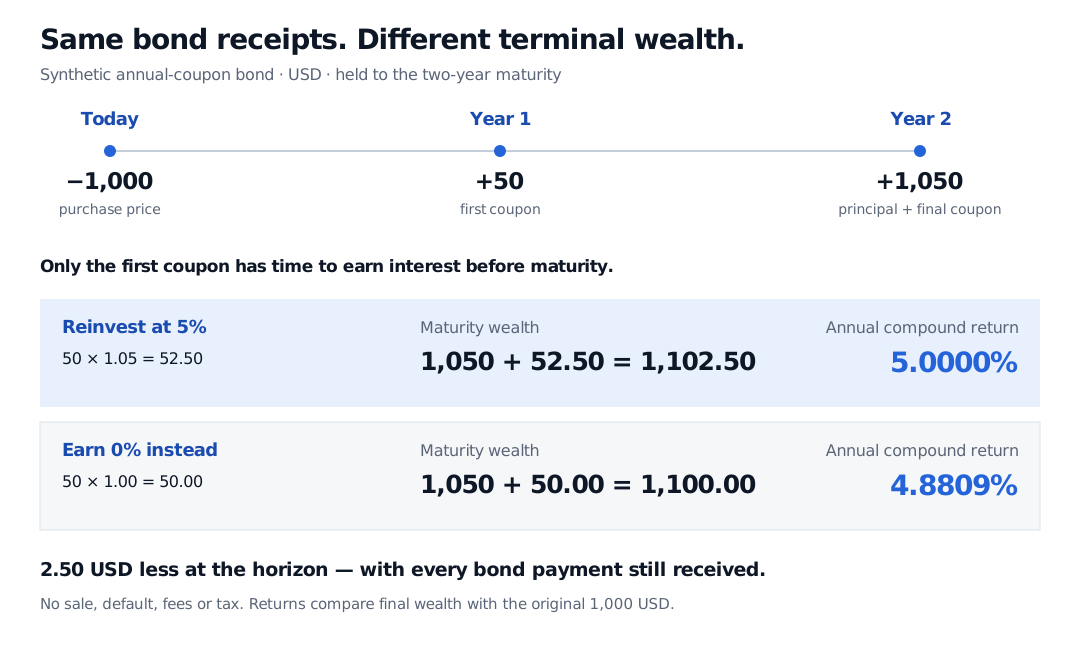
Original synthetic cash-flow ledger. Annual payments and annual effective reinvestment rates; all receipts retained until the two-year horizon. No sale, default, fees or tax.
For a one-year reinvestment rate , the terminal wealth and its annual geometric growth rate are
The denominator is the original purchase price, not the 1,000 USD principal received at maturity plus coupons. With , . With , . This is the growth rate of the complete saving strategy: buy the bond, then retain and invest its receipts.
A yield quote does not reserve a future rate
The bond's annual yield to maturity is 5% because that rate solves its price equation:
This is an internal rate of return for the original dated bond cash flows. Calculating YTM requires no reinvestment assumption. Translating YTM into the growth of terminal wealth does require specifying what happens to the intervening coupons. Reinvesting them at the purchase YTM is a sufficient way to obtain that compound growth rate; the yield quote itself supplies no future reinvestment contract.
For the distinction between the coupon contract, discounting and a quoted yield, Bonds and Yields develops the price equation. Its preview is public; the full lesson requires membership.
Match the cash-flow dates to the goal
Holding a bond to maturity removes the need to sell it at an uncertain market price. It leaves the reinvestment question for every receipt arriving before the investor's horizon. If the investor sells earlier, the sale price creates a separate source of risk. Falling market yields can raise the bond's market price while reducing returns available on newly invested coupons; these two effects enter different parts of the cash ledger.
A zero-coupon bond held to a horizon that matches its maturity has no interim coupons to reinvest. If the saving horizon extends beyond that maturity, its returned principal must still be invested again. Likewise, rolling short-term instruments to fund a longer goal exposes the proceeds of each maturity to future rates.
An issuer's right to redeem a bond early can make the problem more acute. When rates fall, a callable bond may return principal just when comparable reinvestments offer less income. FINRA's discussion of callable bonds explains this link and why the actual call terms matter.
The practical question is therefore: which receipts arrive before the money is needed, and what rate has actually been secured for each intervening period? Spending a coupon to meet a liability on its receipt date creates no need to reinvest that coupon. Accumulating it for a later goal does.
Sources
- Bruce Tuckman, Fixed Income Securities: Tools for Today's Markets, 2nd edition, Wiley, 2002, Chapter 3, “Yield-to-Maturity and Realized Return,” pp. 51–52. Explains why future coupon reinvestment rates need not equal the purchase yield.
- CFA Institute — Interest Rate Risk and Return. Separates contractual payments, coupon reinvestment and the price received on a sale.
- FINRA — Callable Bonds: Be Aware That Your Issuer May Come Calling. Explains early redemption and replacing an income stream after rates fall.