Calculate yield to a specified bond call date, separate redemption proceeds from the final coupon, and compare the call schedule with maturity.
Yield to call
Yield to call (YTC) is the discount rate that equates a bond’s purchase price with its payments through a specified assumed call date, including the contractual redemption amount. It answers a practical question: if the issuer repays this bond early on those terms, what yield does that payment schedule imply?
For a callable bond, the stated maturity is only one possible endpoint. YTC is an internal rate of return for a particular early-redemption scenario. It does not give the probability of that scenario or forecast the issuer’s decision.
Start with the redemption terms
Before calculating, identify the settlement date, full price paid, coupon dates, assumed call date and call price. Check whether the redemption amount includes or excludes interest, and which coupon the holder receives on the call date. A call price quoted per 100 of face must be converted to the same units as the purchase price.
The first eligible call is often the initial comparison, as FINRA’s yield guide explains. A bond with several eligible call dates can have several yields to call, because both the payment horizon and redemption price can change. “YTC” without its assumed date and rate convention leaves out essential information.
A 5% coupon can produce a 7% yield to call
Consider a synthetic bond, purchased for 1,000 USD immediately after a coupon payment. Its face value is 1,000 USD, its fixed annual coupon is 50 USD and its final maturity is three years away. Assume all required payments are made, with no fees or taxes and no accrued interest at purchase.
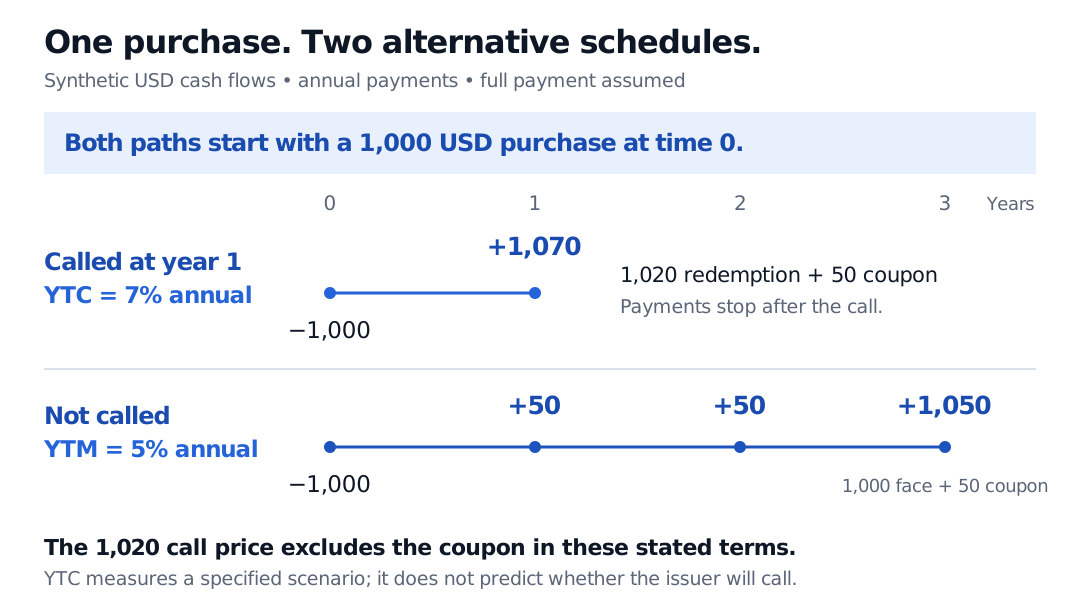
Its terms give the issuer one optional call date, exactly one year after purchase. If called, the holder receives 1,020 USD of redemption proceeds plus that year’s 50 USD coupon. The 20 USD above face is a call premium. There are no later payments under that scenario.
Years after purchase
Called after one year: USD
Not called: USD
0
−1,000
−1,000
1
+1,070
+50
2
—
+50
3
—
+1,050
These columns are alternative complete schedules. Adding the call proceeds to the maturity column would count repayment twice.
With annual compounding, the one-year call equation is
1,000=1+yc1,020+50,yc=1,0001,070−1=7%.
The call path produces 70 USD above the purchase outlay: 50 USD coupon income and a 20 USD redemption gain. Leaving the coupon out would incorrectly produce 2% for these terms.
If the issuer does not call, the yield to maturity solves a different equation:
1,000=1+ym50+(1+ym)250+(1+ym)31,050,ym=5%.
Two alternative synthetic USD payment schedules begin with a 1,000 purchase. Call at year one pays 1,020 redemption plus 50 coupon, yielding 7% annually. No call pays 50, 50 and 1,050 over three years, yielding 5% annually.
Original synthetic cash-flow timeline. Annual payment and compounding conventions are stipulated; these are scenarios, not market quotes or exercise forecasts.
Here YTC exceeds YTM. Early redemption does not mechanically mean a lower yield: purchase price, call premium, coupon entitlement and timing all matter. This arithmetic does not establish that exercising the call would be economically attractive to the issuer.
The general calculation changes the endpoint
For a regular coupon bond bought on a coupon date, let P be the full purchase price, C the coupon per payment period, K the redemption amount excluding the final coupon, and n the number of coupon periods to the assumed call. If the final coupon is payable, solve
P=k=1∑n(1+rc)kC+(1+rc)nK.
The final coupon is already in the sum. If there are m equal periods per year, a nominal annual quote is mrc; its effective annual equivalent is (1+rc)m−1. The example has one annual period, so its 7% is also an effective annual rate. Between coupon dates, or with irregular payments, use the instrument’s actual timing, interest entitlement and quotation rules. Legal and market conventions vary; the simplified equation is not a universal settlement formula.
SelfMadeQuant’s Bonds and Yields lesson develops the underlying dated-payment and single-yield equations. Its public page is a preview; the full lesson requires membership.
Use the yield without turning it into a promise
Comparing YTC with YTM helps reveal what early redemption changes. For this bond’s two stipulated schedules, the lower yield is 5%, at maturity. Yield to worst extends that comparison across the applicable contractual redemption scenarios. It is not a floor on realised returns: default, an early sale, costs and taxes can change the investor’s outcome.
YTC also leaves the post-call investment decision unanswered. The issuer returns principal sooner, and the investor must find somewhere to put it. That reinvestment risk can matter even when the calculated YTC is above YTM. The SEC’s callable-bond explanation describes how falling rates can encourage refinancing and leave holders facing lower reinvestment rates.
For a multi-period call schedule, calculating its cash-flow IRR requires no forecast of coupon reinvestment. Matching that rate as realised compound wealth growth is a separate question about what the interim coupons earn. The one-year example avoids that complication because all proceeds arrive together at the endpoint.
Sources
Frank J. Fabozzi and Francesco A. Fabozzi, Bond Markets, Analysis, and Strategies, 10th ed., MIT Press, 2021, Chapter 3, “Yield to Call” (local digital PDF pages 88–90): assumed call dates, call schedules, coupon payments and redemption proceeds.