Compare eligible bond repayment schedules to calculate yield to worst, and understand why the lowest full-payment yield is neither a call forecast nor a guaranteed return.
Yield to worst
Yield to worst (YTW) is the lowest calculated yield across the applicable contractual repayment scenarios for a bond, assuming the payments in each scenario are made in full and on time. For a conventional callable bond, it compares yield to maturity with the yields to the relevant issuer call dates and prices. It can reveal that an attractive maturity yield depends on the issuer leaving the bond outstanding.
“Worst” belongs to that defined set of payment schedules. It does not mean the worst possible economic outcome: default, a sale at a loss, costs and inflation can leave an investor worse off. Nor does the minimum predict which repayment date the issuer will choose. FINRA distinguishes these calculated yields from total return.
A premium can disappear at the call date
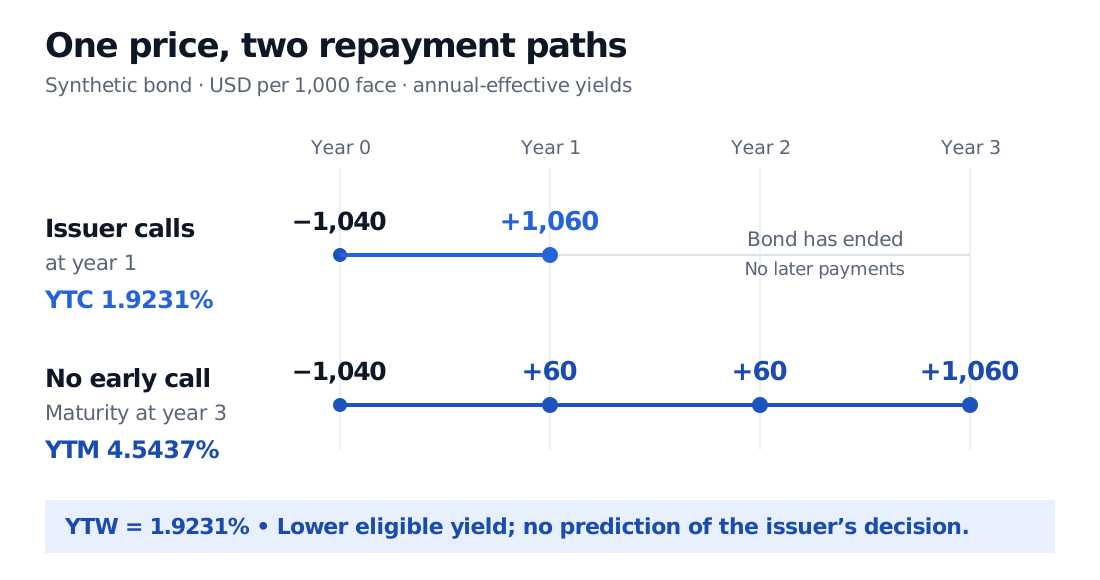
Consider a synthetic bond bought at time zero for USD 1,040 per USD 1,000 face value. It pays a USD 60 coupon at each year-end and repays USD 1,000 principal at year 3. Its only early redemption right is an issuer call at year 1 for USD 1,000, plus that year's USD 60 coupon. If not called then, it remains outstanding to maturity. There are no other calls, holder puts or sinking-fund repayments.
Settlement has zero accrued interest; ignore default, fees and taxes. All quoted yields below are annual effective rates, with the stipulated payment times exactly one year apart.
Full-payment scenario
Year 1 receipt
Year 2 receipt
Year 3 receipt
Calculated annual yield
Issuer exercises its sole call
USD 1,060
—
—
1.9231%
Bond remains to maturity
USD 60
USD 60
USD 1,060
4.5437%
For the call scenario, the single receipt gives an exact yield to call:
ycall=1,0401,060−1=521≈1.9231%.
The investor receives USD 60 of coupon but loses USD 40 of the purchase premium when principal is redeemed at par. The net gain is USD 20 on USD 1,040 invested over one year.
The root is approximately ymat=4.5437%. The two repayment paths therefore give
YTW=min(ycall,ymat)≈1.9231%.
Two synthetic repayment paths for a USD 1,040 bond purchase: a year-1 call pays USD 1,060 and yields 1.9231%; maturity pays USD 60, USD 60 and USD 1,060 at years 1, 2 and 3 and yields 4.5437%.
Original synthetic cash-flow comparison. Both yields use the same purchase price and annual-effective convention. The lower yield identifies a repayment scenario, not its probability.
The Bonds and Yields lesson develops the dated-payment and single-yield equations behind this calculation. Its public preview is available without membership; the full lesson requires membership.
The scenario list matters as much as the minimum
A bond with several call dates needs more than a comparison with an arbitrarily chosen first call. Each relevant date has its own redemption price, remaining coupons and calculated yield. Nasdaq's definition explicitly compares maturity with yields to all possible call dates. The lowest yield need not come from the earliest date when call prices change.
Start with the instrument's terms: settlement date and cash price, coupon dates, maturity redemption, call windows and prices, and any restrictions or notice provisions. Identify which rights belong to the issuer and which belong to the holder. A holder's optional put should not silently be treated as an issuer-imposed repayment. Sinking-fund provisions or other redemption features can also require a different scenario set. For a quoted YTW, establish which features the quoting method includes rather than assuming every vendor or instrument uses an identical rule.
Make the yields comparable, too. A nominal annual yield compounded semiannually and an annual effective yield are different quotes. Use consistent compounding, payment timing and settlement treatment before taking a minimum. The simple annual convention above is an example assumption, not a universal bond-market convention.
A screening yield, with a defined boundary
YTW is useful when comparing the full-payment yield consequences of contractual early redemption. It does not value the embedded option or supply a probability-weighted expected return.
Even when the selected schedule occurs, its cash-flow yield and an investor's realised compound wealth growth are different objects. For a schedule with intermediate coupons, a terminal-wealth calculation must specify their reinvestment. Reinvesting them at the calculated yield is a sufficient assumption for matching its compound growth. If the bond is called before the investor's investment horizon ends, the return available on reinvesting the redemption proceeds remains unknown. Credit losses, an early sale and expenses sit outside this full-payment comparison.
Read a YTW quote as: the lowest yield for the specified eligible schedules, price and quotation convention. It is a useful qualification to a maturity yield, not a promised minimum return.
Frank J. Fabozzi, Bond Markets, Analysis, and Strategies, 9th edition, Pearson, 2016, Chapter 3, pp. 41–43 (call schedules and yield to worst), and Chapter 18, pp. 378–379 (limitations of traditional callable-bond yield comparisons).