Calculate annual coupon income relative to a bond’s current price, then see why a sale loss makes holding-period return differ from current yield.
Current yield
Current yield is a bond’s annual coupon cash divided by its current market price. It answers a narrow but useful question: how much annual coupon income does today’s price buy? It does not tell you how much wealth you will gain, because a bond can pay its coupons while losing value.
For a fixed-rate bond, let C be the annual coupon cash and P the current price, measured for the same face amount:
Current yield=PC.
Express the ratio as a percentage. The numerator is cash, not the coupon percentage: dividing a percentage by a dollar price mixes units. Investor.gov’s definition and cash example make that distinction concrete.
Same coupon, different denominator
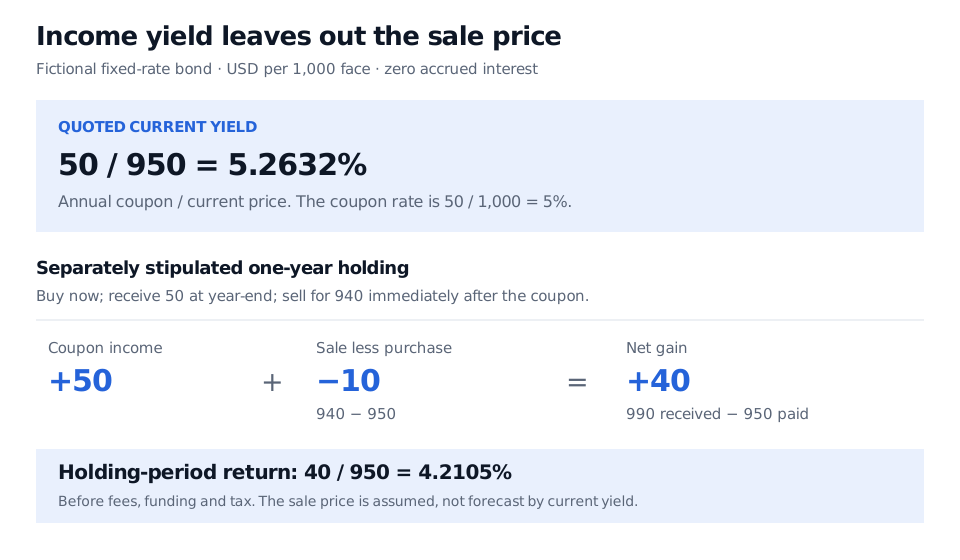
Consider a fictional bond with USD 1,000 face value and USD 50 of annual coupon cash. Its coupon rate is 50/1,000=5%. At a current price of USD 950, its current yield is
95050=191≈5.2632%.
The coupon rate describes payments relative to face value; current yield describes those payments relative to today’s price. The bond has not begun paying a larger coupon just because it trades below face value. A new buyer pays less for the same annual coupon cash.
Quotation basis matters. Here USD 950 is the clean price and accrued interest is zero, so it is also the full amount paid before costs. A clean price excludes accrued interest; a settlement outlay may include it. When using a quoted current yield, check which price the provider uses. For an actual holding-period return, reconcile the full cash paid and received. Do not silently substitute a clean quotation for the settlement amount.
The ratio adds coupon payments over a year without discounting their dates. It does not become an effective compound annual return when coupons arrive more frequently. For the dated-payment perspective, the Bonds and Yields lesson develops bond pricing and the distinction between coupon and yield; its public preview is available, and the full lesson requires membership.
The sale price is missing
Now stipulate a separate holding scenario for that bond: buy for USD 950, receive the entire USD 50 coupon at the end of one year, then sell immediately after the coupon for USD 940. Accrued interest is zero at both transactions. There are no other payments, coupon reinvestment earnings, fees, funding charges or taxes in this example.
The investor receives USD 990: USD 50 of coupon plus USD 940 from selling the bond. Against the USD 950 paid, the net gain is USD 40. Equivalently, the coupon income of USD 50 absorbs a USD 10 price loss. The holding-period return is therefore
R=95050+940−950=95040≈4.2105%.
The quoted current yield is 50 divided by 950, or 5.2632%. In a separate one-year holding, coupon income of 50 plus a sale loss of 10 leaves a gain of 40 and a return of 4.2105%. All cash amounts are USD per 1,000 face.
Original fictional cash ledger. The sale price is stipulated, not predicted by the current-yield ratio. Both purchase and sale have zero accrued interest; results exclude fees, funding and tax.
That difference is why an income screen cannot stand in for a return calculation. FINRA’s yield and return guide distinguishes coupon-based measures from total proceeds and the investor’s gain or loss.
What the ratio can—and cannot—compare
Current yield is convenient when screening the coupon income associated with a market price. With a fixed positive coupon, a lower price mechanically raises the ratio. A high number alone says nothing about whether the issuer will pay, whether the bond will be called, or what price will be available when you exit. It is not a ranking of investment quality.
Yield to maturity answers a different question: which single discount rate reconciles the purchase price with all remaining promised coupon and principal payments, under a stated rate convention? Current yield leaves out the principal-price gain or loss and all payment timing. It needs no maturity date to compute, which is precisely why it cannot measure the return from holding to maturity. For a zero-coupon bond, current yield is zero even when buying below redemption value creates a positive yield to maturity.
Frank J. Fabozzi, Bond Markets, Analysis, and Strategies, 9th edition, Pearson, 2016, Chapter 3, “Conventional Yield Measures — Current Yield,” p. 38: the coupon/price ratio and its omissions of capital gains, capital losses and the time value of money.