Holding-period return measures income and value change over a stated interval. Reconcile a six-month cash ledger and distinguish realised performance from annual growth equivalence.
Holding-period return
Holding-period return (HPR) is the gain or loss on an investment over a stated interval, including income, divided by the capital invested at the start. It is a total return for that particular holding period. A quant comparing an investment with a benchmark must match both the interval and the treatment of income: the percentage alone does not identify either.
For positive starting wealth W0, no external deposits or withdrawals, and ending wealth W1 that includes the investment and all retained income,
RHPR=W0W1−W0.
The holding period can be shorter or longer than a year. HPR is an annual return only when the stated interval is one year.
Reconcile the dollars first
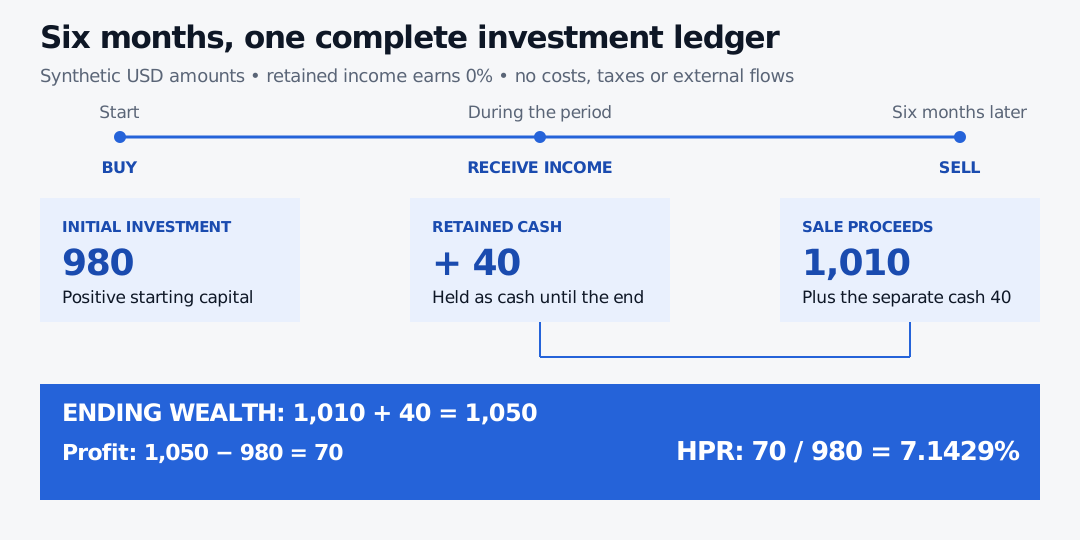
Consider a synthetic investment bought for USD 980, held for six months, then sold for USD 1,010. During the period it pays USD 40 of income. Keep that income in a separate cash balance earning 0% until the sale. There are no external contributions or withdrawals, costs or taxes.
Ending wealth is USD 1,050: the USD 1,010 sale proceeds plus the USD 40 cash balance. Profit is USD 70, consisting of a USD 30 price gain and USD 40 income. Therefore,
RHPR=9801,010−980+40=98070=141≈7.1429%.
A synthetic six-month investment costs USD 980, pays USD 40 retained as cash earning 0%, and is sold for USD 1,010. Ending wealth is USD 1,050, profit is USD 70, and holding-period return is 7.1429%.
Original synthetic USD ledger for a six-month holding period. Income stays in cash earning 0%; no external flows, costs or taxes.
Using only the USD 30 change in price gives a price return of approximately 3.06%. That omits income. Conversely, adding the income to USD 1,050 would count it twice: the cash is already part of ending wealth.
The Equities lesson develops the same income-plus-price decomposition for shares and distinguishes price indices from total-return indices. Its public preview is available; the full lesson requires membership.
Six months is part of the answer
The realised result is 7.14% over six months, rounded to two decimal places. Calling it “7.14% per year” changes its meaning.
For a positive wealth growth factor and a holding period of T>0 years, the constant annualised return with the same compounded growth factor is
rannual=(1+RHPR)1/T−1.
Stipulate that this example's six months is exactly half a year, rather than choosing a calendar day-count convention. Its mathematical annual equivalent is
rannual=(1415)2−1=19629≈14.7959%.
This 14.80% growth-equivalent rate is not an observed one-year return or a forecast. Interpreting it as a future annual outcome would require the complete investment wealth to earn the same growth factor again in another half-year. The sale price, future income and investment opportunities need not repeat.
Reporting rules can also prohibit this extrapolation. For firms claiming GIPS compliance, the 2020 GIPS Standards for Firms, provision 2.A.12 disallows annualising returns for periods shorter than one year. The calculation above illustrates growth equivalence; it does not replace the six-month performance figure.
Keep the account boundary consistent
If income is reinvested, include the resulting holdings and any remaining cash in ending wealth. Their subsequent gains or losses matter; adding the original income separately after valuing those holdings would double-count it. Elton and co-authors make this intermediate-income convention explicit in the footnote to their holding-period-return definition.
For a bond, use consistent full investment values, including accrued interest where applicable, rather than mixing a clean quote with total sale proceeds. A coupon rate describes contractual income relative to face value; it does not measure the gain on the price actually paid and realised at exit.
External deposits are new capital, rather than investment earnings. When contributions or withdrawals occur during the interval, the raw start-to-end wealth ratio mixes performance with those flows. Time-weighted return and money-weighted return handle different questions about performance and cash-flow timing.
Before comparing HPRs, state the dates, currency, income policy, costs and tax treatment. A zero-cost position also needs an explicitly chosen capital base: dividing by zero initial wealth does not define a return.
Sources
Edwin J. Elton, Martin J. Gruber, Stephen J. Brown and William N. Goetzmann, Modern Portfolio Theory and Investment Analysis, 9th edition (Wiley, 2014), Chapter 2, p. 19 and footnote 9: holding-period return and the treatment of income received before the period ends.