The fixed-income market is the market for debt securities, where borrowers raise funding and investors trade claims on debt payments. It is often called the bond market. For a quant, its central task is to turn payment rules into values and risk exposures: a contract can promise fixed amounts while its market price changes every day.
Governments and companies are major issuers. Banks, insurers, pension funds, investment funds and individual investors supply capital for different purposes, including income, liquidity and matching future obligations. The term describes a family of instruments and markets, not one exchange or one level of safety.
Financing a borrower, then transferring the claim
In the primary market, an issuer sells newly issued debt to raise money. An investor buying a bond acquires contractual payment rights rather than an ownership stake in the issuer.
In the secondary market, investors buy and sell existing securities. The sale proceeds go to the seller; the issuer does not receive a new loan every time the bond changes hands. The buyer takes over the remaining claim under the security's terms. CFA Institute's issuance and trading overview explains this split.
The secondary market matters even to investors who intend to hold to maturity. It provides a route to sell when cash is needed and market prices with which to value a portfolio. That route can be expensive or unreliable for a thinly traded issue: a contractual maturity date does not ensure liquidity today.
What is fixed, exactly?
Consider a synthetic, non-callable bond with 100 currency units of face value, a 5% annual coupon rate and two years remaining. It pays once a year. Assume the issuer pays in full and there is no accrued interest, tax or trading cost.
The promised receipts are 5 after one year and 105 after two years, including the final coupon and principal. We compare two valuations at the same instant; no coupon is paid and no time passes between them.
Using an annual effective yield to maturity , the price per 100 face value is
| Required yield | Price per 100 face value | Promised receipts |
|---|---|---|
| 5% annually effective | 100.00 | 5 in year 1; 105 in year 2 |
| 6% annually effective | 98.17 | 5 in year 1; 105 in year 2 |
A 1 percentage point increase in required yield reduces value by about 1.83 per 100 face value. The coupon has not changed. A buyer now pays less for the same future payments, producing the higher yield.
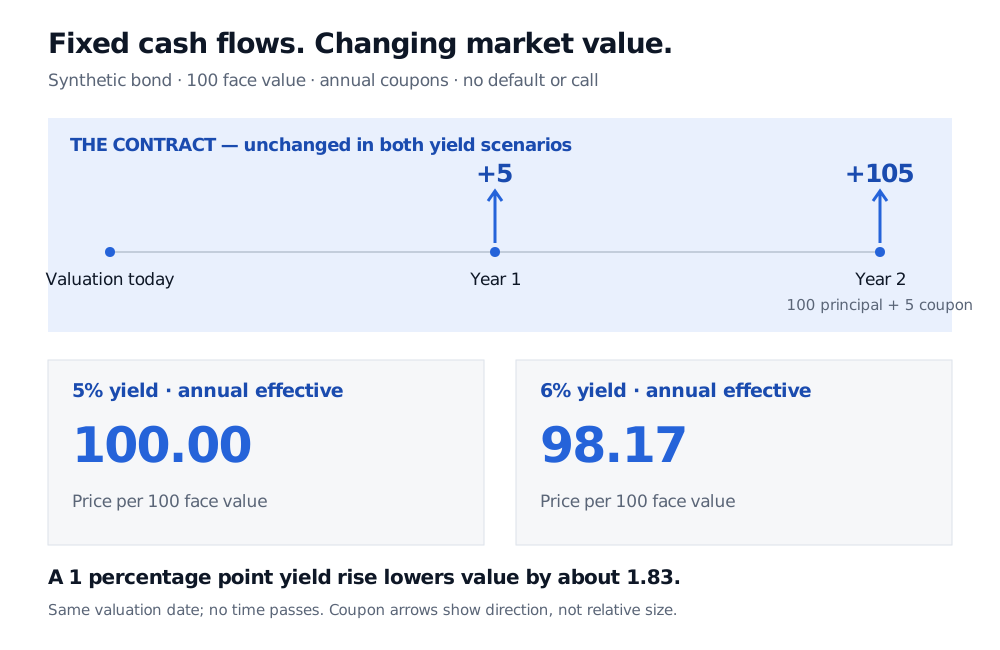
Original synthetic comparison: annual payments, annual effective yields, no default, no call and zero accrued interest. Values are in currency units per 100 face value; arrow lengths are not proportional to payments.
This single-yield calculation summarises the price of this bond. A valuation using a yield curve can instead assign a separate discount factor to each payment date. SelfMadeQuant's Bonds and Yields lesson develops that distinction; the public page is a preview and the full lesson requires membership.
One market label, several sources of risk
A market segment is usually described by issuer, credit quality and maturity, with currency and payment features adding further distinctions. Comparing two headline yields without these details can compare very different exposures.
- Fixed coupons: ordinary fixed-coupon debt keeps its scheduled nominal coupon amounts, but changing market yields alter value. Duration describes local price sensitivity under specified yield-change assumptions.
- Floating coupons: a floating-rate note resets interest using contractual reference-rate rules. “Fixed income” therefore does not mean every payment is fixed. For a concrete issuer example, U.S. Treasury FRNs use an index rate plus a spread.
- Credit exposure: credit risk can change expected receipts through missed payments or restructuring. A higher credit spread is not simply extra interest earned without extra risk.
- Embedded options: a callable bond can be redeemed early under its terms. The remaining payment horizon is then conditional, so the example's fixed schedule is insufficient.
The SEC's bond risk guide also highlights inflation and liquidity risk. Even full receipt of nominal principal does not preserve its purchasing power. A useful fixed-income analysis keeps three questions separate: what is contractually owed, what is expected to be paid, and what can the claim be sold for today?
Sources
- Bruce Tuckman, Fixed Income Securities: Tools for Today's Markets, 2nd ed., Wiley, 2002, Chapter 1, pp. 3–7: dated payments, default-free valuation, quotations and discount factors.
- CFA Institute, Fixed-Income Issuance and Trading — public overview, 2026 curriculum: market segments, investor objectives and primary versus secondary markets. The full reading requires separate access.
- SEC Investor.gov, Bonds — FAQs: debt securities and interest-rate, credit, inflation, liquidity and call risks.
- U.S. Treasury, Floating Rate Notes: an actual floating-coupon instrument and its rate-setting rule.