An amortising bond repays principal in instalments over its life, rather than leaving all principal to a single payment at maturity. An investor therefore receives some capital back before the final date. For the issuer, the debt balance falls as principal is repaid; for the investor, that returned capital needs a new home if it is to keep earning a return.
The label describes principal repayment, not a promise of equal total payments. The schedule can specify equal principal instalments, equal combined payments of principal and interest, or another pattern. Some structures amortise only part of the balance and leave a final balloon payment. Read the repayment terms alongside the interest and early-redemption terms.
Follow the balance, not the original face
Consider a fictional bond with 900 USD original face value and three annual payments remaining. At each year-end it repays 300 USD of principal, plus interest at a fixed 6% annual coupon rate on the opening principal balance. Value it on a payment date immediately after any payment due that day, with the next payment exactly one year away. Assume no default, prepayment, taxes or fees.
| Year-end | Opening principal (USD) | Interest (USD) | Principal repaid (USD) | Total receipt (USD) | Principal left (USD) |
|---|---|---|---|---|---|
| 1 | 900 | 54 | 300 | 354 | 600 |
| 2 | 600 | 36 | 300 | 336 | 300 |
| 3 | 300 | 18 | 300 | 318 | 0 |
The principal repayments add to 900 USD. Interest adds to 108 USD, so the investor receives 1,008 USD across the three dates. Those totals are different quantities: returning principal is not additional investment income.
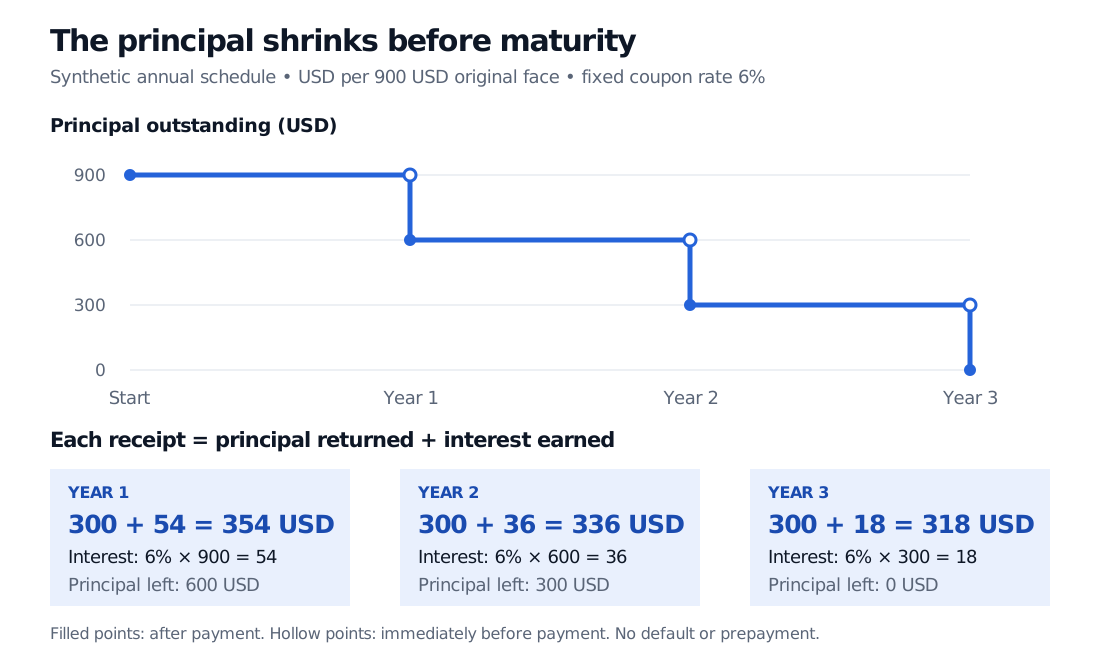
Original synthetic schedule, in USD per 900 USD original face. Filled points show principal after each payment; hollow points show the balance immediately before it. Equal principal repayments produce declining interest and declining total receipts under this fixed-rate contract.
The coupon rate stays at 6%; the coupon amount falls because less principal remains outstanding. Continuing to charge interest on the original 900 USD after principal has been returned would misread this contract.
That distinction appears in actual securities documentation. EBRD's pricing supplement for its callable amortising fixed-rate notes, Annex A, separates interest calculated on the outstanding denomination from the amortisation amount. Its dates, day-count rules and call provisions are specific to that issue; the annual schedule above is a teaching example, not a reproduction of those notes.
Price every receipt on its own date
The present value includes both interest and principal on each payment date. With a 6% annual effective yield to maturity, the example's value is
There is no additional 900 USD payment at year 3: all of that original principal is already included in the three receipts. Adding it again would count principal twice. The result is at par because the coupon-on-balance rate and discount yield match under the stated annual conventions; amortisation alone does not ensure a par price. This payment-date example has no accrued-interest adjustment.
The Bonds and Yields lesson explains dated-payment discounting and the distinction between coupon and yield. Its preview is public; the full lesson requires membership.
Three schedules that are easy to confuse
| Structure | Principal and interest pattern |
|---|---|
| Level principal, as above | Equal principal instalments; with fixed interest on the declining balance, total payments fall. |
| Level payment, or annuity-style amortisation | Equal combined payments under a fixed-rate, regular-period schedule; the interest portion falls and the principal portion rises as the balance runs down. |
| Bullet bond | No scheduled principal repayment before the final date; periodic interest payments do not themselves reduce principal. |
Earlier principal return reduces the amount still awaiting repayment at the final date. It also changes the investor's cash planning: money comes back sooner and may have to be reinvested at lower rates. A long legal maturity therefore does not mean all of the original capital remains invested until that date.
Finally, separate scheduled amortisation from uncertain principal return. A contractual schedule can be fixed, while a mortgage-backed security's actual principal payments depend on mortgage repayments, prepayments and the rules allocating cash to each class of notes. The Reserve Bank of Australia's account of Australian RMBS structures explains how mortgage collections amortise the notes and how the structure reallocates payment-timing risk.
An amortising label does not itself give the issuer a right to prepay. Check any call option, prepayment or extension provisions separately. Nor does a falling scheduled balance remove default risk: the remaining payments are still promises, and the bond's market price can change before they arrive.
Sources
- Frank J. Fabozzi, Bond Markets, Analysis, and Strategies, 9th edition (Pearson, 2016), Chapter 1, p. 6, “Amortization Feature” and “Embedded Options”: principal repayment over time and contractual rights that can alter it.
- European Bank for Reconstruction and Development, Pricing Supplement dated 17 August 2023, callable amortising fixed-rate notes due 17 August 2026, Annex A, p. 8, and issuer-redemption provisions, pp. 3–4: outstanding principal, interest and amortisation are separate contract inputs.
- Ivailo Arsov, In Song Kim and Karl Stacey, Reserve Bank of Australia, Structural Features of Australian Residential Mortgage-backed Securities, June 2015, “Overview of RMBS Structures” and “Tranching”: mortgage collections, principal amortisation and uncertainty in payment timing.