A bullet bond schedules repayment of all its principal in a single payment at maturity. There are no scheduled principal instalments before that date. The consequence is a concentrated funding obligation for the issuer: paying interest along the way does not gradually pay down the debt.
“Bullet” here describes principal timing. It does not require a fixed coupon. Market usage varies: some sources also use bullet bond to mean an issue that cannot be called before maturity. Check the redemption terms rather than inferring them from the label. The IMF's securities classification uses that narrower no-call meaning.
Interest paid is not principal returned
Take a fictional bond with 1,000 USD face value, a fixed annual coupon rate of 5%, and three years remaining. Value it immediately after a coupon has been paid, with the next coupon exactly one year away. Assume annual payments, no default and no early redemption; ignore taxes and fees.
Each remaining coupon is USD. The promised receipts are:
- Year 1: 50 USD coupon; no principal repayment.
- Year 2: 50 USD coupon; no principal repayment.
- Year 3: 50 USD coupon plus 1,000 USD principal, a total of 1,050 USD.
After the first two payments, the issuer still owes the full 1,000 USD principal. The investor has received 100 USD of interest, not recovered 100 USD of principal. Across the remaining life, the contract promises 150 USD of coupons and 1,000 USD of principal: 1,150 USD in total, paid on different dates.
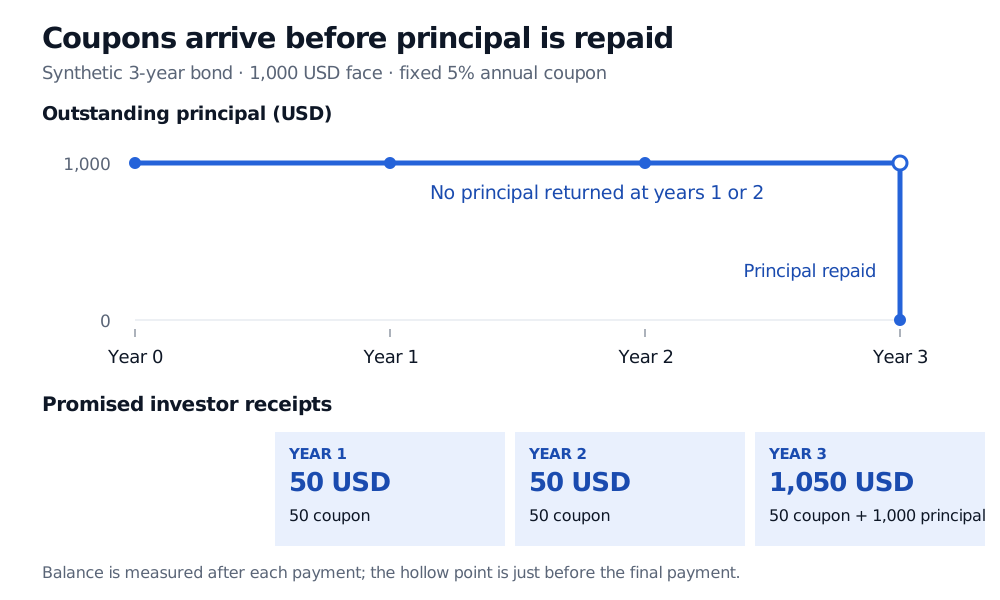
Original synthetic schedule, in USD per 1,000 USD face. The line shows principal outstanding after each payment; the hollow point shows the balance immediately before the final payment. Receipt cards separate coupon income from principal repayment.
Using a 5% annual effective yield to maturity, the present value of those promised receipts is
This example prices at par because the coupon rate equals the yield under the stated matching annual conventions. A bullet structure does not itself imply a par price. The same promised payments have a different present value when the required yield changes. Being on a coupon date also avoids an accrued-interest adjustment in this example.
Bonds and Yields develops the move from dated receipts to discount-factor prices and YTM. Its preview is public; the full lesson requires membership.
Three separate contract questions
| Question | What to look for |
|---|---|
| When is principal repaid? | A bullet schedule defers all scheduled principal repayment to maturity. An amortising schedule returns principal in instalments before the final date. |
| How is interest paid? | A bullet can pay fixed or floating coupons. A conventional zero-coupon bond with one principal payment at maturity also has bullet principal timing, but pays no periodic coupons. |
| Can the schedule change? | Call, put, extension and other redemption provisions must be read separately. In terminology where “bullet” already means non-callable, that narrower meaning is part of the description. |
A floating-rate note can therefore have changing interest payments and still leave its entire principal due at maturity. The U.S. Treasury FRN term sheet, for example, specifies variable interest and principal payable at maturity.
Partial amortisation followed by a large final balloon is different from the pure bullet schedule used here: some principal has already been returned. Also distinguish a single bullet bond from a bullet portfolio, a portfolio strategy that concentrates bond maturities around a chosen horizon.
A date is not a source of repayment
The investor can use a bullet's promised principal date to plan a future cash need. The issuer must arrange cash for that same date, from retained funds, asset proceeds or new borrowing. If repayment depends on issuing replacement debt, refinancing risk matters: access to funding may deteriorate before the principal falls due.
The Reserve Bank of Australia's discussion of bullet notes in RMBS gives a concrete example. It separates principal paid on maturity from amortising pass-through payments, and explains how refinancing conditions can affect repayment. It also distinguishes hard bullets from soft structures whose terms can delay principal repayment. Those extension provisions are specific contractual features, not a property of every bullet bond.
Finally, a promised lump sum remains exposed to default. A holder selling before maturity also faces interest-rate risk and market liquidity. The principal schedule alone says nothing about whether the issuer will pay, what the bond will sell for, or how much purchasing power the eventual repayment will retain. The SEC's corporate-bond guide explains the distinction between contractual payments and credit risk.
Sources
- Frank J. Fabozzi, Bond Markets, Analysis, and Strategies, 9th edition (Pearson, 2016), Chapter 1, p. 6, “Amortization Feature” and “Embedded Options”; Chapter 7, p. 148, the narrower use of bullet for non-callable-for-life issues, and p. 159, bullet loan principal timing.
- International Monetary Fund, Coordinated Portfolio Investment Survey Guide, third edition, Appendix 4, p. 132: classification using bullet for issues without calls or prepayments before maturity.
- U.S. Treasury, Floating Rate Note Term Sheet, sections V and VIII: maturity payment and variable interest.
- Ivailo Arsov, In Song Kim and Karl Stacey, Reserve Bank of Australia, Structural Features of Australian Residential Mortgage-backed Securities, June 2015, “Bullet notes”: principal timing, refinancing and hard/soft structures.
- U.S. SEC Investor.gov, Corporate Bonds: promised interest and principal, default and market risks.