Synthetic stock uses a long call and short put for stock-like exposure. Follow the strike-paying cash leg that turns their forward payoff into a funded share replica.
Synthetic stock
Synthetic stock is a position in other instruments that recreates a stock's directional exposure. The usual synthetic long stock combines a long call with a short put on the same stock, strike and expiry. It rises and falls dollar for dollar with the terminal stock price, but the option pair alone does not have the terminal value of a fully paid share: it still leaves the strike to be funded.
That distinction matters when comparing capital, losses and cash obligations. A small net option premium can buy substantial stock exposure; it does not make the remaining purchase obligation disappear.
The missing strike
Take matching European options with strike K and expiry T, each covering one share-equivalent. Their combined payoff is
max(ST−K,0)−max(K−ST,0)=ST−K.
Above the strike, the long call contributes ST−K and the put has zero payoff. Below it, the call has zero payoff and the written put contributes −(K−ST). At the strike both payoffs are zero. The two branches join into a straight line with slope one.
This is precisely a long forward payoff with delivery price K. Calling it synthetic stock describes the exposure; it does not turn ST−K into ST. The OIC strategy description likewise identifies the option pair as a futures-like position and distinguishes it from share ownership.
To reconstruct the terminal value of one share, add a cash claim paying K at expiry:
call minus putmax(ST−K,0)−max(K−ST,0)+K=ST.
For a stock with no dividends before expiry, deterministic funding and frictionless matching trades, put-call parity gives the corresponding price identity:
C−P+KD(0,T)=S0.
Here the discount factorD(0,T) is the price today of a default-free claim paying one currency unit at T. The strike-paying claim costs KD(0,T) today. The call and put prices are C and P. Rearranging the equation shows the financing inside the option pair: C−P=S0−KD(0,T).
Follow all three legs
Consider an original synthetic one-period model. A non-dividend-paying stock costs USD 100 today and finishes at USD 120 or USD 80. The bank account grows by 1.05 over the period, equivalent to a 5% effective rate for that period. Trading and funding are frictionless, all contracts perform, and the matching European options have strike USD 100. Prices and payoffs below are per one share-equivalent, with no contract multiplier assumed.
The no-arbitrage option prices in this model are C=250/21 and P=50/7. These can be obtained by pricing each option's stock-and-cash replica separately. The resulting initial ledger is:
Position established today
Cash paid / (received), USD
Buy one call
250/21≈11.9048
Sell one put
−50/7≈−7.1429
Option pair: net debit
100/21≈4.7619
Deposit enough to receive 100 at expiry
100/1.05=2000/21≈95.2381
Fully funded package: total cost
100
The cash deposit grows to 100. Now carry every leg through both model states:
Expiry value or signed payoff, USD
Stock finishes at 80
Stock finishes at 120
Long call
0
20
Short put
−20
0
Option pair only
−20
20
Strike-paying deposit
100
100
Funded package
80
120
One share
80
120
The pair's USD 4.7619 entry debit buys a payoff of −20 or +20. Adding the USD 95.2381 deposit raises the initial cost to 100 and the terminal values to 80 or 120. The exact fractions establish the equality; the decimal displays are rounded.
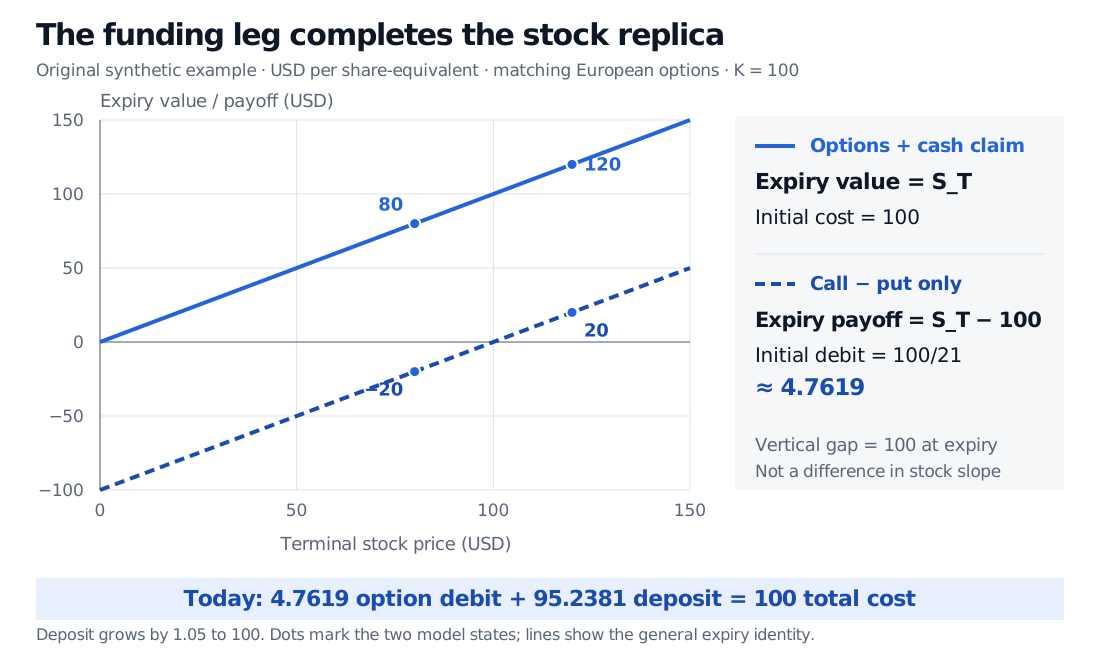
The option pair has payoff terminal stock minus 100, whereas adding a deposit paying 100 gives terminal value equal to stock. In the two model states, stock 80 or 120, the pair pays minus 20 or plus 20 and the funded package is worth 80 or 120. Initial debit 4.7619 plus deposit 95.2381 equals total cost 100 USD.
Original synthetic example, USD per share-equivalent. Solid: call minus put plus the strike-paying claim. Dashed: call minus put only. Dots mark the two model states; the lines illustrate the expiry identity at other stock prices. The deposit grows by 1.05 over one period.
These are terminal values and payoffs, not interchangeable measures of profit. Profit also accounts for the initial capital and the chosen treatment of financing. Comparing the option pair's small premium debit with a share's full purchase price while omitting the future strike obligation gives a misleading capital comparison. Actual margin or collateral requirements are separate from the net premium.
For the matching-portfolio proof behind the price equation, read §1.4 of Options, Payoffs and No-Arbitrage Bounds. The full lesson requires membership; its preview is public. It derives parity by comparing a call plus strike-paying cash with stock plus a put.
Exposure is not ownership
The reverse pair—long put and short call—has payoff K−ST and supplies synthetic short-stock exposure. The same funding distinction applies: reversing the options does not by itself reproduce every cash flow of a fully financed stock short.
For either direction, a valid comparison needs the same underlying and deliverable, strike, expiry, currency, share-equivalent notional, exercise rights and settlement conventions. Two contracts with different multipliers or settlement fixings cannot be treated as offsetting merely because their strike labels match.
Three practical differences remain even when the payoff algebra is correct:
Income and rights. The option pair does not itself receive shareholder dividends or votes. A dividend-paying share has interim cash flows; matching its whole cash-flow stream requires explicit dividend treatment as well as the strike-paying claim. Forecast dividends do not supply certain replicating receipts.
Funding and loss capacity. The written put carries a substantial downside obligation. Its payoff reaches −K if the stock finishes at zero. Spreads, fees, unequal borrowing and lending terms, and collateral calls affect the cost and feasibility of carrying the position.
Exercise and delivery. The equations above use European options held to expiry. American options can generate earlier exercise or assignment. Physical exercise can require payment of the strike and receipt of shares; cash settlement pays a difference instead. Exercise instructions, settlement timing and residual positions near the strike still need to be managed.
Synthetic stock is therefore useful as a replication and exposure-building idea. Matching terminal economics under stated assumptions does not guarantee identical operating mechanics or ownership rights.
Sources
John C. Hull, Options, Futures, and Other Derivatives, 9th Global Edition, Pearson 2018, §11.4, pp. 263–265, especially equation 11.6 and Table 11.2; §11.7, pp. 271–272, for dividend treatment. The numerical model, ledger and figure here are original.