Replication builds a self-financing strategy that matches a claim in every model state. Follow a put’s stock-and-cash ledger and separate gross deposit from net cost.
Replication
Replication means constructing a trading strategy whose cash flows match a target claim in every state covered by the model, at the required payment dates. For a claim with a single expiry payment, the strategy must deliver that payoff without further outside funding after it is set up. This turns derivative pricing into a trading question: what does it cost today to manufacture the promised payment?
The matching requirement is stronger than having similar average returns or reducing a portfolio’s risk. A hedge can leave residual exposure; exact replication leaves none within its stated model and trading assumptions.
Manufacture a put with stock and cash
Consider a synthetic one-period market. A non-dividend-paying stock costs USD 100 now and ends at either USD 120 or USD 80. Cash invested now grows by a factor of R=1.05 over the entire period: a 5% period return, with no annualisation implied. Borrowing and lending use the same rate. Fractional stock positions and short selling are allowed; short-sale proceeds can be used immediately, with no fees, collateral restrictions or trading costs.
The target is one unit of a European put with strike USD 100, represented by its net cash payoff PT=max(100−ST,0) at expiry. It pays USD 0 in the up state and USD 20 in the down state. All monetary amounts below refer to that one payoff unit, with no contract multiplier.
Let Δ be the number of shares and B0 the initial cash-account deposit. Matching both states requires
120Δ+1.05B080Δ+1.05B0=0,=20.
Subtracting the second equation from the first gives
Δ=120−800−20=−21,B0=1.0560=7400.
So the replica is short half a share and deposit USD 400/7, approximately USD 57.14. The negative delta makes sense: the put gains when the stock falls. At expiry, the deposit has grown to USD 60 and the short stock is closed by buying back half a share.
Expiry cash flow, USD
Stock at 120
Stock at 80
Receive matured cash deposit
+60
+60
Buy back half a share to close the short
−60
−40
Replica net payoff
0
20
Target put payoff
0
20
These are net economic payoffs. The example does not prescribe the delivery mechanics of an actual exchange-listed put.
The deposit is larger than the cost
The stock short produces USD 50 at inception. That receipt finances part of the USD 400/7 deposit. The investor supplies only the difference:
P0=ΔS0+B0=−50+7400=750≈7.14 USD.
The gross deposit is approximately USD 57.14; the net initial replica cost is approximately USD 7.14. Confusing them overstates how much new capital the idealised strategy requires. Conversely, treating the short-sale receipt as free profit ignores the obligation to return the shares.
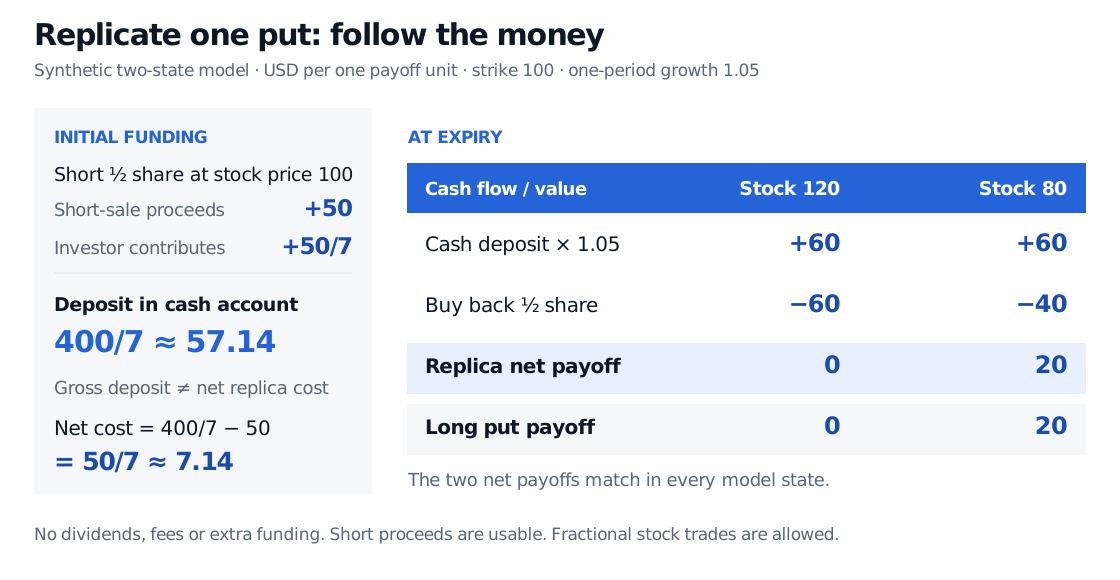
Funding one synthetic put replica: short half a share at stock price 100 to receive 50 USD, add investor capital 50/7 USD, and deposit 400/7 USD. At expiry the deposit pays 60. Closing the stock short costs 60 in the up state or 40 in the down state, leaving 0 or 20, exactly the put payoffs.
Original synthetic funding and expiry ledger, in USD per one put payoff unit. The cash account grows by 1.05 over one period. Gross cash deposited, short-sale proceeds and net investor capital are separate amounts; the two right-hand columns exhaust this model’s states.
The strategy is self-financing after inception: the initial stock and cash positions supply the expiry payoff, with no later capital injection. Self-financing permits initial capital; it does not mean a zero-cost trade. In a multi-period strategy, it also requires every rebalance to be funded by the existing portfolio.
Why matching payoffs fixes a price
The law of one price connects this construction to valuation. If the put traded above the replica’s cost, a trader could sell the put and buy the replica. Their expiry obligations cancel in each model state, while the initial price difference can be invested. If the put traded below the replica, reverse both positions. This argument requires the stated ability to take and fund those long and short positions.
This probability is a pricing weight consistent with the stock and cash prices, not an estimate of how often the stock will rise. The hedge was obtained without a real-world probability forecast. Bjørn Kjos-Hanssen’s university derivation makes the same stock-plus-cash construction explicit before introducing risk-neutral probabilities.
Exact where, and for how long?
The fixed half-share short works because this market has just two terminal stock prices. If the stock could instead finish at USD 100, the same portfolio would deliver USD 10 while the put would pay zero. That extra state is outside the original model and immediately breaks this particular replication.
A complete market is one in which every claim in the specified claim class can be replicated by the allowed strategies. The two distinct stock outcomes and the cash account make this one-period model complete. In an incomplete market, a claim may have no exact replica, so no-arbitrage alone need not determine one price for it.
Replication can also require trading over time. Static replication sets the positions once and holds them to the relevant payments. Dynamic replication changes the holdings as information arrives, using only information then available. Matching the option’s local delta today is not by itself a full-lifetime replication. Discrete rebalancing, jumps, transaction costs and funding or stock-borrow constraints can leave hedging error in practice.
To extend the one-step calculation into a recombining tree, the full public Binomial Model sample lesson develops replication, risk-neutral weights and the multi-step model.
Sources
John C. Hull, Options, Futures, and Other Derivatives, 9th Global Edition (Pearson, 2018), §§13.1–13.3, pp. 296–304: one-step no-arbitrage construction, risk-neutral valuation and extension to two steps. The put, funding ledger and figure here use original synthetic inputs.