A financial market is an arrangement through which participants issue or trade financial instruments, such as shares, bonds, currencies and derivatives. It brings together people seeking funding, investment or risk transfer, using rules and institutions that determine how trades are agreed and completed. For a quant, the practical consequence is immediate: a model's value is only useful if you also understand the price, size and conditions at which you can transact.
A market need not be a physical place or a single exchange. An equity market can span several trading venues; a currency transaction can be agreed with a dealer. The instrument, the trading arrangement and the post-trade arrangements are separate things to identify.
Funding a company versus trading its shares
When a company issues new stock to investors, the proceeds go to the issuer: this is a primary-market transaction. When an investor later sells existing shares to another investor, the cash normally goes to the selling holder: this is a secondary-market transaction. The SEC's definitions of primary and secondary markets make that distinction explicit.
Secondary trading does not give the company fresh cash on each resale. It can nevertheless support funding by giving investors a way to change or exit positions and by providing prices that inform future issuance. Neither an exit nor a favourable price is assured.
Other markets serve different needs. A government can raise money by issuing a bond; an importer can exchange currency; an airline can use a derivative to reduce exposure to fuel prices. A derivative transaction can transfer risk without raising capital for the company whose share or commodity price underlies it.
“The price is 100” leaves out the trade
Consider a synthetic single-venue share market, quoted in USD per share. The best bid is 99.90 and the best ask is 100.10, each with at least 10 shares available. Freeze those quotes and quantities during the hypothetical execution, and ignore fees and taxes.
The bid is the price available to an incoming seller; the ask is available to an incoming buyer. The bid–ask spread is 0.20 USD per share. Their midpoint is 100.00 USD, a useful reference rather than a promised trading price.
| Action or valuation | Calculation | Cash amount or marked value |
|---|---|---|
| Buy 10 shares at the ask | 10 × 100.10 | Pay 1,001 USD |
| Mark 10 shares at the midpoint | 10 × 100.00 | Marked value 1,000 USD |
| Sell 10 shares at the bid | 10 × 99.90 | Receive 999 USD |
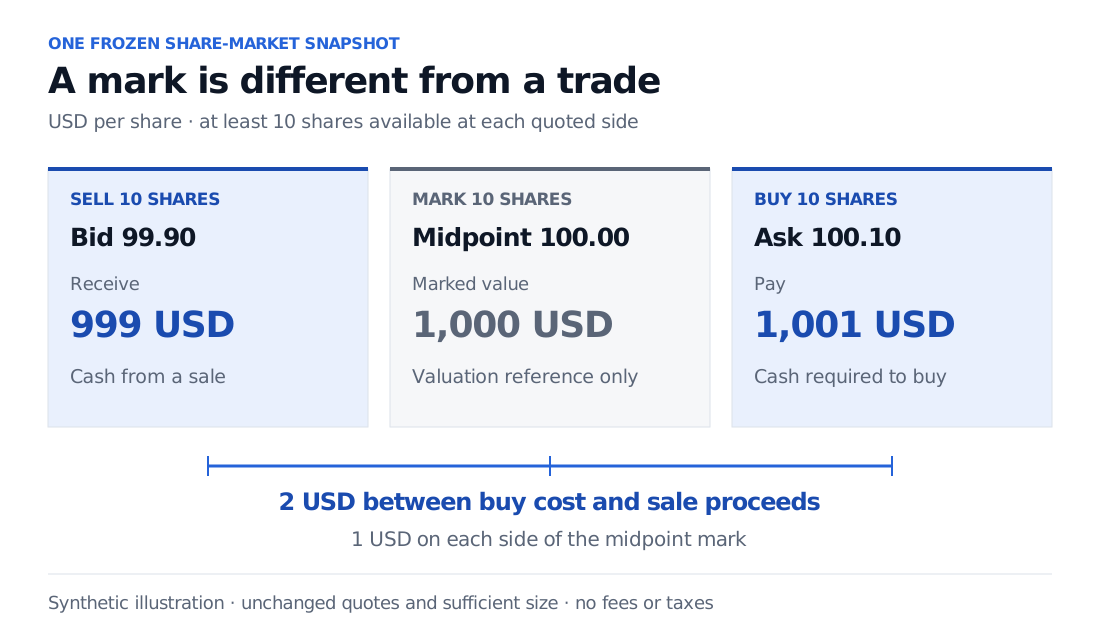
Original synthetic quote snapshot. Prices are USD per share; each displayed side covers ten shares. The midpoint mark is a valuation reference. The buy and sale are alternative actions against the same frozen snapshot, excluding fees and taxes.
The difference between the two execution cash amounts is 2 USD. A buy followed by a sale at these unchanged quotes would lose that amount before other costs. Buying for 1,001 USD and marking at 1,000 USD already shows a 1 USD shortfall against the midpoint; marking does not recover it as cash.
An order book records available prices and displayed quantities. If the order is larger than the available size, it may trade at additional prices or fail to fill completely, depending on the order's instructions and venue rules. Quotes can also change before an order arrives. The SEC's order-type guide explains why a market order does not guarantee an execution price, while a limit order controls the acceptable price but may remain unfilled.
To explore the mechanism, use the public order-book simulator: select buy or sell, market or limit, and a quantity, then compare the predicted fill with the simulated result. Its Thin, Normal and Deep settings change available liquidity. The tool's presets are separate scenarios from this article's frozen quote example.
Who performs each job?
Participants have both roles and motives. The same institution can perform several roles, and two people trading the same instrument can have different reasons for doing so.
| Role | Job in the market |
|---|---|
| Issuer | Creates a security to raise funding under its terms. |
| Investor or end user | Holds an investment or changes an exposure, including for hedging. |
| Broker | Acts for a client in routing or executing an order. |
| Dealer | Trades as principal, using its own balance sheet. |
| Trading venue | Provides rules and facilities for agreeing trades. |
| Clearing and settlement providers | Process obligations and support their completion. |
A market maker supplies two-sided quotes and takes inventory risk when those quotes trade. A hedger reduces an existing exposure; a speculator deliberately accepts exposure based on a view. These motives are not fixed by an institution's name. A bank can hedge one position while making markets in another.
The Market Participants lesson develops these roles, trade motives and custody arrangements. Its public preview is open; the full lesson requires membership.
Agreement, clearing and settlement are different stages
Execution establishes a trade's price, quantity and other terms. Clearing processes the resulting obligations: this can include matching or confirming details, calculating net amounts and managing counterparty exposures. Settlement completes the relevant transfers or discharges the obligations. In a share purchase, that involves the security and cash; a cash-settled derivative instead calls for its contractual cash payment.
A central counterparty becomes the buyer to each seller and the seller to each buyer for trades it accepts for clearing. This changes the counterparty relationships and concentrates risk management; it does not make the transaction risk-free. The RBA's infrastructure explanation distinguishes CCPs from securities settlement facilities and explains how delivery-versus-payment arrangements link securities and cash transfers.
The execution venue does not by itself specify the clearing route. An exchange organises trading under its rules. An over-the-counter trade is agreed outside an exchange, potentially through a dealer or electronic platform; eligible OTC derivatives may still be centrally cleared. Other trades remain bilateral. Settlement timing and mechanics depend on the instrument, jurisdiction and agreement, so “every trade settles immediately” is an unsafe assumption.
For the distinction between where terms are agreed and how obligations are managed, continue with Exchanges and OTC Markets, available as a public preview with the full lesson for members.
A usable market description therefore says what is traded, who can trade it, how price and size are agreed, and how the obligations are completed. A price series alone supplies only part of that description.
Sources
- SEC Investor.gov — Primary Market and Secondary Market: new issuance versus trading existing securities.
- SEC Investor.gov — Types of Orders: executable prices and the distinction between market and limit orders.
- Reserve Bank of Australia — About Financial Market Infrastructure: CCPs, settlement facilities and delivery versus payment.
- John C. Hull, Options, Futures, and Other Derivatives, 9th Global Edition, Pearson Education Limited, 2018, §§1.1–1.2, pp. 24–25: exchange trading, OTC trading and alternative clearing arrangements. The quote ledger and figure are original synthetic illustrations.