Read the rule before the model
Consider two synthetic calls on one underlying unit. Both have strike , both settle in USD at expiry , and neither permits early exercise. Prices are quoted in USD per unit. The underlying starts at 100 on 26 October 2026 and is observed at 80, 100 and 120 on 26 January, 26 April and 26 July 2027 respectively; the last date is expiry.
The vanilla call uses only the final price:
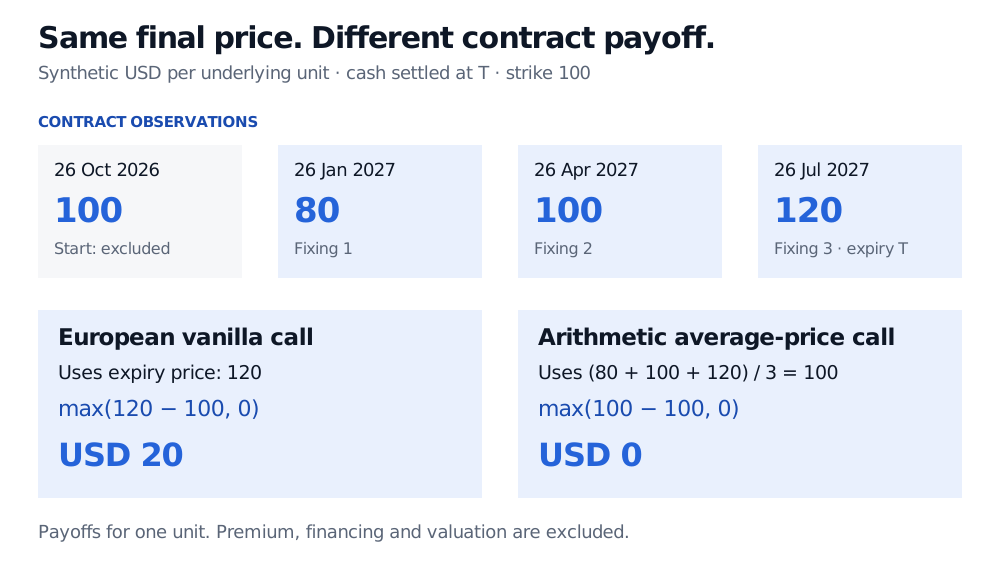
The Asian contract has not malfunctioned: it insures a different exposure. An average-price option can help match a business exposure accumulated across several dates, rather than one final purchase or sale. Whether it is a good match depends on the actual fixing weights, benchmark and cash-flow dates. The calculation above establishes a payoff on one supplied path. It establishes neither today's option price nor the holder's profit.
A map of the departures
These features can be combined in one contract. The name of a family is a starting point for reading its terms, not a complete specification.
| Feature | What changes from a vanilla payoff? | Terms to check |
|---|---|---|
| Barrier | A monitored level determines whether the ordinary payoff is activated or extinguished. | In/out, up/down, monitoring dates, whether equality counts as a hit, rebate and payment date. |
| Asian | An average enters the payoff or sets the strike. | Arithmetic/geometric mean, weights, fixing dates, fixed/floating strike. |
| Lookback | A monitored maximum or minimum enters the payoff or sets the strike. | Which extremum, observation schedule, endpoint inclusion, fixed/floating strike. |
| Digital | A condition switches a specified payment on or off. | Cash/asset payment, trigger, strict or inclusive inequality, observation and settlement dates. |
| Multiasset | Several underlyings feed a basket, spread or selection rule; rainbow options include best/worst selection designs. | Weights, normalization, currencies, selection rule and joint dependence. |
| Quanto | A foreign-market exposure is paid in another currency using an agreed conversion factor. | Quote units, conversion factor and settlement currency; valuation can depend on asset–FX dependence. |
What the label cannot tell you
The label also gives no automatic ranking of risk, price or profitability. Compare actual positions: long versus short, premium paid, payoff bounds, discontinuities, available hedges, liquidity and counterparty terms. A lower premium may simply buy less protection. A payoff that is easy to write can still be difficult to hedge near a trigger.
Sources
- John C. Hull, Options, Futures, and Other Derivatives, 9th Global Edition, Pearson, 2018: Chapter 26 opening, Sections 26.10–26.15; Section 30.3. These distinguish nonstandard contract designs, binary, average and multiasset payoffs, and cross-currency settlement.
- MathWorks, Supported Equity Derivative Functions: contract-family definitions and arithmetic/geometric, fixed/floating Asian distinctions.