A lookback option uses a monitored maximum or minimum. Compare the four fixed and floating payoff rights, and see why the observation schedule is part of the contract.
Lookback option
A lookback option is an option whose payoff uses the highest or lowest eligible underlying price during a specified observation window. It can preserve the benefit of an earlier peak or trough after the underlying reverses. The name identifies a family of rights: it does not by itself say which extreme is used, what is compared with it, or when cash is paid.
This is path dependence: knowing only the expiry price is generally insufficient. Two contracts seeing the same path can also pay different amounts because one has a fixed strike and the other sets its strike from an extremum.
Two calls looking at opposite turning points
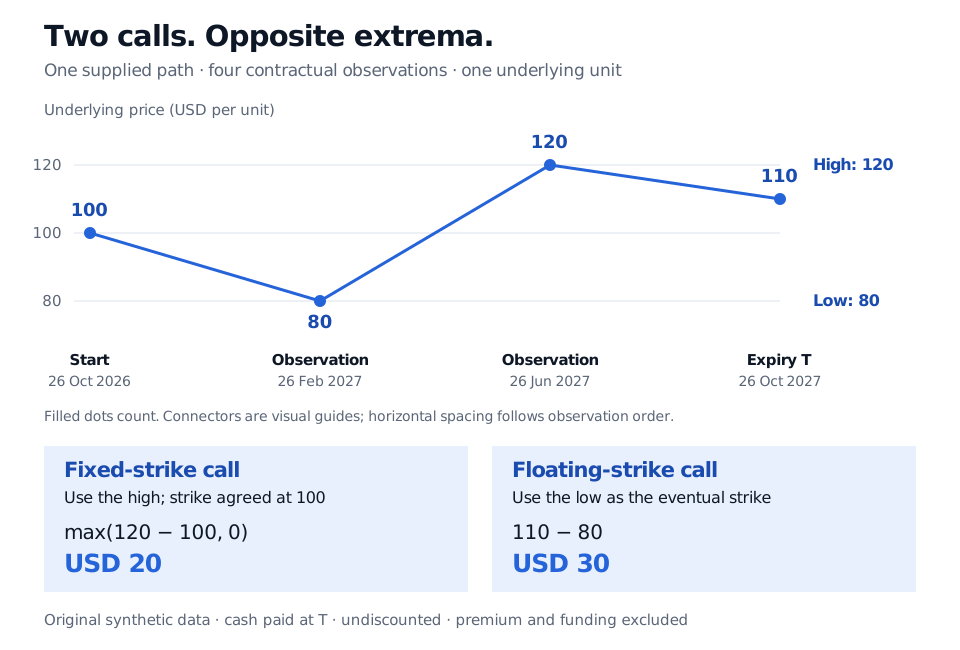
Take a synthetic underlying with four contractual observations: 100, 80, 120, 110 USD per unit, on 26 October 2026, 26 February 2027, 26 June 2027 and 26 October 2027. All four count, including start and expiry. Consider separate European, cash-settled contracts for exactly one underlying unit, with payment only at expiry T.
Four synthetic monitored prices 100, 80, 120 and 110 USD per underlying unit. Fixed call with strike 100 uses maximum 120 and pays USD 20. Floating call uses minimum 80 and terminal 110 and pays USD 30. Both settle at expiry for one underlying unit.
Original synthetic dated path. Filled dots are contractual observations; connectors supply no between-date prices. Horizontal spacing follows observation order. Cash payoffs are undiscounted and exclude premium and funding.
The fixed call captures a high relative to an agreed strike; the floating call captures recovery from a low. The numbers above do not establish a general value ranking between the two families. “Buy at the low” is a description of the floating call's payoff rule. Under these cash-settlement terms, the holder neither buys the stock retrospectively nor has to identify the low and exercise at that moment.
The four rights in one table
Let D be the contractual observation set and write
m=t∈DminSt,M=t∈DmaxSt.
Here both start and expiry belong to D, so m≤ST≤M. With predetermined strike priceK for the fixed contracts, the terminal cash payoffs per underlying unit are:
Right
What the contract compares
Payoff at T
Example cash
Fixed call
Maximum against K
max(M−K,0)
USD 20
Fixed put
K against minimum
max(K−m,0)
USD 20
Floating call
Expiry price against minimum
ST−m
USD 30
Floating put
Maximum against expiry price
M−ST
USD 10
The example uses K=100 for both fixed rights. These are four separate positions. The floating payoffs need no positive-part sign under the stated expiry-inclusive window, but they can be zero. A partial-window variant needs its own terms; expiry may sit outside its extrema window.
The observation rule is an economic term
On the same supplied path, counting only start and expiry gives minimum 100 and maximum 110. The fixed call at strike 100 then pays USD 10, and the floating call also pays USD 10. The omitted dip and peak have no contractual effect.
Adding eligible observations to a nested schedule, while holding expiry and the other terms fixed, cannot lower any of the four standard payoffs: the minimum can only fall and the maximum can only rise. Continuous monitoring considers the whole interval. A finite list of observations cannot establish its continuous extrema. Broadie, Glasserman and Kou distinguish contractual fixing dates from the finer time grid a numerical valuation method may use.
For an outstanding contract, preserve its eligible extreme recorded so far. Restarting the minimum or maximum at today's spot would discard part of the right. The confirmation must also specify the observation window, price source, settlement basis and quantity.
What the cash amounts leave out
A payoff is the contractual cash amount in a realised scenario. Today's option price requires a model for future eligible prices and discounting. Profit additionally depends on the premium paid and relevant funding or transaction costs. A favourable historical extreme therefore does not guarantee a profitable purchase.
For the next step into valuation, Lookback Options — Extrema Payoffs and Reflection develops the payoff taxonomy and running-extremum state variables. The public page is a preview; the full lesson requires membership.
Sources
John C. Hull, Options, Futures, and Other Derivatives, 9th Global Edition, Pearson, 2018, §26.11, pp. 629–631. Fixed and floating payoffs, extrema recorded to date, and observation frequency.