A fixed-strike lookback call uses the monitored maximum; a put uses the minimum. See how the observation schedule changes cash payoff while the strike stays fixed.
Fixed-strike lookback option
A fixed-strike lookback option pays the positive difference between a predetermined strike and the most favourable underlying price recorded under the contract's monitoring rules. A call uses the highest recorded price; a put uses the lowest. A price spike or dip can therefore contribute to the eventual payoff even after the underlying has reversed direction. It is a lookback option with a fixed strike, rather than a strike determined retrospectively from the path.
The strike stays put; the reference price changes
For the European, cash-settled contracts considered here, let K be the strike and D the set of contractual observation times. Define
MD=t∈DmaxSt,mD=t∈DminSt.
For one underlying unit, the cash payoffs at expiry T are
Fixed call=max(MD−K,0),Fixed put=max(K−mD,0).
The strike price is agreed in advance. It is the underlying reference price in the payoff that changes from the terminal price to a path extremum. The positive part still matters: a call pays zero if every eligible observation is at or below the strike; a put pays zero if every eligible observation is at or above it.
The contract records an extremum automatically. The holder does not have to identify the best moment and exercise then. Under these stated terms, recording a new high or low changes the eventual payoff calculation, while payment remains at T.
A reversal does not erase a recorded extreme
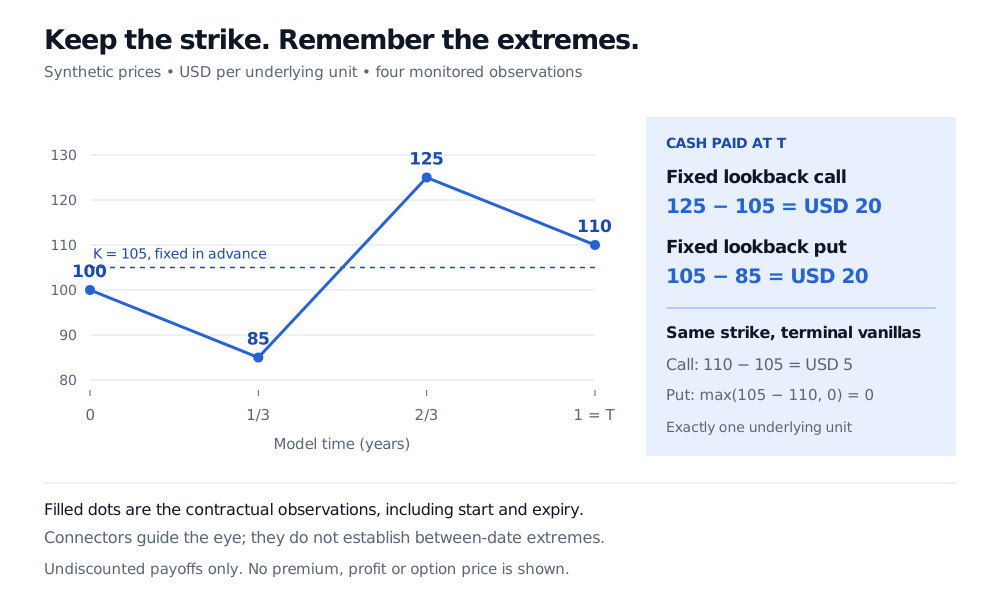
Consider a synthetic underlying observed at model times 0,1/3,2/3,1 years with prices 100, 85, 125, 110 USD per unit. All four observations, including start and expiry, count. Set K=105 and settle cash at T=1 year for exactly one underlying unit. Time labels are model year fractions, without a calendar day-count calculation.
Four synthetic monitored prices 100, 85, 125 and 110 USD per unit give maximum 125 and minimum 85. Strike 105 produces fixed lookback call and put payoffs of USD 20 each at expiry; terminal vanilla call pays USD 5 and put zero.
Original synthetic example. Filled dots are the contractual observations; connectors do not specify what happened between them. All amounts are undiscounted cash payoffs at year 1 for one underlying unit.
Contract, same fixed strike 105
Price used
Cash paid at T
Fixed lookback call
Highest observation: 125
USD 20
Fixed lookback put
Lowest observation: 85
USD 20
Terminal vanilla call
Expiry price: 110
USD 5
Terminal vanilla put
Expiry price: 110
USD 0
These are four separate contracts. The call preserves the benefit of the recorded high; the put preserves the benefit of the recorded low. Neither figure is a profit or today's option price: no premium or funding cost has been supplied.
A floating-strike lookback option uses a different comparison. On this same path, its call pays ST−mD=110−85=25 and its put pays MD−ST=125−110=15 USD. Substituting an observed extreme for K in a terminal vanilla formula would describe those floating contracts, not the fixed contracts above.
Monitoring is part of the payoff
If only the start and expiry observations counted in the example, the maximum would be 110 and the minimum 100. The fixed call would pay USD 5 and the fixed put USD 5. The intermediate high and low would have no contractual effect.
For nested observation schedules on the same path, adding eligible observations can only raise the maximum or lower the minimum. It therefore cannot reduce either fixed-strike lookback payoff when the strike and payment terms are unchanged. A continuously monitored contract uses extrema over the entire monitoring interval, which can be more extreme than the recorded samples. Four observations alone do not reveal those continuous extrema. The contractual schedule and a valuation model's numerical time grid are separate choices. Broadie, Glasserman and Kou analyse this distinction and continuity corrections.
When expiry is an eligible observation, MD≥ST and mD≤ST. Each fixed lookback payoff is consequently at least the matching European vanilla option payoff on every path. With otherwise identical settlement and credit terms, this payoff dominance also implies a no-arbitrage price ordering. It does not imply greater profit after paying different premiums.
For further study, Lookback Options — Extrema Payoffs and Reflection classifies fixed and floating payoffs and introduces running extrema as pricing state variables. The public link is a preview; the full lesson requires membership.
Sources
John C. Hull, Options, Futures, and Other Derivatives, 9th Global Edition, Pearson, 2018, §26.11, pp. 629–631. Fixed and floating lookback definitions, and the importance of observation frequency.
Mark Broadie, Paul Glasserman and Steven Kou, Connecting Discrete and Continuous Path-Dependent Options, Finance and Stochastics 3 (1999), 55–82, §§1–2. Contractual fixing schedules, numerical discretisation and continuity corrections.