The terminal spread ledger
| Observation date | Role | Underlying price |
|---|---|---|
| 26 October 2026 | Start | 100 |
| 26 February 2027 | Intermediate observation | 80 |
| 26 June 2027 | Intermediate observation | 120 |
| 26 October 2027 | Expiry | 110 |
The call's eventual strike is 80; the put's is 120. Those are prices selected by the contract's rule, rather than a strike agreed numerically in advance.
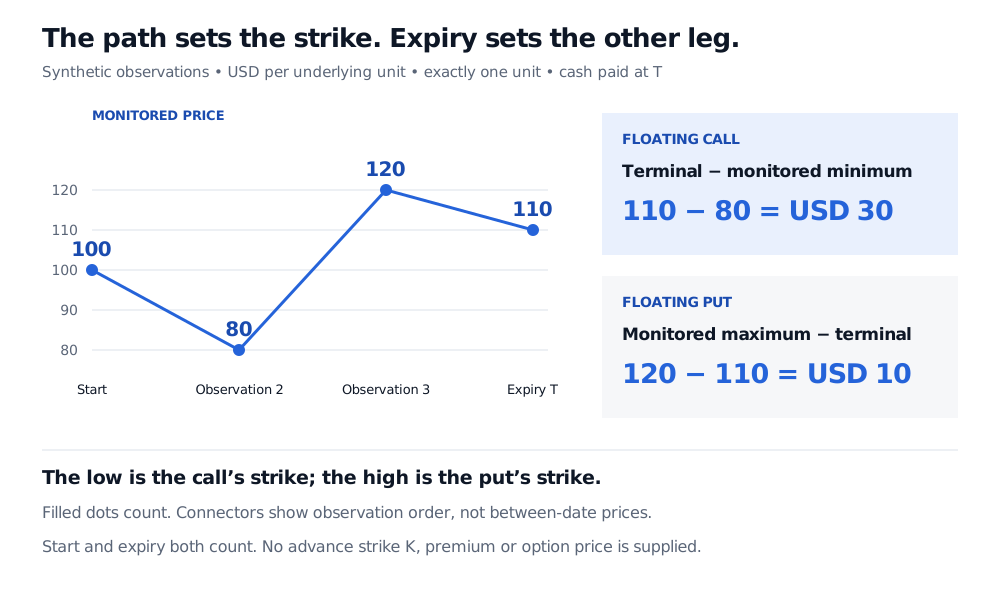
The attractive phrase “buy at the low” describes the call's payoff calculation. In these cash-settled examples it is not an instruction to buy stock at an earlier date, an early-exercise decision, or permission to choose an arbitrary quantity after seeing the path.
Why there is no positive-part sign
Let be the contractual observation set, with expiry . Define the monitored minimum and maximum by
Because expiry counts, . Both amounts are already nonnegative: wrapping them in changes nothing. This reasoning relies on the stated observation window. A variant whose extrema window ends before expiry needs its own payoff terms.
“Floating” also does not mean the payoff is guaranteed to be positive. A call pays zero when expiry is a monitored minimum; a put pays zero when expiry is a monitored maximum. Both pay zero on a constant path.
As a useful ledger check, buying one of each with the same monitoring and settlement terms gives combined terminal cash
The two terminal-price terms cancel. In the example, USD 30 plus USD 10 equals the monitored range of USD 40. This is a sum of two contractual payoffs, before either premium; it does not state a trading profit.
The schedule changes the strike
If only the start and expiry dates counted on the same supplied path, the minimum would be 100 and the maximum 110. The floating call would pay USD 10 and the put USD 0. The intermediate dip and peak would have no contractual effect.
For nested observation sets with the same terminal price, adding observations can only lower the minimum or raise the maximum. It therefore cannot reduce either floating lookback payoff. Continuous monitoring takes extrema over the entire monitoring interval; those may lie beyond any finite set of sampled levels. The four observations above alone cannot reveal the continuous minimum or maximum.
From payoff to valuation
To value an outstanding floating call, the modeller needs its minimum recorded so far as well as current spot and the remaining contract terms; a floating put needs its recorded maximum. The past extremum remains relevant even after the price moves away from it. A valuation model must then account for future prices, future eligible extrema and discounting. None of the cash amounts above is today's option price.
Sources
- John C. Hull, Options, Futures, and Other Derivatives, 9th Global Edition, Pearson, 2018, §26.11, pp. 629–631. Floating lookback definitions, extrema recorded to date and observation frequency.
- Basileios Papatheodorou, Enhanced Monte Carlo Methods for Pricing and Hedging Exotic Options, University of Oxford, 2005, §2.2, pp. 17–18. Floating payoff formulas and sampled-extremum error.
- Mark Broadie, Paul Glasserman and Steven Kou, Connecting Discrete and Continuous Path-Dependent Options, Finance and Stochastics 3 (1999), 55–82, §§1–2. Discrete and continuous monitoring, and continuity corrections.