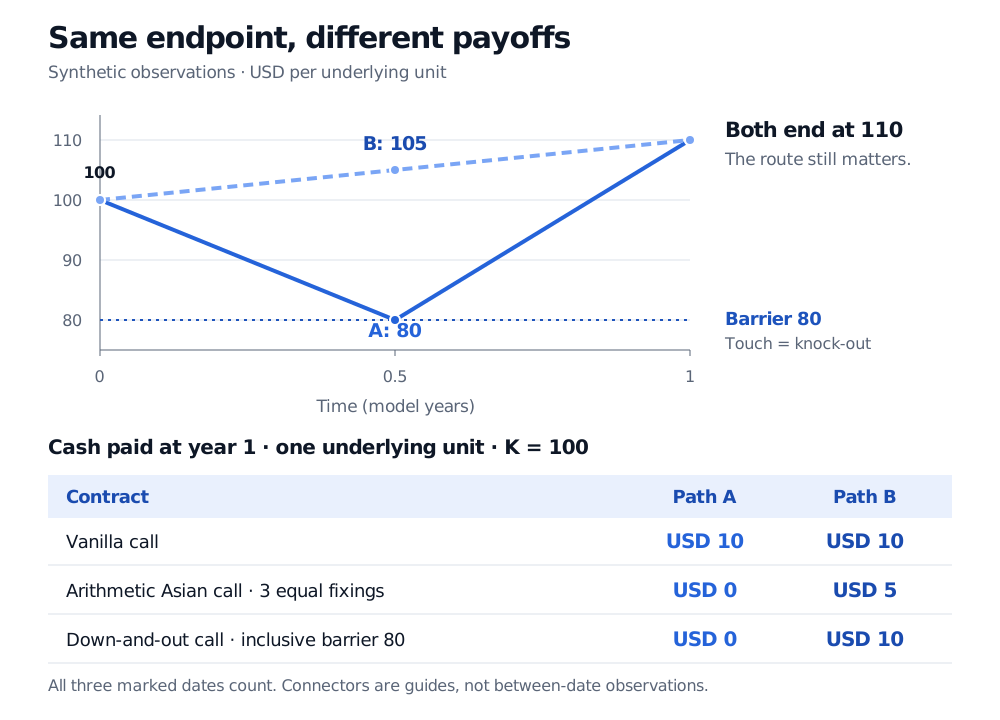
Path dependence means the final price alone may not determine a payoff. Compare identical endpoints, different averages and barrier hits, and the state a model must retain.
Path dependence
Path dependence means that a contract's payoff depends on observations of the underlying before expiry, so the final price alone may not determine the cash payment. A risk system that keeps only the terminal price can therefore assign the wrong payoff even when it gets that price exactly right.
For an ordinary European option with a fixed strike, the terminal payoff is a function of ST. A path-dependent payoff instead uses a feature of the observed history: an average, an extreme, a barrier hit, or a sequence of returns. Path dependence and exercise style are separate features; a contract can depend on the path and still pay only at expiry.
Same destination, different cash payment
Consider two synthetic price paths observed at model times 0, 0.5 and 1 year. Prices are USD per underlying unit. Each contract below covers one unit, settles in cash at year 1 and has strike K=100. The Asian fixes at all three dates, including time zero; the barrier also monitors all three dates.
Observation time, years
0
0.5
1
Path A: USD per unit
100
80
110
Path B: USD per unit
100
105
110
Both paths end at 110. A vanilla call therefore pays max(110−100,0)=10 on either path. Two other contracts distinguish them:
An arithmetic Asian call compares the equally weighted average with the strike. Path A averages 290/3≈96.6667, giving zero payoff. Path B averages 315/3=105, giving USD 5.
A down-and-out call, with barrier 80, zero rebate and touch counting as a hit, is knocked out on A. It pays zero despite the recovery to 110. B avoids the barrier and pays USD 10.
Two synthetic paths start at 100 and finish at 110. Path A visits 80; B visits 105. Vanilla call payoffs are USD 10 and 10, three-fixing arithmetic Asian call payoffs are 0 and 5, and down-and-out call payoffs with inclusive barrier 80 are 0 and 10.
Original deterministic example. Prices are USD per underlying unit; all three marked observations enter the average and barrier test. All payoffs are USD cash at year 1 for one unit, before premium and financing. Lines connect observations as visual guides; they do not specify between-date prices.
This is a payoff comparison, not an option valuation or a trading-profit calculation. No probabilities have been assigned to these paths.
Keep the part of history the contract needs
“Depends on the path” need not mean “store every past tick”. Many contracts admit a compact summary of their history.
For example, at the next arithmetic fixing, update
Qn+1=Qn+Stn+1,An+1=n+1Qn+Stn+1.
Only a scheduled fixing changes this sum. For a lower barrier H with inclusive touch, the hit flag becomes true when either it was already true or the new monitored price satisfies S≤H. A later recovery does not reset that flag.
This separates a contract's memory from the dynamics of its underlying. A Markov process has a future distribution determined by its current state. A Markov stock model can support a path-dependent option: the payoff remembers history even if future stock dynamics do not. Under an appropriate Markov model, adding the running sum, extremum or hit flag to the underlying's state can produce a Markov state for valuation. Time and the remaining observation schedule must also be known; richer models may require volatility or other state variables.
For the average-based case, Asian Options — Averaging and the Pricing PDE develops valuation with an additional accumulated-price state. The public page is a preview; the full lesson requires membership.
The observation rule is part of the exposure
Change the example's barrier monitoring to times 0 and 1 only, and A no longer knocks out: both calls pay USD 10. That changes the contract. It is not an innocuous shortcut for the three-date rule.
Likewise, observations on a finite grid cannot establish that a continuously monitored barrier was never crossed between them. A numerical pricing grid and a contractual monitoring schedule answer different questions. Back, Liu and Loewenstein's barrier discussion explicitly distinguishes discrete observations from its continuous-monitoring valuation assumption.
In practice, specify the reference price, observation times, averaging weights or barrier inequality, and the payment rule before computing a payoff. For an existing position, retain the fixings or hit state accumulated since the contract began. Restarting the history today creates a different exposure.
Monte Carlo can evaluate these payoffs across model-generated future paths, but it is not required merely because a contract is path dependent. Some contracts have analytical formulas; others suit trees or differential-equation methods with additional state variables. Whatever the method, it must preserve the contractual history that affects payment.
Sources
John C. Hull, Options, Futures, and Other Derivatives, 9th Global Edition, Pearson, 2018, §14.1, pp. 324–325; §26.9, pp. 626–628; §26.11, pp. 629–630; §26.13, pp. 631–633: Markov dynamics and barrier, lookback and average-based payoffs. The paths and calculations here are original synthetic examples.
The same authors, §§12.1–12.2: barrier-hit and running-extremum payoffs, monitoring assumptions and analytical valuation examples. Checked 26 October 2026.