An arithmetic Asian option uses an average of contractual price fixings. Work through its payoff, distinguish averaging payoffs from prices, and retain past fixings correctly.
Arithmetic Asian option
An arithmetic Asian option is an Asian option whose payoff uses an arithmetic average of specified underlying prices. For a fixed-strike call, a high final price can produce a modest payout if earlier fixings were low. This makes the contract relevant to an exposure accumulated across several dates, such as purchases priced against an average, rather than a single purchase at expiry.
“Arithmetic” identifies the averaging rule. It does not by itself specify whether the average replaces the underlying price or the strike, which dates count, or how settlement works.
Average first, apply the payoff second
For fixing dates t1,…,tn and nonnegative contractual weights wi summing to one, define
A=i=1∑nwiSti,i=1∑nwi=1.
Equally weighted fixings have wi=1/n. A cash-settled fixed-strike arithmetic average-price call pays (A−K)+ per underlying unit at the specified payment date; the corresponding put pays (K−A)+. Here x+=max(x,0), and K is the strike price. Multiply by the contract's underlying-unit quantity to obtain its cash payout. The average and strike must use the same quote units.
Consider a synthetic call with two equally weighted fixings, at 0.5 and 1 year. The initial spot is excluded. Prices and strike are in currency units per underlying unit; K=95, and cash payment is at T=1 year.
Fixing date
Price
Weight
Contribution to average
0.5 year
80
1/2
40
1 year
120
1/2
60
Total
1
100
The average is (80+120)/2=100, so the call pays max(100−95,0)=5 currency units per underlying unit. A vanilla call with the same strike and expiry uses only the terminal 120 and pays 25. These are terminal payoffs: no premium, funding costs or net profit has been calculated.
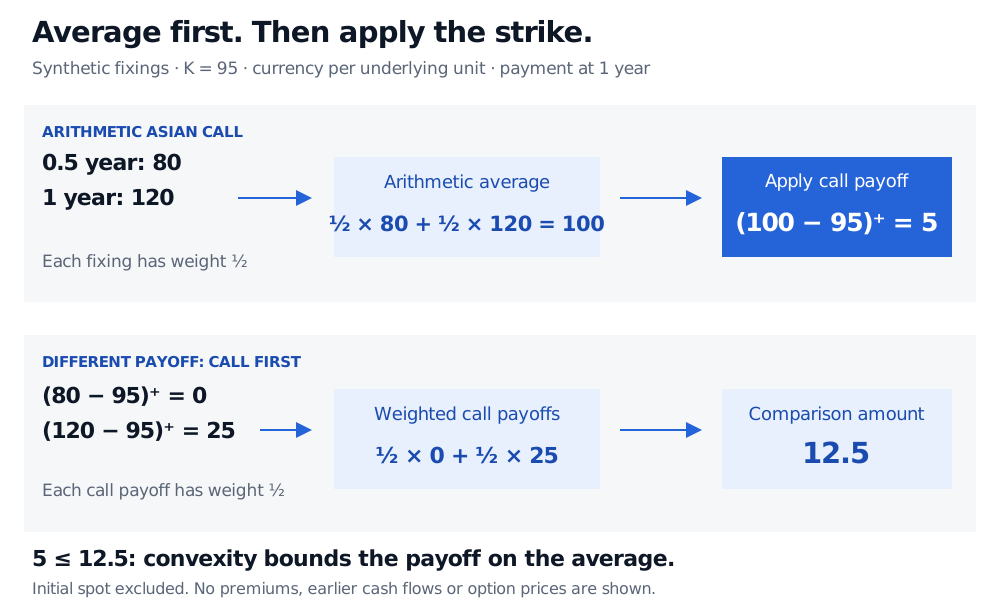
Two equally weighted fixings of 80 and 120 produce average 100 and an arithmetic Asian call payoff of 5 at strike 95. Applying the call separately to the fixings instead gives 0 and 25, whose half-weighted sum is 12.5.
The same synthetic inputs in a different order of operations: average-then-call pays 5; call-then-average gives 12.5. Both comparison amounts are evaluated at the one-year payment date; no earlier cash payment or discounting is implied.
Averaging the individual call payoffs would give (0+25)/2=12.5. That is a different payoff. By Jensen's inequality, the convex positive-part function gives the pathwise bound
(i∑wiSti−K)+≤i∑wi(Sti−K)+.
This compares an option on the average with a weighted collection of payoffs on the individual fixings. It is not a pathwise comparison with a single terminal vanilla call: the average can be above or below the final fixing. A price comparison also requires matched payment dates and a valuation model.
Past fixings stay in the calculation
Once a fixing is known, its contribution is locked into the eventual average. In the example, after the first fixing of 80, the final average is (80+ST)/2. The call finishes strictly in the money only if ST>110. At exactly 110, the average equals the strike and the payoff is zero.
This is path dependence with a compact record: for a discrete arithmetic average, the accumulated weighted sum and remaining fixing schedule preserve the relevant history. Discarding the known 80 and averaging only future observations would change the contract.
A running equally weighted mean can be updated without retaining every observation:
Ak=k(k−1)Ak−1+Stk,A1=St1.
The observation count matters alongside the old mean. A numerical time grid does not create extra contractual fixings, and a finite set of fixings is not the same contract as a continuously averaged price.
Two nearby contracts to distinguish
An average-strike arithmetic call pays (ST−A)+: the average sets the strike instead of replacing the terminal price. The fixed-strike formulas and the Jensen comparison above should not be carried across to that variant without checking them.
A geometric Asian option uses a product-based mean. Under a jointly lognormal price model, its geometric mean is lognormal; an arithmetic sum of those prices is generally not. Replacing the arithmetic mean with a geometric mean therefore changes the payoff, even when the geometric contract is used to help calculate the arithmetic contract's price.
Monte Carlo valuation can simulate prices on the contractual fixing dates, compute the arithmetic payoff separately on each path, then estimate the expected discounted payoff under a pricing model. A geometric Asian with a known model price can serve as a control variate. For that next step, Monte Carlo Option Pricing, §4.4 explains the control-variate estimator and its Asian-call application; the full lesson requires membership and has a public preview.
Sources
John C. Hull, Options, Futures, and Other Derivatives, 9th Global Edition, Pearson, 2018, §26.13, pp. 631–633: arithmetic average-price and average-strike payoffs, seasoned averages and moment-matching valuation.
ICE Futures Europe: Dated Brent (Platts) Average Price Options, contract specifications checked 26 October 2026. This real contract uses an arithmetic-average reference price and has its own exercise and settlement rules; it illustrates why a payoff definition alone does not specify the full instrument.