An Asian option uses an average of scheduled underlying prices. See how averaging method, fixing calendar and fixed versus floating strike determine its payoff.
Asian option
An Asian option is an option whose payoff uses an average of the underlying asset's prices over a specified observation window. This lets a firm hedge an average purchase cost or sale receipt, rather than only the price on one expiry date. The average may determine the asset-price input to the payoff or the strike itself; these are different contracts.
Asian options are path dependent: the final price alone generally does not determine what they pay. The fixing calendar, averaging rule and payoff formula are part of the exposure.
One average, two different calls
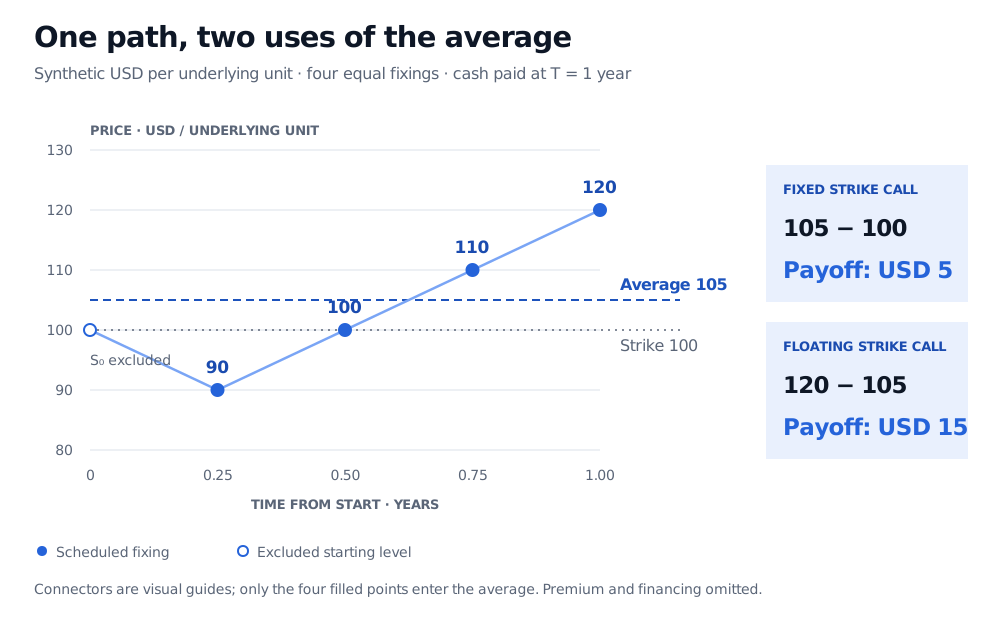
Consider a synthetic cash-settled contract for one underlying unit, with all prices quoted in USD per unit. It has four equally weighted fixings at 0.25, 0.50, 0.75 and 1 year. The starting price is excluded; the final fixing is also the expiry price. Both contracts below settle at year 1.
Fixing time, years
0.25
0.50
0.75
1.00
Price, USD per unit
90
100
110
120
Their arithmetic average is
A=490+100+110+120=105.
A fixed-strike call, also called an average-price call, compares that average with a predetermined strike price. With K=100, it pays
(A−K)+=max(105−100,0)=5.
A floating-strike call, also called an average-strike call, uses the average as its strike and compares it with the final price ST. It pays
(ST−A)+=max(120−105,0)=15.
These amounts are USD cash for the stated one-unit exposure. A terminal vanilla call with strike 100 would pay USD 20 on this path. None of these payoffs includes the premium or the cost of financing it, so none is a net trading profit.
Synthetic four equal fixings 90, 100, 110 and 120 average 105. A fixed-strike call with strike 100 pays USD 5; a floating-strike call pays USD 15, both at year 1.
Original synthetic path in USD per underlying unit. Four equal scheduled fixings exclude the starting level. The same arithmetic average produces different fixed- and floating-strike call payoffs, both paid at year 1.
The corresponding puts reverse the comparison. Writing the contract's chosen average as M, the four European terminal payoffs are:
Where the average enters
Call payoff
Put payoff
Average price: fixed strike K
(M−K)+
(K−M)+
Average strike: floating strike M
(ST−M)+
(M−ST)+
Here (x)+=max(x,0). Averaging does not itself specify an early-exercise right; the table assumes European exercise, with cash paid at expiry. The two classifications of average price versus average strike are described in Back, Liu and Loewenstein's derivatives text.
Choose the average separately from the strike rule
For n equally weighted positive fixings, the two common means are
An arithmetic Asian option uses A; a geometric Asian option uses G. Either mean can enter a fixed- or floating-strike payoff. On the four fixings above, G≈104.4009, compared with A=105.
For the same positive observations and weights, G≤A. A fixed-strike call therefore pays no more under geometric averaging than arithmetic averaging. The direction reverses for a floating-strike call: a smaller average means a smaller strike in (ST−M)+. “Geometric pays less” is not a rule for every Asian payoff.
The difference also matters for valuation. Under geometric Brownian motion, the fixing log-prices are jointly normal, so their weighted sum is normal and the geometric average is lognormal. The fixing levels need not be independent. The arithmetic average generally lacks that lognormal distribution; substituting one mean for the other changes the contract, rather than providing an exact price for it.
The fixing schedule is part of the hedge
A company paying for equal quantities at several dates is exposed to an arithmetic average cost. A matching average-price call can offset the amount by which that average exceeds a budget strike. This requires the same prices, quantities, currency and observations as the purchase exposure; mismatches create basis risk. Premium, financing and settlement timing still affect the total cost.
Before interpreting an Asian payoff, establish:
Observations: the reference price and fixing dates, including whether the starting and final prices enter the mean. Daily observations are discrete; they are not a continuous-time integral.
Weights: equal weight per fixing is different from weighting by quantities, volumes or elapsed time. Unequal purchase quantities may require a weighted hedge.
Known fixings: an option already inside its averaging window retains the observations already taken. Restarting the mean today discards contractual history.
Payment: the averaging window and cash-settlement date need not coincide. Neither is determined by the word “Asian”.
ICE's commodity-option documentation illustrates explicitly selected fixing dates and editable weights. Its particular instrument setup is an example, rather than a universal term sheet.
Averaging can reduce sensitivity to an isolated final-price spike when that price has only a small weight in a fixed-strike average. It does not establish a universal price ranking against every vanilla option: strike design, observation window, carry and model assumptions all matter. Computing a payoff on one supplied path also does not value the option; valuation requires a model for possible future paths and an appropriate discounting rule.
For that next step, Asian Options — Averaging and the Pricing PDE develops the additional state variable used in valuation. The linked page is a public preview; the full lesson requires membership.
Sources
John C. Hull, Options, Futures, and Other Derivatives, 9th Global Edition, Pearson, 2018, §26.13, pp. 631–633: average-price and average-strike payoffs, averaging and repeated cash-flow exposures.