A rainbow option has a payoff linked to two or more risky assets. The label identifies a multi-asset family rather than one payoff formula: selecting the best asset, selecting the worst asset and taking an option on a weighted basket create different exposures. For a quant, the first task is to identify the rule that combines the assets; the next is to model their outcomes jointly.
Terminology varies. Hull uses “rainbow” broadly for options involving several risky assets, including baskets. A narrower usage emphasizes maximum, minimum and ranked-asset payoffs. Reading the actual payoff resolves the ambiguity. (Hull, §26.15)
Select an asset, or combine the assets?
Consider two synthetic assets whose levels are each rebased to 100 initially. One year later, A is at 120 and B at 90. Their simple price returns, excluding dividends, are and . These normalized levels make performance comparable; raw share prices with different starting levels would not do so.
Compare three European options, each cash-settled in USD at that terminal observation. Each has USD 1,000 notional and a zero performance strike. There is no currency conversion. With denoting cash notional and the strike in decimal-return units, the rules are
The best-of call selects A's 20% gain and pays USD 200. The worst-of call selects B's −10% return, then applies the call's zero floor: it pays USD 0, with no payment owed by the long holder. The equal-weight basket first averages the returns to 5%, so its call pays USD 50. Averaging takes place across assets at one date, rather than across observation dates as in an Asian option.
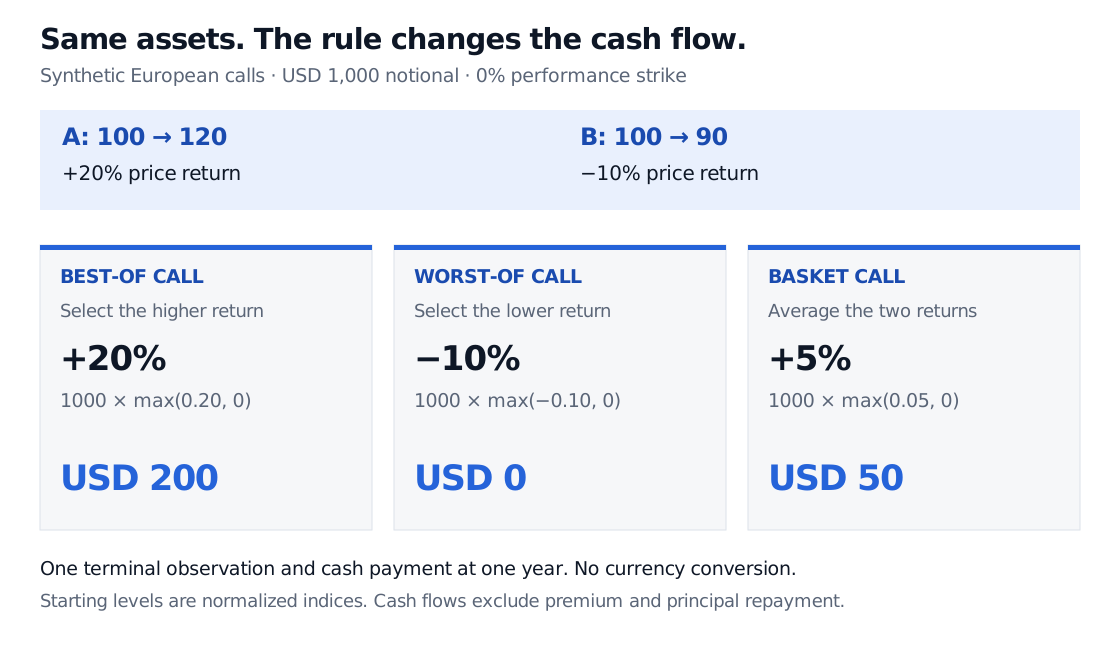
Original synthetic comparison: normalized index levels are dimensionless; notional and terminal cash flows are USD. One terminal observation and payment at one year; dividends, premium and principal repayment are excluded.
For these matching calls, any nonnegative weighted average with weights summing to one lies between the minimum and maximum returns. Applying the same nondecreasing call payoff preserves that ordering. It is a useful check on the three cash flows, but changing strikes, notionals or other features removes the basis for that comparison. The notional scales the option payment; it is not an amount of principal promised back to the holder. None of the amounts above is profit after the option premium.
What the label leaves open
The term sheet must specify what is compared: normalized price returns, total returns including distributions, specified quantities of assets, or individual option payoffs. It must also specify the strike, participation, caps, dates and settlement currency. Selecting the asset with the largest quoted price is a different rule from selecting the largest percentage return.
Multi-asset exposure does not require multiple currencies. Two domestic stocks can support a rainbow payoff. If the assets use different currencies, the conversion convention becomes another contract term; a quanto option, for example, fixes the conversion used in its payoff. Nor does “rainbow” itself imply path dependence: the three examples above use only initial reference levels and terminal observations. Adding intermediate barriers or averaging dates would add a separate monitoring feature.
From a payoff to a value
Knowing each asset's distribution separately is insufficient. A worst-of call needs every asset to clear its performance strike; a best-of call can pay when only one does. The joint distribution determines how often these events occur and how large the payments become. Correlation is part of many models of that dependence, but a general rainbow label supplies no universal direction for a price change when correlation rises.
Stulz's original paper derives European calls and puts on the minimum or maximum of two asset values under explicit joint lognormal assumptions. Those are particular contracts and models, rather than a formula for every product called a rainbow. (Stulz, §§2–3)
To see one building block for joint simulation, §2.1 of Correlated Randoms and Low-Discrepancy Sequences constructs normal vectors with a specified covariance matrix. The full lesson requires membership and has a public preview. The payoff rule still has to be supplied separately; generating correlated shocks does not define the contract or determine a premium by itself.
Sources
- John C. Hull, Options, Futures, and Other Derivatives, 9th Global Edition, Pearson 2018, §§26.14–26.15, pp. 633–635: better/worse-of asset relationships, broad rainbow terminology and baskets.
- René M. Stulz, Options on the Minimum or the Maximum of Two Risky Assets: Analysis and Applications (1982), §§2–3: model assumptions and European minimum/maximum contracts. The normalized-return cash-flow comparison above is original.