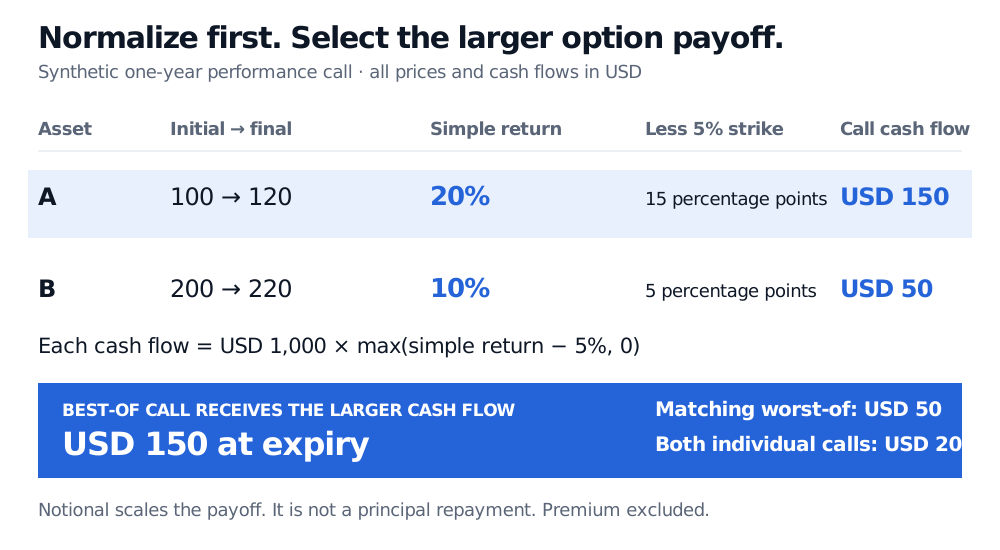
A best-of option selects the largest contract-defined asset outcome. See how normalized returns, a performance strike and cash notional produce a best-of call payoff.
Best-of option
A best-of option pays according to the largest of several contract-defined asset outcomes. In a best-of performance call, the holder receives the positive excess of the highest underlying return over a strike, scaled by a cash notional. The attraction is the ability to benefit from whichever asset wins at expiry; the cost of that choice is reflected in the option premium.
It belongs to the rainbow option family. “Best” needs a precise definition: the highest normalized return, the highest value of specified asset quantities, and the largest individual option payoff can describe different contracts. A higher quoted share price alone does not establish better performance.
A winner is measured against its own starting level
Consider a synthetic European, cash-settled call on two stocks, both quoted in USD. Initial prices are USD 100 and USD 200 per share. There is one terminal observation, one year later, at USD 120 and USD 220. The contract uses simple price returns, excluding dividends, and pays at that observation date. There is no currency conversion.
With notional N in USD and performance strike k, expressed as a decimal return, this best-of call pays
Xbest=Nmax(max(R1,R2)−k,0).
Here N=1,000 and k=0.05. Stock A returns 20% and stock B returns 10%, so A wins even though B has the higher final share price. Subtracting the 5% strike leaves 15 percentage points, producing USD 150 at expiry.
Synthetic one-year USD ledger: A moves from 100 to 120 and returns 20%; B moves from 200 to 220 and returns 10%. With USD 1000 notional and a 5% performance strike, their call cash flows are USD 150 and USD 50. Best-of selects USD 150; worst-of selects USD 50; both calls together pay USD 200.
Original synthetic contract: one terminal observation and cash settlement at one year. Prices are USD per share; notional and payoffs are USD. The premium is excluded.
The USD 1,000 is a scaling notional: this option does not promise to return USD 1,000 of principal. USD 150 is the terminal payoff to the long holder, before accounting for the premium and its financing. Rebasing B's prices into a different share-unit convention would leave its return unchanged if both its initial and final prices were adjusted consistently.
Selecting the winner does not pay both calls
Let Ci=Nmax(Ri−k,0) be the cash payoff of a separate call on asset i's performance, using the same strike, notional and settlement date. Then
Xbest=max(C1,C2).
The holder receives the larger payoff, rather than their sum. In the example, the two separate calls pay USD 150 and USD 50, while the best-of pays USD 150. The matching worst-of call pays USD 50. More generally, for this matched two-asset contract,
Xbest+Xworst=C1+C2.
This is a state-by-state identity, including a tie and outcomes at or below the strike. Once the two individual payoffs are ordered, their maximum plus their minimum is their sum. It is also a useful implementation check: a payoff routine that adds both winning amounts is pricing a different position. Stulz's original analysis gives the corresponding relationship for calls on asset values with a common strike. (Stulz, §3.1.1)
Read the selection rule before modelling it
A call on the maximum of specified asset values uses those values in its strike comparison. A best-of return contract first normalizes each asset by its own initial level. A “best of assets or cash” payoff can include an explicit cash floor. These formulations should not be substituted for one another merely because each contains a maximum.
Nor does the presence of two assets make the payoff a diversified portfolio return. The contract selects a winner after the outcomes are known; a fixed-weight basket combines outcomes according to weights fixed by its own rules.
For valuation, the separate return distributions do not determine how often each asset wins or how often both exceed the strike. Their joint distribution matters. Correlation is one model input, but a price conclusion needs a specified dependence model as well as the payoff. Extra features such as participation rates, caps, observation schedules and currency conversion change the contract further.
For a modelling next step, §2.1 of Correlated Randoms and Low-Discrepancy Sequences constructs normal shocks with a prescribed covariance matrix. The full lesson requires membership; its public page provides a preview. That construction supplies joint shocks, while the payoff rule above determines what each resulting scenario pays.
John C. Hull, Options, Futures, and Other Derivatives, 9th Global Edition, Pearson 2018, §§26.14–26.15, pp. 633–635: better/worse-of asset identities and multi-asset option context.